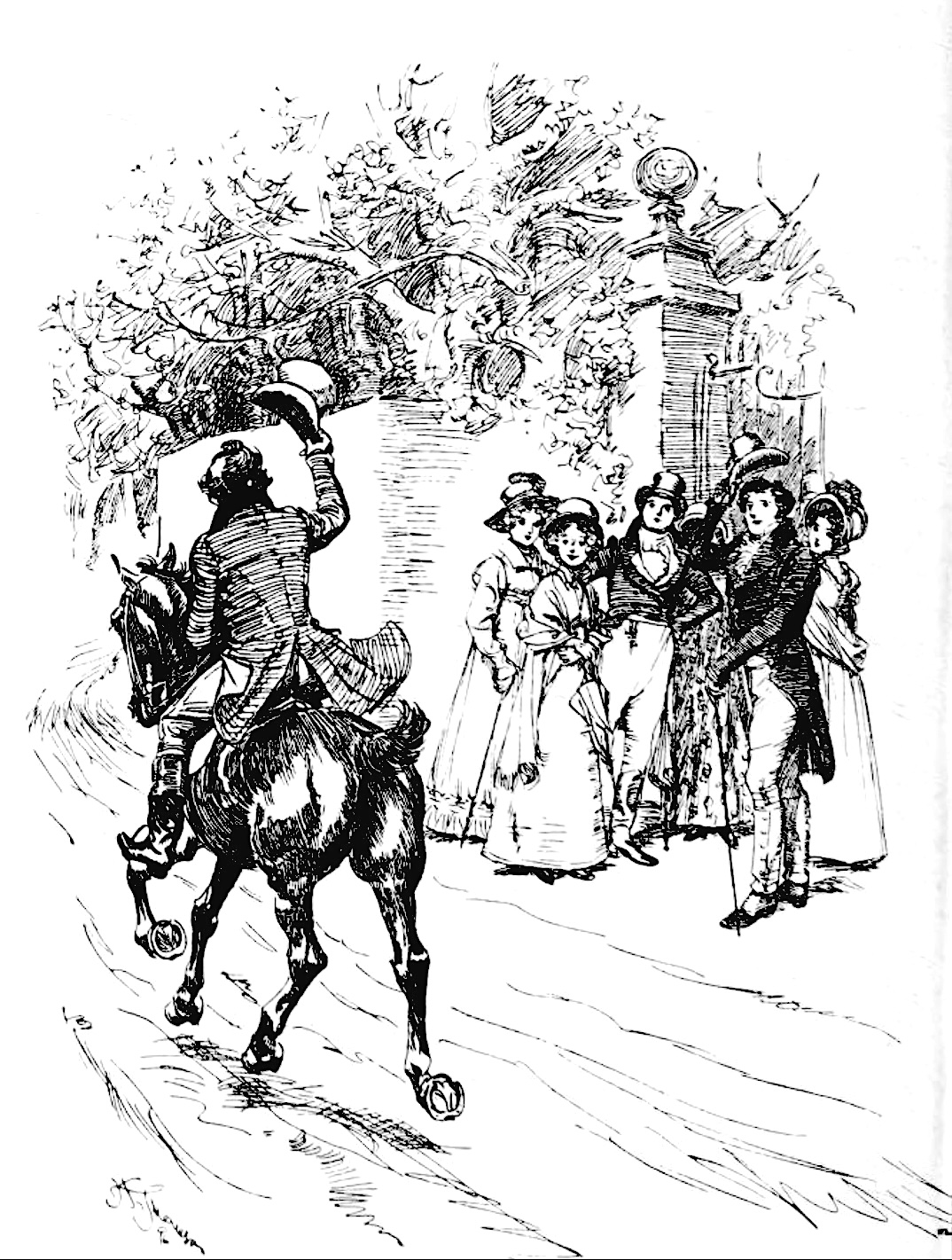
Mr. Perry passed by on horseback
Hugh Thomson
1905
Photomechanical reproduction of a pen-and-ink drawing
12 by 7.5 cm (4 ¾ by 3 inches), vignetted
Jane Austen, Emma, facing page 311.
Scanned image and text by Philip V. Allingham.


[Victorian Web Home —> Jane Austen —> Visual Arts —> Illustration —> Hugh Thomson —> Next]
Mr. Perry passed by on horseback
Hugh Thomson
1905
Photomechanical reproduction of a pen-and-ink drawing
12 by 7.5 cm (4 ¾ by 3 inches), vignetted
Jane Austen, Emma, facing page 311.
Scanned image and text by Philip V. Allingham.
[You may use this image without prior permission for any scholarly or educational purpose as long as you (1) credit the person who scanned the image, and (2) link your document to this URL in a web document or cite the Victorian Web in a print one.]
He had walked up one day after dinner, as he very often did, to spend his evening at Hartfield. Emma and Harriet were going to walk; he joined them; and, on returning, they fell in with a larger party, who, like themselves, judged it wisest to take their exercise early, as the weather threatened rain; Mr. and Mrs. Weston and their son, Miss Bates and her niece, who had accidentally met. They all united; and, on reaching Hartfield gates, Emma, who knew it was exactly the sort of visiting that would be welcome to her father, pressed them all to go in and drink tea with him. The Randalls party agreed to it immediately; and after a pretty long speech from Miss Bates, which few persons listened to, she also found it possible to accept dear Miss Woodhouse’s most obliging invitation.
As they were turning into the grounds, Mr. Perry passed by on horseback. The gentlemen spoke of his horse.
“By the bye,” said Frank Churchill to Mrs. Weston presently, “what became of Mr. Perry’s plan of setting up his carriage?” [Chapter LI, 309]
Having an afternoon walk before summer shower comes on, Emma, the Westons, Harriet, Frank Churchill, Miss Bates, and her niece Jane Fairfax have just reached the impressive gates of Hartfield, the Woodhouses’ estate, when Mr. Perry, the local apothecary, passes on horseback. There ensues a conversation about when Perry intends to purchase (“set up”) a coach rather than continuing to ride to pay his calls in the neighbourhood. Frank says he is convinced that he has received the gossip from Mrs. Weston in correspondence directed to him at Enscombe, but she is quite mystified. In fact, Frank has used the passing of Mr. Perry to mention the apothecary’s planning to acquire a carriage, allowing him to communicate in some sort of secret in code with Jane Fairfax. This conversation feeds Mr. Knightley's growing distrust of Frank Churchill. Mr. Knightley begins to suspect that Frank is playing a double game, toying with the affections of both young women, Emma Woodhouse and Jane Fairfax. None of this scheming is apparent, however, in the seemingly undisturbed visages of the six fashionably-dressed young people whom Thomson depicts at the gates of the estate.
Austen, Jane. Emma. Ed. Austin Dobson. With forty pen-and-ink illustrations by Hugh Thomson. The Novels of Jane Austen. London: Macmillan, 1896, rpt. 1905.
Austen, Jane. Emma. Ed. R. Brimley Johnson. With coloured illustrations by C. E. Brock. The Novels and Letters of Jane Austen. 2 vols. New York & Philadelphia: Frank S. Holby, 1906.
Austen, Jane. Emma. Ed. George Justice. 4th edition. New York: W. W. Norton, 2011.
Austen, Jane. Emma: An Annotated Edition. Ed. Bharat Tandon. Cambridge, Mass., and London: Belknap Press of Harvard U. P., 2012.
Last modified 9 May 2026