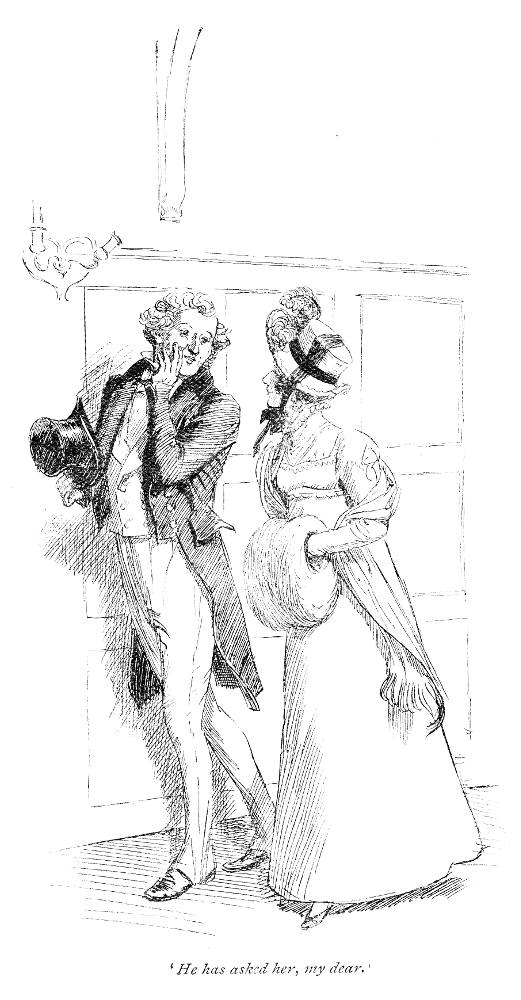
‘He has asked her, my dear’
Hugh Thomson
1905
Photomechanical reproduction of a pen-and-ink drawing
13.3 by 7 cm (5 ¼ by 2 ⅞ inches), vignetted
Jane Austen, Emma, facing page 218.
Scanned image and text by Philip V. Allingham.


[Victorian Web Home —> Jane Austen —> Visual Arts —> Illustration —> Hugh Thomson —> Next]
‘He has asked her, my dear’
Hugh Thomson
1905
Photomechanical reproduction of a pen-and-ink drawing
13.3 by 7 cm (5 ¼ by 2 ⅞ inches), vignetted
Jane Austen, Emma, facing page 218.
Scanned image and text by Philip V. Allingham.
[You may use this image without prior permission for any scholarly or educational purpose as long as you (1) credit the person who scanned the image, and (2) link your document to this URL in a web document or cite the Victorian Web in a print one.]
Long before he reappeared, attending the short, neat, brisk-moving aunt, and her elegant niece, — Mrs. Weston, like a sweet-tempered woman and a good wife, had examined the passage again, and found the evils of it much less than she had supposed before — indeed very trifling; and here ended the difficulties of decision. All the rest, in speculation at least, was perfectly smooth. All the minor arrangements of table and chair, lights and music, tea and supper, made themselves; or were left as mere trifles to be settled at any time between Mrs. Weston and Mrs. Stokes. — Every body invited, was certainly to come; Frank had already written to Enscombe to propose staying a few days beyond his fortnight, which could not possibly be refused. And a delightful dance it was to be.
Most cordially, when Miss Bates arrived, did she agree that it must. As a counsellor she was not wanted; but as an approver (a much safer character) she was truly welcome. Her approbation, at once general and minute, warm and incessant, could not but please; and for another half-hour they were all walking to and fro, between the different rooms, some suggesting, some attending, and all in happy enjoyment of the future. The party did not break up without Emma’s being positively secured for the two first dances by the hero of the evening, nor without her overhearing Mr. Weston whisper to his wife, “He has asked her, my dear. That’s right. I knew he would!” [Chapter XXIX, 227]
The single-paged line-engraving effectively culminates Chapter XXIX in the Macmillan single-volume edition of 1905, amply illustrated by Gordon Thomson. Of course, the casual reader might have difficulty identifying the two figures in the hallway of The Crown Inn beforehand, but the concluding paragraph makes it very clear that the well-dressed, middle-aged man to the left is Mr. Weston, owner of the great house known as Randalls, and that the elegantly dressed younger woman beside him is not the slightly obtuse Miss Bates (who has just arrived to attend the council of war regarding organising the ball). The object of the plate is not merely to realize Regency fashion, but to underscore the social significance of the upper-middle class denizens’ organizing a social event that will showcase the terpsichorean talents of the protagonist and young man who currently appears to be Emma’s intended, the eligible and dashing Frank Churchill.
Although identifying the figures here is a challenge, the chief problem for the reader is to resolve the enigmatic title: who precisely has asked whom for what? Tantalizingly, the illustration of Austen’s hallway scene could be suggesting that Frank has already made a formal proposal of marriage to Emma. Such is not the case at all as the moment realized merely establishes that Frank, fully two weeks before the social event, has already written to Enscombe in order to be permitted to stay beyond his original fortnight, and that by the end of the planning party Frank has secured the first two dances of the evening with the heroine. The only point yet to be resolved at the beginning of Chapter XXX is whether the Churchills will permit Frank to overstay his original visit. Only, one assumes, if he remains in the south will the incipient romance between Frank Churchill and Emma Woodhouse develop into an engagement by the mid-point of the Regency novel.
Austen, Jane. Emma. Ed. Austin Dobson. With forty pen-and-ink illustrations by Hugh Thomson. The Novels of Jane Austen. London: Macmillan, 1896, rpt. 1905.
Austen, Jane. Emma. Ed. R. Brimley Johnson. With coloured illustrations by C. E. Brock. The Novels and Letters of Jane Austen. New York & Philadelphia: Frank S. Holby, 1906. 2 vols.
Austen, Jane. Emma. Ed. George Justice. 4th edition. New York: W. W. Norton, 2011.
Austen, Jane. Emma: An Annotated Edition. Ed. Bharat Tandon. Cambridge, Mass., and London: Belknap Press of Harvard U. P., 2012.
Last modified 26 May 2026