
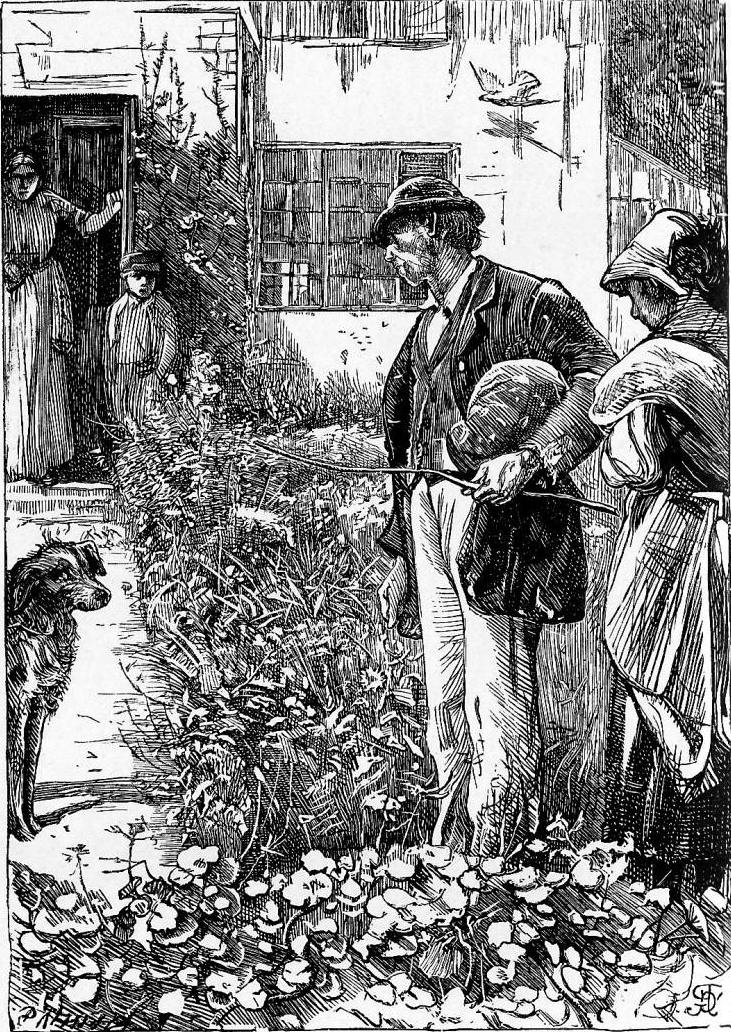
"This is a sweet spot, ain't it? A lovelly spot!"
1868
12.6 x 8.7 cm (4 ⅞ by 3 ⅜ inches), framed.
In the third of the four Pinwell Illustrations — which the 1893 reprint of the Illustrated Library Edition by Chapman and Hall has mistakenly attributed to Marcus Stone — George Pinwell excels himself in depicting a profusion of flowering plants and a hairy dog, as well as revealing his capacity for visual story-telling that we have seen in his previous illustrations for the 1868 edition of The Uncommercial Traveller. [Commentary continued below.]
[Click on image to enlarge it.]
Scanned image and text by Philip V. Allingham.
Passage Illustrated
The slinking tramp is of the same hopeless order, and has the same injured conviction on him that you were born to whatever you possess, and never did anything to get it: but he is of a less audacious disposition. He will stop before your gate, and say to his female companion with an air of constitutional humility and propitiation — to edify any one who may be within hearing behind a blind or a bush — "This is a sweet spot, ain't it? A lovelly spot! And I wonder if they'd give two poor footsore travellers like me and you, a drop of fresh water out of such a pretty gen-teel crib? We'd take it wery koind on 'em, wouldn't us? Wery koind, upon my word, us would?" He has a quick sense of a dog in the vicinity, and will extend his modestly-injured propitiation to the dog chained up in your yard; remarking, as he slinks at the yard-gate, "Ah! You are a foine breed o' dog, too, and you ain't kep for nothink! I'd take it wery koind o' your master if he'd elp a traveller and his woife as envies no gentlefolk their good fortun, wi' a bit o' your broken wittles. He'd never know the want of it, nor more would you. Don't bark like that, at poor persons as never done you no arm; the poor is down-trodden and broke enough without that. Oh, DON'T!" He generally heaves a prodigious sigh in moving away, and always looks up the lane and down the lane, and up the road and down the road, before going on. [pp. 121-122]
Commentary
Focusing not on the lady of the house and her boy in the background, Pinwell emphasizes the tension between the male tramp and the family dog, of whom, despite the apparent nonchalance of the caption, the tramp is apprehensive. The piece which the illustration complements, "Tramps," which first appeared in All the Year Round on 16 June 1860, reflects Dickens's growing abhorrence of wandering beggars as well as his life-long love of the Kentish countryside near Gadshill, particularly the area between Maidstone and Rochester. Increasingly Dickens would fear house-breakers and trespassers, and would protect himself with dogs and gardeners hired to patrol the estate.
As the second most important character in the drawing (as his job is to guard the property against such vagabonds), the dog glances towards the viewer, as if his attitude towards the scene should be the reader's. The mid-sized and minimally threatening animal occupies a marginal space between the tramps and his owners' property, in theory being the "person" whom the tramp addresses on the facing page. Thus, the reader encounters text and illustration simultaneously, and the text and woodcut are mutually informative. Good as the image of the tramp and the canine guardian may be, the idiosyncratic voice of the rhetorical vagabond is more engaging since he speaks for not only himself and his voiceless female companion, but also to the knowing dog in a rapid-fire patter that is both humorous and menacing. The picture admirably conveys the tramp's apprehensions about the dog, but not his seeming to address only his companion, when in fact he is speaking so as to be overheard by the occupants of the house beyond the garden.
Whereas C. S. Reinhart in his "He lies on the broad of his back, with his face turned up to the sky. . . has furnished the American Household Edition reader with a bucolic idyll containing a fetching beauty, and has minimized the presence of the male tramp, and Dalziel regards tramps as either objects worthy of satire or mindless bucolics, Pinwell speaks more directly to middle-class anxieties about the threat posed to their property and safety by tramps. Gone from Pinwell's pleasing composition for Chapter Eleven is any suggestion of comic patter.
Household Edition Illustrations Associated with Tramps and Country Vagabonds
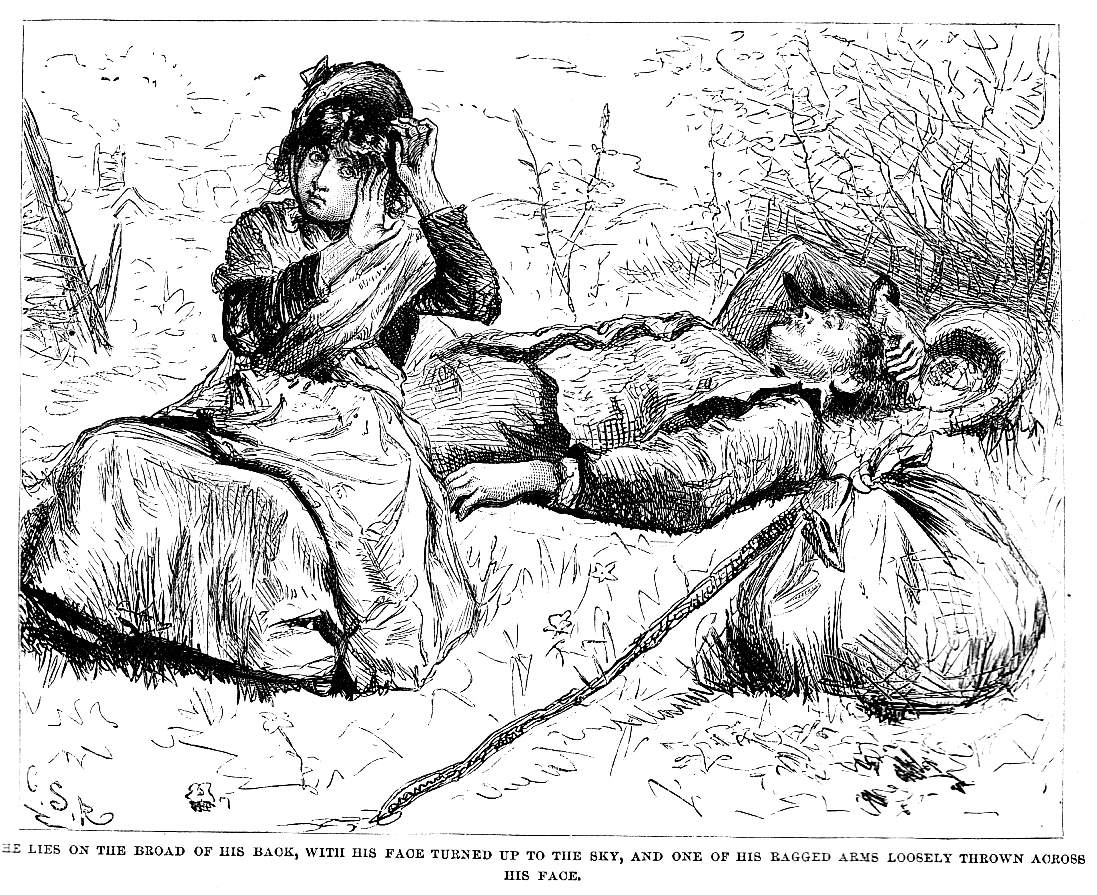


Left: C. S. Reinhart's American Household Edition illustration "He lies on the broad of his back, with his face turned up to the sky. . ." for "Tramps"; centre: E. G. Dalziel's British Household Edition illustration "'Then you're a tramp,' he ses. "I'd rather be that than a beadle,' I ses." for "Tramps"; right, E. G. Dalziel's uncaptioned illustration "'The Chair-Caners." [Click on images to enlarge them.]
References
Davis, Paul. Charles Dickens A to Z: The Essential Reference to His Life and Work. New York: Facts On File, 1998.
Dickens, Charles. Christmas Books and The Uncommercial Traveller. Illustrated by Harry Furniss. Charles Dickens Library Edition. 18 vols. London: Educational Book Company, 1910. Vol. 10.
Dickens, Charles. The Uncommercial Traveller. Illustrated by Marcus Stone [W. M., and George Pinwell]. Illustrated Library Edition. London: Chapman and Hall, 1868, rpt., 1893.
Dickens, Charles. Hard Times and The Uncommercial Traveller. Illustrated by Charles Stanley Reinhart. The Household Edition. New York: Harper and Brothers, 1876.
Dickens, Charles. The Uncommercial Traveller. Illustrated by Edward Dalziel. The Household Edition. London: Chapman and Hall, 1877.
Dickens, Charles. The Uncommercial Traveller. Illustrated by G. J. Pinwell and W. M. The Centenary Edition. London: Chapman and Hall; New York: Charles Scribner's Sons, 1911.
Schlicke, Paul, ed. "The Uncommercial Traveller." The Oxford Companion to Dickens. Oxford and New York: Oxford U. P., 1999. Pp. 100-101.
Slater, Michaell, and John Drew, eds. Dickens' Journalism: 'The Uncommercial Traveller' and Other Papers 1859-70. The Dent Uniform Edition of Dickens' Journalism, vol. 4. London: J. M. Dent, 2000.
Last modified 23 August 2013