
Commentary
Certainly the most disjointed of Ainsworth's novels, and probably unfinished, this is the story of Auriol Darcy, a young Elizabethan who dreams (or did it really happen?) that he kills his great-grandfather, an alchemist who goes by the name of Dr. Lamb, in order to possess himself of the "elixir of life" which enables him to live on to the nineteenth century, subject from 1800 on to a curse which requires that he deliver up every ten years a woman he loves to the devil, otherwise known as Rougemont. [Worth, 120]
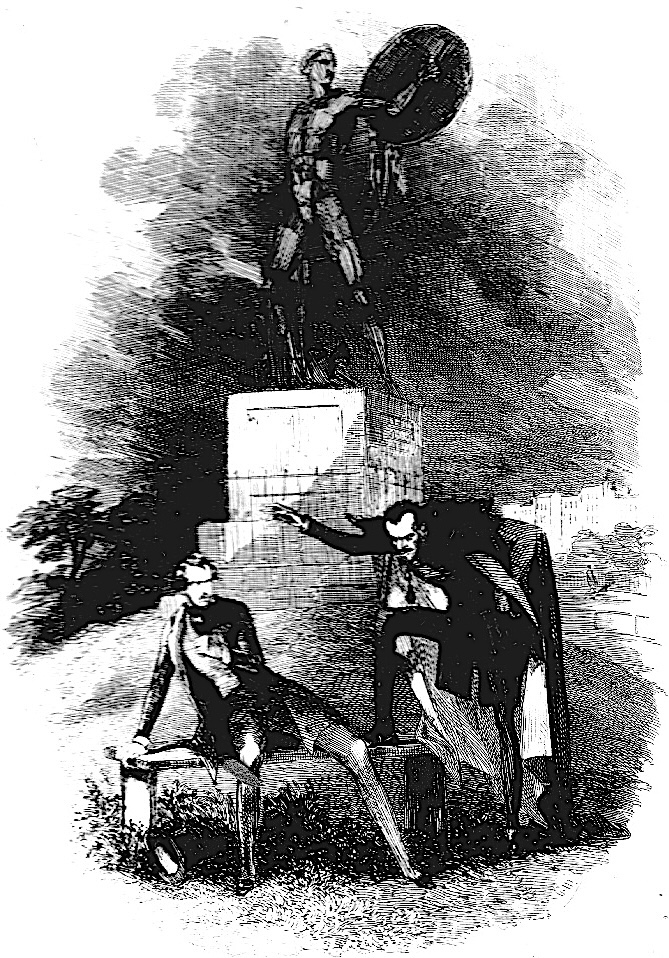
According to Michael Steig, Phiz provided a total of fifteen etchings for the serial run of the novel, fourteen in total when it first appeared as Revelations Of London in Ainsworth's Magazine, from October 1844 through May 1845, in eight monthly instalments. "Following the novelist's break with his publisher, Mortimer, Auriol was suspended in May 1845" (Sutherland, 33). The serial continued in The New Monthly Magazine with just one further illustration in two instalments as Auriol; Or, The Elixir of Life (July through August 1846). The 1850 Chapman and Hall single volume (Volume XII of A Uniform Collected Edition of Ainsworth's Works) contained the title-page and engraved frontispiece (originally in the December 1844 instalment, referencing page 76 in volume, "Book the First — Ebba," Chapter V, "The Meeting near the Statue," which occurred at the end of the third serial instalment, December 1845).
Since George Cruikshank was the principal illustrator for Ainsworth's Magazine, for the series of fifteen full-page steel-engravings to accompany the novel, Phiz appears to have adopted elements of the older artist's style and composition. For example, Phiz was fond of the unframed vignette, but only five of the Auriol series are vignetted: numbers 1, 3, 7, 9, and 12. More significantly, Phiz has shifted his style to conform to Cruikshank's practices, abandoning light-hearted caricature and visual humour in favour melodramatic nocturnal scenes with intense, dense cross-hatching to create a sombre mood for the chief scenes such as the Seizure of Ebba (January, 1845) in Ainsworth's Faustian Gothic tale. Occasionally, as in The Barber of London, Phiz allows himself a comedic vignette, using such comic characters as Ainsworth's humorous dwarf, Flapdragon. For the most part, however, the series is highly reminiscent of Cruikshank's illustrations for Ainsworth's previous novels, Windsor Castle, which ran in Ainsworth's Magazine from June 1842 — June 1843, and The Miser's Daughter, which ran in Ainsworth's Magazine from January through June 1842, both illustrated by Cruikshank.
Illustrations in Ainsworth's Magazine (Vols. 6 — 13 as Revelations of London)
- 1. The Mysterious Interview in Hyde Park (frontispiece for the single-volume edition of 1850)
- 2. The Elixir of Long Life (Oct., 1844)
- 3. The Ruined House in the Vauxhall Road (Oct., 1844)
- 4. The Dog-Fancier (Nov., 1844, facing p. 481)
- 5. The Hand and the Cloak; originally The Unexpected disappearance of Old Parr (facing p. 379, Nov., 1844)
- 6. The Iron-Merchant's Daughter (Dec., 1844)
- 7. The Barber of London (January, 1845)
- 8. The Seizure of Ebba (January, 1845)
- 9. The Antiquaries (February, 1845)
- 10. The Chamber of Mystery (February, 1845)
- 11. The Tomb of the Rosicrucian in "The Intermean — 1800," Chapter One, "The Tomb of the Rosicrucian" (March, 1845)
- 12. The Compact (March, 1845)
- 13. The Significant Whisper (April, 1845)
- 14. The Enchanted Chairs (May, 1845: concludes at Book the Second, Chapter 3)
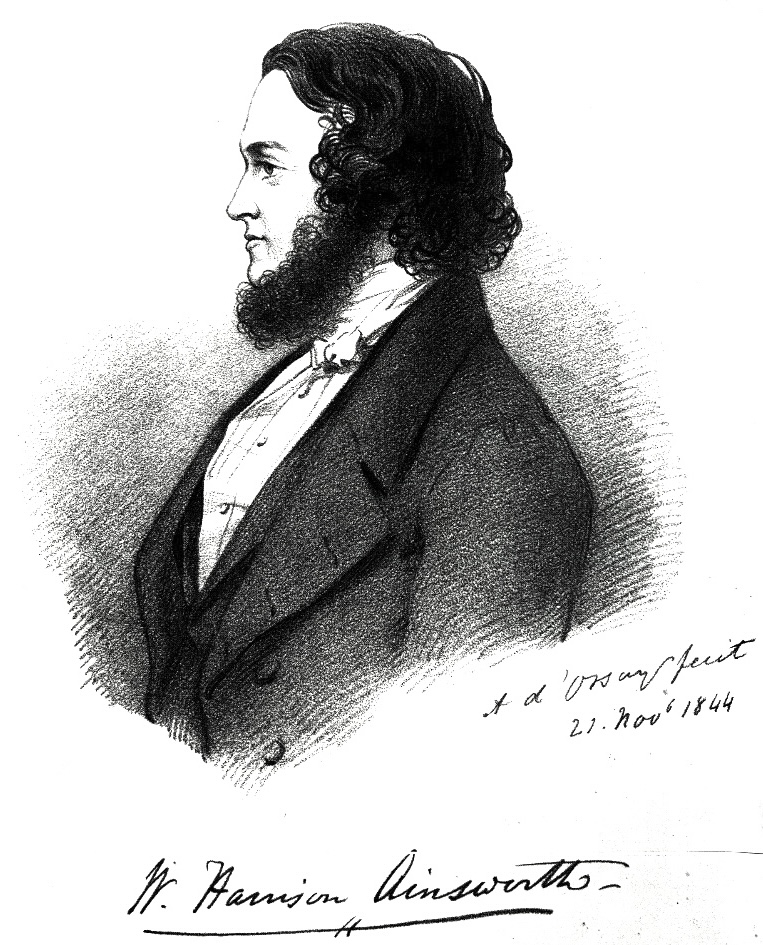
- 16. Portrait of William Harrison Ainsworth in Vol. VII, iv. (October, 1844)
Illustration in The New Monthly Magazine (July — August 1845) as Auriol; Or, The Elixir of Life
- 15. Rougemont's device to perplex Auriol in The New Monthly Magazine (August 1845), ending with Book the Second, Chapter 5.
Related Material
- Hablot Knight Browne, 1815-1882; A Brief Biography
- William Harrison Ainsworth (1805-1882)
- William Harrison Ainsworth (1805-1882) — King of the Historical Potboiler: A Brief Biography
Scanned images and text by Philip V. Allingham. [You may use the images without prior permission for any scholarly or educational purpose as long as you (1) credit the person who scanned them and (2) link your document to this URL in a web document or cite the Victorian Web in a print one.]
Bibliography
Ainsworth, William Harrison. Revelations of London. Ainsworth's Magazine: A Miscellany of Romance. London: John Mortimer, 1844-45 (Vols. VII & VIII).

Ainsworth, William Harrison. Auriol; Or, The Elixir of Life. Book the Second, Chapter 5. Phiz's final illustration: Rougemont's device to perplex Auriol in The New Monthly Magazine (August 1845), ending with Book the Second, Chapter 5.
Ainsworth, William Harrison. Auriol; Or, The Elixir of Life. London: Chapman and Hall, 1850; George Routledge and Sons, 1865.
Lester, Valerie Browne. Phiz: The Man Who Drew Dickens. London: Chatto and Windus, 2004.
Steig, Michael. Dickens and Phiz. Bloomington & London: Indiana U. P., 1978.
Sutherland, John A. "Auriol." The Stanford Companion to Victorian Fiction. Stanford, Cal.: Stanford U. P., 1989, rpt. 1990, 33.
Vann, J. Don. "Auriol; or, The Elixir of Life, published as Revelations of London in Ainsworth's Magazine, October 1844 through May 1845, in Ainsworth's Magazine, October 1844 — May 1845 (partal publication)." Victorian Novels in Serial. New York: Modern Language Association, 1985. Pp. 24-25.
Worth, George J. "Appendix: Concise Synopsis of Ainsworth's Novels." William Harrison Ainsworth. New York: Twayne, 1972. Pp. 117-124.
Created 29 September 2026