
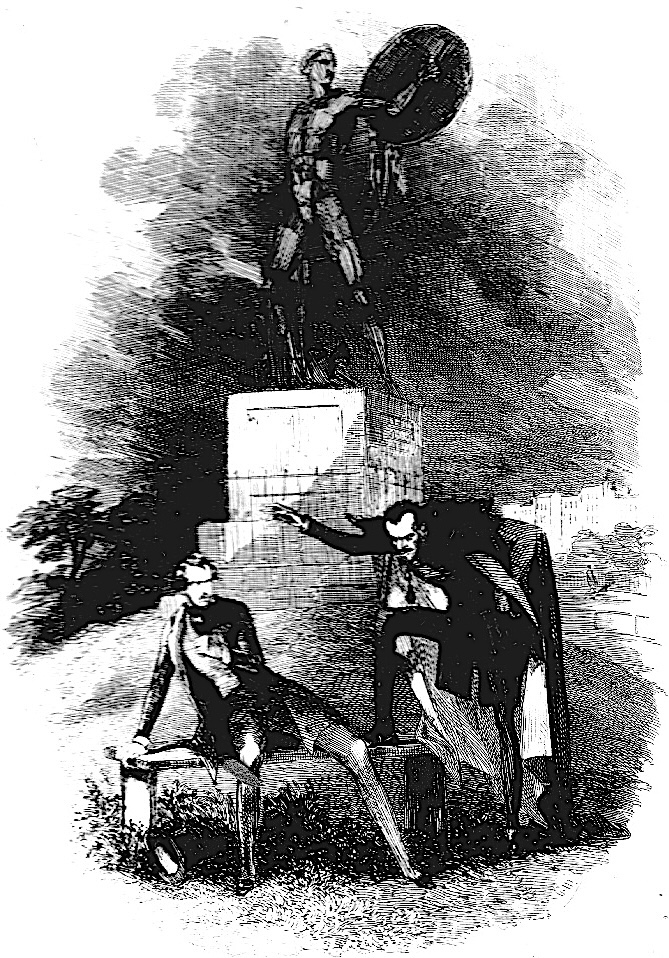
The Mysterious Interview in Hyde Park
Phiz
October 1844
15.1 cm high by 10.2 cm wide (5 ⅞ by 4 inches), vignetted
Frontispiece, facing title page, for William Harrison Ainsworth's Auriol; Or, The Elixir of Life (London: Chapman and Hall, 1850); facing p. 484 in the serial: V. "The Meeting."
[Click on the image to enlarge it and mouse over text for links.]
Scanned image & text by Philip V. Allingham.
[You may use this image without prior permission for any scholarly or educational purpose as long as you (1) credit the person who scanned the image and (2) link your document to this URL in a web document or cite the Victorian Web in a print one.]

Passage Illustrated: Night, Hyde Park, London, in the Nineteenth Century
Utterly disregarding the dripping state of his habiliments, Auriol proceeded quickly to the place of rendezvous. Arrived there, he looked around, and not seeing any one, flung himself upon a bench at the foot of the gentle eminence on which the gigantic statue of Achilles is placed.
It was becoming rapidly dark, and heavy clouds, portending speedy rain, increased the gloom. Auriol's thoughts were sombre as the weather and the hour, and he fell into a deep fit of abstraction, from which he was roused by a hand laid on his shoulder.
Recoiling at the touch, he raised his eyes, and beheld the stranger leaning over him, and gazing at him with a look of diabolical exultation. The cloak was thrown partly aside, so as to display the tall, gaunt figure of its wearer; while the large collar of sable fur with which it was decorated stood out like the wings of a demon. The stranger's hat was off, and his high broad forehead, white as marble, was fully revealed.
"Our meeting must be brief," he said. "Are you prepared to fulfil the compact?"
"What do you require?" replied Auriol.
"Possession of the girl I saw three days ago," said the other; "the iron-merchant's daughter, Ebba. She must be mine."
"Never!" cried Auriol firmly — "never!"
"Beware how you tempt me to exert my power," said the stranger; "she must be mine — or ——"
"I defy you!" rejoined Auriol; "I will never consent."
"Fool!" cried the other, seizing him by the arm, and fixing a withering glance upon him. "Bring her to me ere the week be out, or dread my vengeance!"
And, enveloping himself in his cloak, he retreated behind the statue, and was lost to view. ["Book the First — Ebba," Chapter V, "The Meeting near the Statue," p. 484 in serial, pp. 75-77 in volume]
Commentary
According to Steig, Phiz provided a total of fifteen etchings for the serial run of the novel when it first appeared as Revelations Of London in Ainsworth's Magazine, from October 1844 through May 1845, in eight monthly instalments. A further six instalments, also illustrated, appeared in The New Monthly Magazine as Auriol; Or, The Elixir of Life (August 1845 through January 1846). The 1850 Chapman and Hall single volume contained the title-page and engraved frontispiece (referencing page 76 in "Book the First — Ebba," Chapter V, "The Meeting near the Statue," which occurs at the end of the third serial instalment, December 1845).
The statue towering in the background accords well with the chronological and geographical setting of the main part of the novel, for The Wellington Monument surmounted by Sir Richard Westmacott's eighteen-foot bronze statue of Achilles was erected on 18 June, 1822, the seventh anniversary of the famous battle fought in Belgium between France and Great Britain, at the south-east corner of London's 350-acre Hyde Park, adjacent to Kensington Gardens. Made from thirty-three tonnes of bronze melted down from captured French cannons, the heroic statue (whose head is modelled upon Wellington's) commemorated the Battle of Waterloo, whose outcome determined the fate of nineteenth-century Europe. The dramatic figure of the lithe Greek hero of Homer's Iliad, three times the height of a tall man, looms above a nervous Auriol and the Satanic stranger (in fact, Cyprian de Rougement) in an emotionally charged nocturnal scene that follows the protagonist's querying Ebba about the mysterious stranger in "Book the First — Ebba," Chapter IV. "The Iron-Merchant's Daughter."
The frontispiece focuses upon the relationship between the protagonist, introduced in the opening chapter (set in December, 1599), and the novel's principal antagonist, the mysterious Cyprian de Rougement, the program's recurring Faustian figure, who will force the immortal Auriol Darcy into a dark compact whereby he will use Ebba as leverage to claim Auriol's soul and enlist the soul of the London beauty in his legion of cursed women.
Related Material
- Hablot Knight Browne, 1815-1882; A Brief Biography
- William Harrison Ainsworth (1805-1882)
- William Harrison Ainsworth (1805-1882) — King of the Historical Potboiler: A Brief Biography
Bibliography
Ainsworth, William Harrison. Auriol; Or, The Elixir of Life. London: Chaman and Hall, 1850; George Routledge and Sons, 1865.
Lester, Valerie Browne. Phiz: The Man Who Drew Dickens. London: Chatto and Windus, 2004.
Steig, Michael. Dickens and Phiz. Bloomington & London: Indiana U. P., 1978.
Sutherland, John A. "Auriol." The Stanford Companion to Victorian Fiction. Stanford, Cal.: Stanford U. P., 1989, rpt. 1990, 33.
Vann, J. Don. "Auriol; Or, The Elixir of Life in Ainsworth's Magazine, October 1844 — May 1845." Victorian Novels in Serial. New York: Modern Language Association, 1985. Pp. 24-25.
Victorian
Web
Illus-
tration
Phiz
Auriol
Next
Created 5 August 2002 Last updated 25 September 2026