

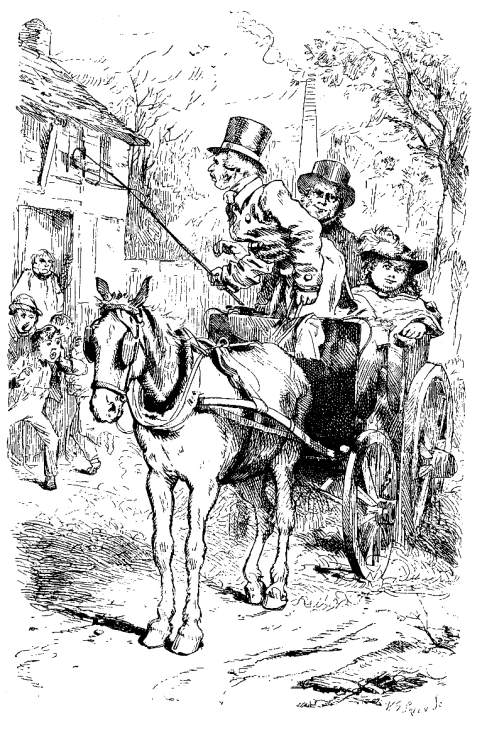
The Boffin Progress by Marcus Stone. Wood engraving and coloured lithograph. 15.1 cm high by 11.4 cm wide (5 ¾ by 4 ½ inches), vignetted. Wood engraving by Dalziel. Dickens's Our Mutual Friend, Chapter Nine, "Mr. and Mrs. Boffin in Consultation." [This part of the novel originally appeared in periodical form in July 1864; the third serial instalment contains Chapters 8, 9, and 10 in Book I. Dickens commended Stone for the realisation of the newly rich Boffins, enjoying immensely Boffin's being presented as "an oddity of a very honest kind, that people would like" (qtd, in Kitton, 198). The object of the Boffins' coach excursion is the residence of the Reverend Frank Milvey, whom they wish to consult about their project of adopting an orphan. As the illustration suggests, the impecunious Anglican clergyman (left rear, in his shirt-sleeves) has half-a-dozen children of his own to provide for at his "modest abode." The colourized version serves as the frontispiece for the Authentic Edition, Vol. XIV (1901), effectively introducing the well-dressed Boffins and uniformed their coachman. The artist shifts the passage's focus from the Boffin equipage in the foreground to the young minister and his family in the rear of the illustration. [Click on the images to enlarge them.]
Passage illustrated: The "Progress" in a rehabilitated farm wagon
In order that these visits might be visits of state, Mrs. Boffin's equipage was ordered out.
This consisted of a long hammer-headed old horse, formerly used in the business, attached to a four-wheeled chaise of the same period, which had long been exclusively used by the Harmony Jail poultry as the favourite laying-place of several discreet hens. An unwonted application of corn to the horse, and of paint and varnish to the carriage, when both fell in as part of the Boffin legacy, had made what Mr. Boffin considered a neat turn-out of the whole; and a driver being added, in the person of a long hammer-headed young man who was a very good match for the horse, left nothing to be desired. He, too, had been formerly used in the business, but was now entombed by an honest jobbing tailor of the district in a perfect Sepulchre of coat and gaiters, sealed with ponderous buttons.
Behind this domestic, Mr. and Mrs. Boffin took their seats in the back compartment of the vehicle: which was sufficiently commodious, but had an undignified and alarming tendency, in getting over a rough crossing, to hiccup itself away from the front compartment. On their being descried emerging from the gates of the Bower, the neighbourhood turned out at door and window to salute the Boffins. Among those who were ever and again left behind, staring after the equipage, were many youthful spirits, who hailed it in stentorian tones with such congratulations as 'Nod-dy Bof-fin!' 'Bof-fin's mon-ey!' 'Down with the dust, Bof-fin!' and other similar compliments. These, the hammer-headed young man took in such ill part that he often impaired the majesty of the progress by pulling up short, and making as though he would alight to exterminate the offenders; a purpose from which he only allowed himself to be dissuaded after long and lively arguments with his employers.
The Arrival of the Boffins at the Reverend Frank Milvey’s abode
At length the Bower district was left behind, and the peaceful dwelling of the Reverend Frank Milvey was gained. The Reverend Frank Milvey’s abode was a very modest abode, because his income was a very modest income. He was officially accessible to every blundering old woman who had incoherence to bestow upon him, and readily received the Boffins. He was quite a young man, expensively educated and wretchedly paid, with quite a young wife and half a dozen quite young children. He was under the necessity of teaching and translating from the classics, to eke out his scanty means, yet was generally expected to have more time to spare than the idlest person in the parish, and more money than the richest. He accepted the needless inequalities and inconsistencies of his life, with a kind of conventional submission that was almost slavish; and any daring layman who would have adjusted such burdens as his, more decently and graciously, would have had small help from him.
With a ready patient face and manner, and yet with a latent smile that showed a quick enough observation of Mrs Boffin’s dress, Mr Milvey, in his little book-room — charged with sounds and cries as though the six children above were coming down through the ceiling, and the roasting leg of mutton below were coming up through the floor — listened to Mrs Boffin’s statement of her want of an orphan. [Chapter IX, "Mr. and Mrs. Boffin in Consultation," pp. 88-89]
Scanned images and text by Philip V. Allingham. [You may use the images without prior permission for any scholarly or educational purpose as long as you (1) credit the person who scanned them and (2) link your document to this URL in a web document or cite the Victorian Web in a print one.]
Bibliography
Dickens, Charles. Our Mutual Friend. Illustrated by Marcus Stone. Volume 14 of the Authentic Edition. London: Chapman and Hall; New York: Charles Scribners' Sons, 1901.
Kitton, Frederic G. Dickens and His Illustrators. 1899. Rpt. Honolulu: U. Press of the Pacific, 2004.
Created 17 November 2010
Last updated 19 March 2026