
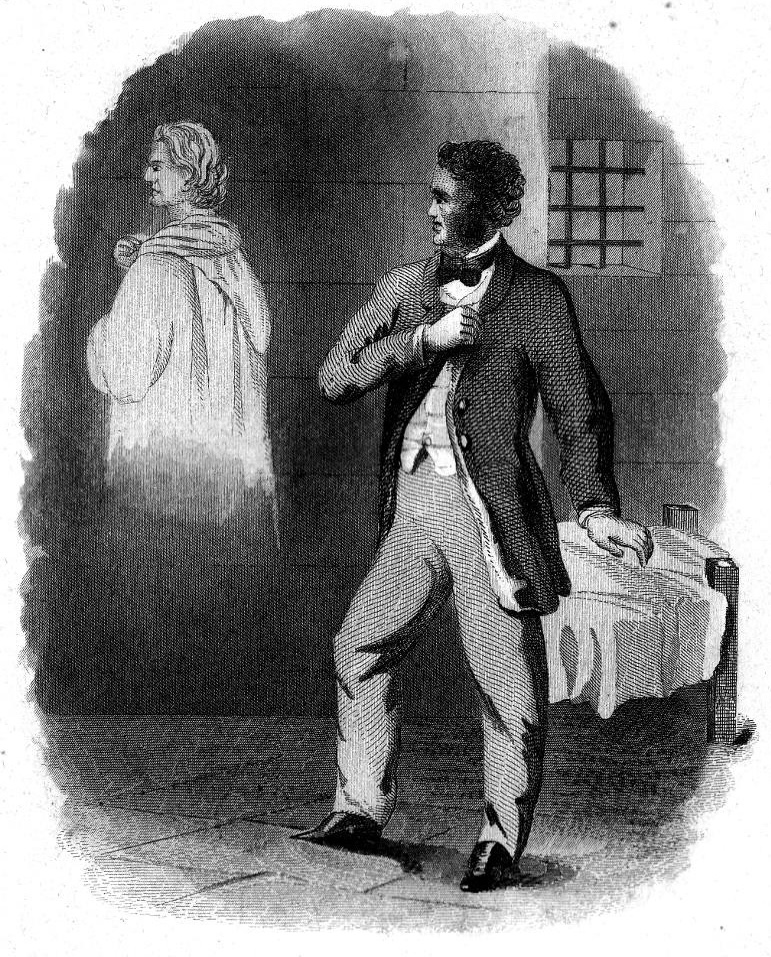
"The Phantom in Fenwick's Cell"
F.O. Freeman (engraver) and J. N. Hyde
1862
Steel engraving
10.2 cm by 7.8 cm (4 inches by 3 inches) vignetted, facing p. 180.
Bulwer-Lytton's A Strange Story
Boston: Gardner A. Fuller.
Scanned image and text by P.V. Allingham.
[You may use this image without prior permission for any scholarly or educational purpose as long as you (1) credit the person who scanned it and (2) link your document to this URL in a web document or cite the Victorian Web in a print one.]
Passage Illustrated: Imprisoned, Allen Encounters Margrave's Phantom
I have read in Scandinavian legends of an apparition called the Scin-Laeca, or shining corpse. It is supposed in the northern superstition, sometimes to haunt sepulchres, sometimes to foretell doom. It is the spectre of a human body seen in a phosphoric light; and apparition in Scandinavian fable that I knew not how to give it a better name than that of Scin-Laeca, — the shining corpse.
There it was before me, corpse-like, yet not dead; there, as in the haunted study of the wizard Forman! — the form and the face of Margrave. Constitutionally, my nerves are strong, and my temper hardy, and now I was resolved to battle against any impression which my senses might receive from my own deluding fancies. Things that witnessed for the first time daunt us witnessed for the second time lose their terror. I rose from my bed with a bold aspect, I approached the phantom with a firm step; but when within two paces of it, and my hand outstretched to touch it, my arm became fixed in air, my feet locked to the ground. I did not experience fear; I felt that my heart beat regularly, but an invincible something opposed itself to me. I stood as if turned to stone. And then from the lips of this phantom there came a voice, but a voice which seemed borne from a great distance, — very low, muffled, and yet distinct; I could not even be sure that my ear heard it, or whether the sound was not conveyed to me by an inner sense.
“I, and I alone, can save and deliver you,” said the voice. “I will do so; and the conditions I ask, in return, are simple and easy.”
“Fiend or spectre, or mere delusion of my own brain,” cried I, “there can be no compact between thee and me. I despise thy malice, I reject thy services; I accept no conditions to escape from the one or to obtain the other.”
“You may give a different answer when I ask again.” [Chapter XL, page 180]
Commentary: Dr. Allen Fenwick, Jailed for the Murder of Derval, Meets Grayle's Spirit
In John McLenan's uncaptioned headnote vignette, on the first page of eighteenth instalment (Chapters 41-42) in Harper's Weekly: A Journal of Civilization, the protagonist is released from his cell, exonerated of the charge of having murdered Sir Philip Derval (whom, in fact, Margrave has silenced). McLenan, the American serial illustrator, had already introduced the Margrave phantom in the previous instalment, in the flashback involving Sir Philip Derval and the obsession of Louis Grayle, the Elixir of Life. The luminous phantom of Grayle, having adopted the youthful form of Margrave, had thrown Fenwick into a trance and stolen Derval's manuscript — and therefore Fenwick's proof that Grayle and Margrave are one and the same. A bloody knife and casket planted in Fenwick's study (likely by Margrave) frame the young physician for the murder of Sir Philip Derval. Strahan strongly suspects Fenwick of having secreted the manuscript he had lent him, and the authorities incarcerate Fenwick on a charge of murder.
The "phantom" or baleful mesmeric influence could have manipulated him mentally, Fenwick realizes, but it could hardly have physically removed Derval's manuscript. Thus, Fenwick reasons that an intruder must be responsible. However, the appearance of the Scin-Laeca in Chapter Forty forces the young physician to question his own rationalist assumptions. In the serial version, John McLenan had already depicted (not very satisfactorily) the phantom appearing before Derval in a vignette for 23 November 1861: Uncaptioned headnote vignette on the first page of sixteenth number (Chapters 39-40) in Harper's Weekly: The Spirit of Louis Grayle Rises before Derval as Margrave. Consequently, Gardner's designer, J. N. Hyde, undoubtedly saw an opportunity for a much more telling moment realised, the interview between the highly moral rationalist and the atavistic spectre, to Fenwick's mind a "Fiend" (demonic spirit), who tempts him with the possibility of deliverance upon "conditions" (180), terms which Fenwick rejects out of hand. However, after another nocturnal visit from "the Luminous Shadow" (182), the very real agency of Fenwick's attorney, Stanton, effects the doctor's release when he proves the charges against his client false. Here is that dialogue about the Phantom's "terms," and Fenwick's:
“Have you considered?” whispered the voice, still as from afar. “I repeat it, — I alone can save you.”
“Is it among the conditions which you ask, in return, that I shall resign to you the woman I love?”
“No.”
“Is it one of the conditions that I should commit some crime,--a crime perhaps heinous as that of which I am accused?”
“No.”
“With such reservations, I accept the conditions you may name, provided I, in my turn, may demand one condition from yourself.”
“Name it.”
“I ask you to quit this town. I ask you, meanwhile, to cease your visits to the house that holds the woman betrothed to me.”
“I will cease those visits. And before many days are over, I will quit this town.”
“Now, then, say what you ask from me. I am prepared to concede it. And not from fear for myself, but because I fear for the pure and innocent being who is under the spell of your deadly fascination. This is your power over me. You command me through my love for another. Speak.”
“My conditions are simple. You will pledge yourself to desist from all charges of insinuation against myself, of what nature soever. You will not, when you meet me in the flesh, refer to what you have known of my likeness in the Shadow. You will be invited to the house at which I may be also a guest; you will come; you will meet and converse with me as guest speaks with guest in the house of a host.” [Chapter LXI, 183]
Commentary: Dr. Allen Fenwick Reacts to the sudden appearance of Grayle's Spirit
McLenan did not attempt either of the previously discussed phantom scenes in his serial program, but in the headnote vignette for number 16 (Chapters 39-40) did represent the spirit of Louis Grayle as Margrave rising before Fenwick as he reads a manuscript penned by Sir Philip Derval. However, the phantom in this wood-engraving is nothing more than a shadow; featureless, it in no way suggests the handsome Margrave. In contrast, Freeman and Hyde's The Phantom in Fenwick's Cell, facing the text realised, presents a ghostly youth in monk-like garb turned away from Fenwick, whose posture and expression suggest a mixture of surprise and indignation. Compelling the reader to examine the dialogue, the artist has caught the wraith in the act of disappearing, so that it appears above the waist only. The remarkable features are the monk's hood and the youth's copious hair. Freeman emphasizes the setting by the bed and barred window to the right.
Bibliography
Bulwer-Lytton, Edward G. D. A Strange Story. Illustrated by John McLenan. Harper's Weekly V, 10 August — 8 March 1862.
Bulwer-Lytton, Edward G. D. A Strange Story. Illustrated by F. O. Freeman and J. N. Hyde. Boston: Gardner A. Fuller, 1862.
Bulwer Lytton, Edward (Lord Lytton). A Strange Story. The Works of Edward Bulwer Lytton, Vol. VII. New York: P. F. Collier, n. d. Pp. 7-242.
Victorian
Web
E. Bulwer-
Lytton
Illustra-
tion
Freeman and
McLenan
Next
Created 25 July 2026