
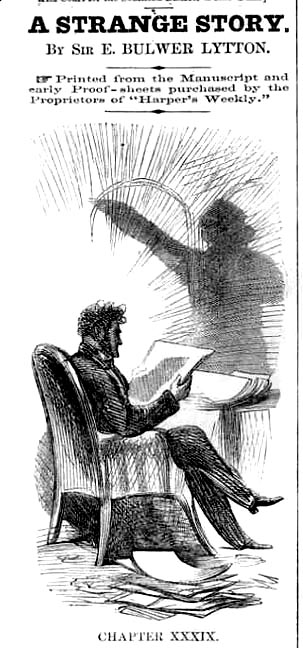
Uncaptioned headnote vignette on the first page of sixteenth instalment (Chapters 39-40)
John McLenan
1861
Wood engraving
11 cm. by 6 cm.
Bulwer-Lytton's A Strange Story
Harper's Weekly 5 (23 November 1861): 746.
Scanned image and commentary by Philip V. Allingham.
[You may use this image without prior permission for any scholarly or educational purpose as long as you (1) credit the person who scanned the image and (2) link your document to this URL in a web document or cite the Victorian Web in a print one.]

Passage Illustrated: The Spirit of Louis Grayle Rises before Derval as Margrave
On searching for some old title-deeds required for a mortgage, [Sir Philip Derval] chanced upon a collection of manuscripts much discoloured, and, in part, eaten away by moth or damp. These, on examination, proved to be the writings of Forman. Some of them were astrological observations and predictions; some were upon the nature of the Cabbala; some upon the invocation of spirits and the magic of the dark ages. All had a certain interest, for they were interspersed with personal remarks, anecdotes of eminent actors in a very stirring time, and were composed as Colloquies, in imitation of Erasmus, — the second person in the dialogue being Sir Miles Derval, the patron and pupil; the first person being Forman, the philosopher and expounder.
But along with these shadowy lucubrations were treatises of a more uncommon and a more startling character, — discussions on various occult laws of nature, and detailed accounts of analytical experiments. These opened a new, and what seemed to Sir Philip a practical, field of inquiry, — a true border-land between natural science and imaginativespeculation. . . . .
I had just read thus far when a dim shadow fell over the page, and a cold air seemed to breathe on me, — cold, so cold, that my blood halted in my veins as if suddenly frozen! Involuntarily I started, and looked up, sure that some ghastly presence was in the room. And then, on the opposite side of the wall, I beheld an unsubstantial likeness of a human form. Shadow I call it, but the word is not strictly correct, for it was luminous, though with a pale shine. In some exhibition in London there is shown a curious instance of optical illusion; at the end of a corridor you see, apparently in strong light, a human skull. You are convinced it is there as you approach; it is, however, only a reflection from a skull at a distance.
The image before me was less vivid, less seemingly prominent than is the illusion I speak of. I was not deceived. I felt it was a spectrum, a phantasm; but I felt no less surely that it was a reflection from an animate form, — the form and face of Margrave; it was there, distinct, unmistakable. Conceiving that he himself must be behind me, I sought to rise, to turn round, to examine. I could not move: limb and muscle were overmastered by some incomprehensible spell. Gradually my senses forsook me; I became unconscious as well as motionless. When I recovered, I heard the clock strike three. I must have been nearly two hours insensible! The candles before me were burning low. My eyes rested on the table; the dead man’s manuscript was gone! [Chapter XXXIX, 746]
Commentary: The Elixir of Life Sought After by Grayle and Enjoyed by Margrave
The figure seated in the arm-chair, reading the folio pages, is almost certainly our protagonist, Dr. Allen Fenwick, perusing the manuscript leant him by the traveller from the East, Richard Strahan, at Derval Court, which he has just inherited. Fenwick reading well into the evening has reached the point in Derval's narrative where, after the body of Haroun of Aleppo has been discovered, and his likely killer, Louis Grayle, has mysteriously disappeared from Aleppo. Derval, the narrator of the manuscript, concludes that Grayle had successful discovered Haroun's mysterious, life-restoring elixir, "the great Principle of Animal Life," that will enable him to cheat mortality. The luminous phantom of the reborn Grayle, having adopted the youthful form of Margrave, throws Fenwick into a trance and steals the manuscript. He also plants a bloody knife and casket in Fenwick's study in order to frame the young physician for the murder of Sir Philip Derval. Strahan strongly suspects Fenwick of having secreted the manuscript he had leant him, and the authorities arrest Fenwick on a charge of murder.
Bibliography
Bulwer-Lytton, Edward G. D. A Strange Story. Illustrated by John McLenan. Harper's Weekly V, 10 August — 21 December 1861.
Bulwer Lytton, Edward (Lord Lytton). A Strange Story. The Works of Edward Bulwer Lytton, Vol. VII. New York: P. F. Collier, n. d., pp. 7-242.
Victorian
Web
E. Bulwer-
Lytton
Illustra-
tion
John
McLenan
Next
Created 21 November 2007 Last modified 3 July 2026