
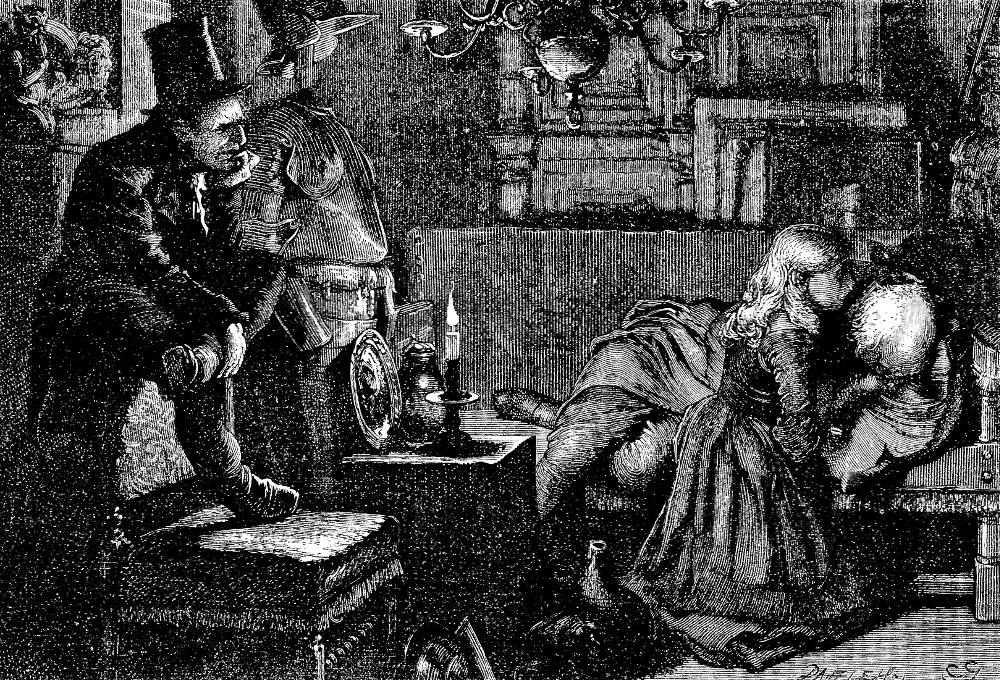
He soon cast his eyes upon a chair, into which he skipped with uncommon agility, and perching himself on the back with his feet upon the seat, was thus enabled to look on — Chap. IX by Charles Green. 1876. 9.4 cm high by 13.8 cm wide (3 ⅝ by 4 ⅞ inches). Dickens's The Old Curiosity Shop, in the 1876 British Household Edition, XII: 37. [Click on the images to enlarge them.]
Passage Illustrated: Quilp the Eavesdropper

Harry Furniss's foreground Quilp, and thrusting Nell and her grandfather into the background in Quilp watches Nell comforting her Grandfather, with a closeup of the dwarf as close observer. (1910)
These were not words for other ears, nor was it a scene for other eyes. And yet other ears and eyes were there and greedily taking in all that passed, and moreover they were the ears and eyes of no less a person than Mr. Daniel Quilp, who, having entered unseen when the child first placed herself at the old man’s side, refrained — actuated, no doubt, by motives of the purest delicacy — from interrupting the conversation, and stood looking on with his accustomed grin. Standing, however, being a tiresome attitude to a gentleman already fatigued with walking, and the dwarf being one of that kind of persons who usually make themselves at home, he soon cast his eyes upon a chair, into which he skipped with uncommon agility, and perching himself on the back with his feet upon the seat, was thus enabled to look on and listen with greater comfort to himself, besides gratifying at the same time that taste for doing something fantastic and monkey-like, which on all occasions had strong possession of him. Here, then, he sat, one leg cocked carelessly over the other, his chin resting on the palm of his hand, his head turned a little on one side, and his ugly features twisted into a complacent grimace. And in this position the old man, happening in course of time to look that way, at length chanced to see him: to his unbounded astonishment. [Chapter IX, 36]
Commentary: Just How Old is Little Nell?
Green seems to be following Cattermole's lead here in depicting Nell as a mere child, who is having to play the role of comforter to the adult who should be looking after her, but instead dissipates his energies and resources in gambling, hoping to provide for her when he is dead. The interview in the curiosity shop between the debtor and his usurer once Nell has gone to bed reinforces the reader's suspicion that the odious dwarf means to leverage Grandfather Trent's promissory notes as a means of securing the old man's consent to an unequal marriage of a middle-age grotesque and a young beauty.
Thus, the reader approaches the scene which shows Nell as a child comforting her despondent guardian with the inevitable question, "Is Nell really of marriageable age at the time of the story?" In Chapter VIII, Dick Swiveller had objected to his friend Fred's proposal that he marry Nell: "And she nearly fourteen!" cried Dick. (28) Fred replies that what he is contemplating is having Dick marry her "say in two years' time, in three, in four." In other words, if she were sixteen a marriage would be possible, although perhaps it would be more socially acceptable if she were eighteen. When Quilp proposes in his counting-house in Chapter VI that Nell become his "number two' (that is, the second Mrs. Quilp), he, too, refers to a marriage perhaps four years hence as being socially acceptable: "Say that Mrs. Quilp lives five years, or only four, you'll be just the proper age for me" (22). If the date of the action is not 1840, but a generation earlier, some time in the 1820s, would either young Dick or middle-aged Daniel have been legally able to marry Nell? Under the terms of the Marriage Act of 1753, minors could marry with the permission of parents or a guardian — in this case, Grandfather Trent, should he still be alive, or more likely Fred Trent, Nell's older brother. Those under the age of twenty-one (clearly this is the case with Little Nell, no matter whose illustrations establish her age) had to have parental consent if they married by licence; marriages by banns in the parish church, however, were legally valid as long as the parent of the minor did not actively and vocally forbid the publishing of the banns. This situation, recognizing the legitimacy of a marriage conducted after the duly read banns, persisted until 1929, when, as a result of campaigning by the National Union of Societies for Equal Citizenship, Parliament raised the minimum age to sixteen for both sexes in the Ages of Marriage Act.
Consequently, although Dickens frames the possibility of a Nell nearly eighteen years of age marrying either a twenty-five-year-old Dick Swiveller or a forty-five-year-old Daniel Quilp, in fact either man could have married her sooner with her guardian's consent. Fred knows that Grandfather Trent will be reluctant to yield such consent, and so is prepared to wait until he becomes Nell's guardian. Quilp faces (he believes) no such impediment as he expects to able to manipulate Grandfather Trent by leveraging consent in exchange for cancellation of gambling debts. In neither instance is the prospective bridegroom anticipating having to ask Nell for her consent.
The situation in view of Nell's putative age in Green's illustrations (about fourteen) is not illegal, although somewhat repugnant; in the original Phiz and Cattermole illustrations, however, the situation is different because both illustrators imply that she is a mere child, and certainly not an adolescent. In Green's frontispiece, Nell, although short and underdeveloped, may be as old as thirteen, and we may judge her to be about the same age in her writing lesson with Kit.

In the scene that we have just witnessed outside Quilp's warehouse, Nell's face and figure suggest those of an adolescent, and Green maintains this impression in all subsequent illustrations except the scene in which a kneeling Nell comforts her grandfather in Chapter IX. This is not, however, the impression that readers would have derived from the early illustrations in Master Humphrey's Clock. The despicable Quilp, armed with the knowledge of Grandfather Trent's gambling, intends to coerce him into agreeing to letting Quilp marry a girl perhaps thirty years his younger.
John Stuart Mill has mused about the kind of awkward position in which Quilp intends to place Nell's guardian: ". . . undue influence. This can be exerted in different ways, in some of which there will be disagreement about whether or not undue influence was really present. Coercion is an example of undue influence, but there are also the pressures of economic inducements, and sometimes of customs and traditions. A person who would not otherwise perform an act may do so because of economic inducements" (On Liberty, Chapter VII, "Weak Paternalism").
In one of the best known images from Master Humphrey's Clock, Cattermole's frontispiece for The Old Curiosity Shop showing Nell and Master Humphrey entering the shop after dusk, Nell looks to be about ten, but perhaps as much as fourteen in the scene in which Nell apprehensively watches Quilp smoking in Chapter IV, Nell in Quilp's Counting-House; or, Quilp in a Smoking Humour, and studies Quilp's reaction to her Grandfather's note in his countinghouse in Chapter VI, Little Nell is Anxious. We revert to a much younger, more childlike Nell in Chapter IX as Nell comforts her Grandfather while Quilp spies on them in Cattermole's Little Nell as Comforter. She seems, however, to have acquired half-a-dozen years as she and her guardian abandon London in The Pilgrimage Begins (Chapter XII), but to have reverted to her child-like form in A Rest by the Way; or, Little Nell and Her Grandfather Looking back on London (Chapter XV) and Punch in the Churchyard (Chapter XVI).
However, by Chapter XXIV in Master Humphrey's Clock Nell is once more a teenager in At the Schoolmaster's Porch (Part 14). This unpredictable oscillation between a prepubescent Nell (for example, hiding from Quilp) and an adolescent Nell, confidently acting as Mrs. Jarley's docent in the waxworks scene does not enable to reader with confidence to assess either Little Nell's age or maturity, let alone her readiness for marriage to either a Dick or a Daniel. Certainly in the most famous image of Nell, the Cattermole tailpiece, The Spirit's Flight, Nell is undoubtedly "little," and has not reached the age of discretion, so that the designs older males have had upon her seem akin to child sexual abuse. And perhaps that was precisely the anxiety which the illustrators prior to Green and Worth in the Household Edition attempted to induce in readers: Nell, beautiful, pensive, pure, and not yet even in early adolescence, is an inappropriate object of adult male desire. We may be inclined to excuse Dick's designs, at least, as mercenary rather than sexual, as he mistakenly believes, based on what his friend Fred has told him, that Nell is an heiress.
Readers will likely conjecture about these possibilities at this point in the narrative as the designing Fred Trent and the lascivious Quilp begin to close in on the innocent Nell. Green's Quilp studies the situation not with a malicious grin, but a studious and rapt look, as if he is already calculating how he may use his knowledge of the grandfather's clandestine turns at the tables to his advantage — after, of course, like a true, fairytale Bluebeard, he has disposed of the first Mrs. Quilp.
Other depictions of Nell tending her Grandfather in his Fever


Left: Worth shows that Nell has been sitting up with her feverish grandfather, and has even slept at his bedside, well within reach of supplies necessary to the sickroom in Listening to those repetitions of her name (Chapter XI). Right: The style of the leading member of the team of illustrators, George Cattermole, was ideal for the subject of the quaint interior of the London antique shop that gives Dickens's fourth novel its title, Little Nell as Comforter (Part 7), although not so well suited to the depiction of Nell and Quilp (20 June 1840).
Related Material
- Dickens's The Old Curiosity Shop — Some Discussions
- The Old Curiosity Shop Illustrated: A Team Effort by "The Clock Works."
- Kyd's Characters from Dickens (1889)
Scanned images and text by Philip V. Allingham. [You may use these images without prior permission for any scholarly or educational purpose as long as you (1) credit the person who scanned the images and (2) link your document to this URL in a web document or cite the Victorian Web in a print one.]
Bibliography
Dickens, Charles. The Old Curiosity Shop in Master Humphrey's Clock. Illustrated by Phiz, George Cattermole, Samuel Williams, and Daniel Maclise. 3 vols. London: Chapman and Hall, 1841; rpt., Bradbury and Evans, 1849.

Dickens, Charles. The Old Curiosity Shop. Illustrated by Thomas Worth. The Household Edition. VI. New York: Harper and Brothers, 1872.
Dickens, Charles. The Old Curiosity Shop. Illustrated by Charles Green. The Household Edition. XII. 22 vols. London: Chapman and Hall, 1876.
Dickens, Charles. The Old Curiosity Shop. Illustrated by Harry Furniss. The Charles Dickens Library Edition. V. 18 vols. London: Educational Book, 1910.
Created 4 May 2019
Last modified 14 April 2026