

“Pray control your agitation.”
A. A. Dixon
1905
Watercolour as lithograph
4 ¾ inches high by 5 inches wide (12.1 cm by 8 cm)
Third illustration for Collins Pocket edition, p. 33.
Book I, “Recalled to Life,” Ch. 4, “The Preparation,” p. 33. Penguin edition p. 55. Oxford World's Classics edition p. 27. Mr. Lorry at the George Inn at Dover prepares Lucie Manette for the revelation that her father has been “restored to life.”
Scanned image and text by Philip V. Allingham.

Passage Realised: Mr. Lorry's Startling Disclosure is Not "Business" at all
After this odd description of his daily routine of employment, Mr. Lorry flattened his flaxen wig upon his head with both hands (which was most unnecessary, for nothing could be flatter than its shining surface was before), and resumed his former attitude.
“So far, miss (as you have remarked), this is the story of your regretted father. Now comes the difference. If your father had not died when he did — Don’t be frightened! How you start!”
She did, indeed, start. And she caught his wrist with both her hands.
“Pray,” said Mr. Lorry, in a soothing tone, bringing his left hand from the back of the chair to lay it on the supplicatory fingers that clasped him in so violent a tremble: “pray control your agitation — a matter of business. As I was saying —”
Her look so discomposed him that he stopped, wandered, and began anew:
“As I was saying; if Monsieur Manette had not died; if he had suddenly and silently disappeared; if he had been spirited away; if it had not been difficult to guess to what dreadful place, though no art could trace him; if he had an enemy in some compatriot who could exercise a privilege that I in my own time have known the boldest people afraid to speak of in a whisper, across the water there; for instance, the privilege of filling up blank forms for the consignment of any one to the oblivion of a prison for any length of time; if his wife had implored the king, the queen, the court, the clergy, for any tidings of him, and all quite in vain; — then the history of your father would have been the history of this unfortunate gentleman, the Doctor of Beauvais.” [Book the First, “Recalled to Life,” Ch. 4, “The Preparation,” p. 33]
Relevant Illustrations of the the Scene at Dover from 1859 & 1874 Editions
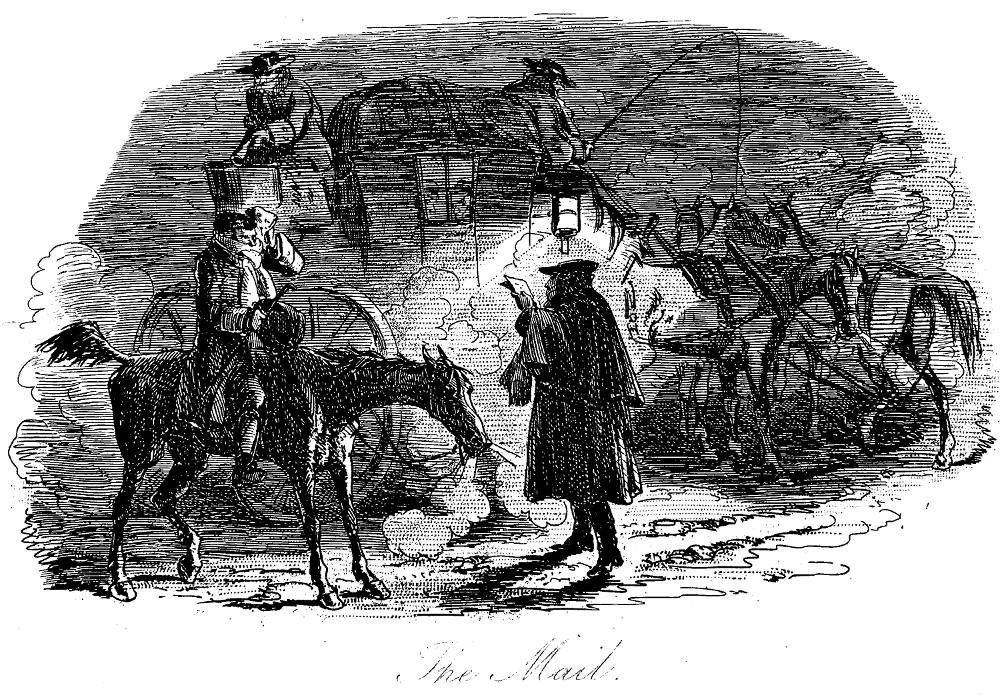

Left: Phiz's celebrated representation of the dramatic delivery of the note regarding Dr. Manette's release, June 1859: The Mail. Right: A stylish realisation of the disclosure scene at the George Inn, Dover, Barnard's uncaptioned headpiece for Book One in the Household Edition, She curtsied to him (young ladies made curtsies in those days) with a pretty desire to convey to him that she felt how much older and wiser he was than she. (Vol. VIII, 1874).
Commentary: Setting the Scene in Reaction to Barnard's Treatment in 1874
Lucie Manette meets Mr. Jarvis Lorry of Tellson's Bank in her room at the old coaching inn ("The Royal George Hotel") at the port of Dover in the fourth chapter of Book the First, "Recalled to Life," Dickens's A Tale of Two Cities (Household Edition, 1874), p. 1. Whereas Barnard had sketched in the details of the cheerful room at The George, Dixon focuses entirely on the figures. To emphasize the contrast, he has made Mr. Jarvis Lorry of Tellson's Bank, with branches conveniently in London and Paris, rather older than his counterpart in the Household Edition. Dixon also offers little detail abut the room in which the banker and Dr. Manette's daughter meet to discuss the implications of Jerry Cruncher's message, "Recalled to Life."
Other Illustrated Editions (1859-1910)
- Hablot K. Brown or 'Phiz' (16 monthly steel-engravings)
- John McLenan (64 wood-engravings, 1859)
- Sol Eytinge, Junior (8 wood-engravings, 1867)
- Fred Barnard (25 wood-engravings, 1874)
- Harry Furniss (32 lithographs, 1910)
Related Material
- A Tale of Two Cities 1859 — the last Dickens's novel "Phiz" Illustrated
- How did Victorian critics define the historical novel?
- A Tale of Two Cities (1859): A Model of the Integration of History and Literature
- Costume Notes on A Tale of Two Cities
- List of Phiz's Plates (21 November 1859) from the first volume edition.
- McLenan's 27 August 1859 illustration in Harper's Weekly Magazine
- 25 Illustrations for Dickens's A Tale of Two Cities by Fred Barnard (from the Household Edition, 1874)
- Darnay Arrested by Harry Furniss from Volume 13 in The Charles Dickens Library Edition (1910).
Bibliography
Dickens, Charles. A Tale of Two Cities. Ilustrated by Hablot Knight Browne. London: Chapman and Hall, 1859.
Dickens, Charles. A Tale of Two Cities and Great Expectations. Diamond Edition. Illustrated by Sol Eytinge, Junior. Boston: Ticknor and Fields, 1867.
Dickens, Charles. A Tale of Two Cities. Illustrated by Fred Barnard. The Household Edition, 22 vols. London: Chapman and Hall, 1874. Vol. VIII.
Dickens, Charles. A Tale of Two Cities. Illustrated by A. A. Dixon with an engraved title by Harry Furniss. London: Collins, 1905. (From the personal collection of George Gorniak, Editor of The Dickens Magazine.)
Dickens, Charles. A Tale of Two Cities, American Notes, and Pictures from Italy. Illustrated by Harry Furniss. Charles Dickens Library Edition. 18 vols. London: Educational Book Company, 1910. Vol. XIII.
Created 2 November 2013
Last updated 31 August 2026