

“Change that coat for this of mine.”
Arthur A. Dixon
1905
Watercolour as lithograph
11.9 cm high by 8 cm wide (4 ⅝ inches by 3 ⅛ inches), framed
Eleventh illustration for Collins edition, facing p. 417.
Book III, “The Track of a Storm,” Ch. 13, “Fifty-Two.” Penguin edition p. 380. Oxford World's Classics edition, facing p. 417. Carton assumes Darnay's identity in the prison of La Force.
Scanned image and text by Philip V. Allingham.

Passage Realised: Carton attempts to rescue Darnay by sacrificing himself
The prisoner turned his face partly aside.
“You have no time to ask me why I bring it, or what it means; I have no time to tell you. You must comply with it — take off those boots you wear, and draw on these of mine.”
There was a chair against the wall of the cell, behind the prisoner. Carton, pressing forward, had already, with the speed of lightning, got him down into it, and stood over him, barefoot.
“Draw on these boots of mine. Put your hands to them; put your will to them. Quick!”
“Carton, there is no escaping from this place; it never can be done. You will only die with me. It is madness.”
“It would be madness if I asked you to escape; but do I? When I ask you to pass out at that door, tell me it is madness and remain here. Change that cravat for this of mine, that coat for this of mine. While you do it, let me take this ribbon from your hair, and shake out your hair like this of mine!” [Book III, “The Track of a Storm,” Ch. 13, “Fifty-Two,” p. 423]
Relevant Illustrations of the Defarges from Other Editions: 1859 and 1874
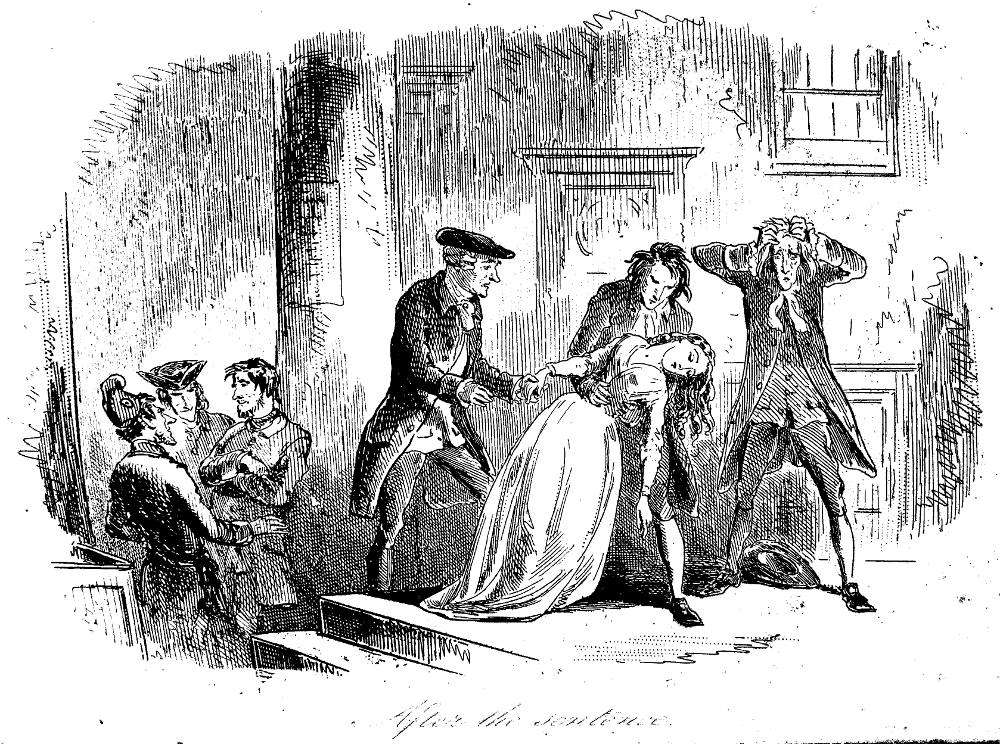

Left: Phiz's December 1859 depiction of Lucie's swooning on the steps outside the Tribunal, After the Sentence. Right: A slightly later British interpretation of the same scene, its emotion somewhat muted, Fred Barnard's As he was drawn away, his wife released him. (Vol. VIII, 1874).
Related Material
- A Tale of Two Cities 1859 — the last Dickens's novel "Phiz" Illustrated
- How did Victorian critics define the historical novel?
- Images of the French Revolution
- A Tale of Two Cities (1859): A Model of the Integration of History and Literature
- Costume Notes on A Tale of Two Cities
Bibliography
Allingham, Philip V. "Charles Dickens's A Tale of Two Cities (1859) Illustrated: A Critical Reassessment of Hablot Knight Browne's Accompanying Plates." Dickens Studies. 33 (2003): 109-158.
Dickens, Charles. A Tale of Two Cities. Illustrated by John McLenan. Harper's Weekly: A Journal of Civilization, 7 May through 3 December 1859.
Dickens, Charles. A Tale of Two Cities. Ilustrated by Hablot Knight Browne. London: Chapman and Hall, 1859.
Dickens, Charles. A Tale of Two Cities and Great Expectations. Diamond Edition. Illustrated by Sol Eytinge, Junior. Boston: Ticknor and Fields, 1867.
Dickens, Charles. A Tale of Two Cities. Illustrated by Fred Barnard. The Household Edition, 22 vols. London: Chapman and Hall, 1874. Vol. VIII.
Dickens, Charles. A Tale of Two Cities. Illustrated by A. A. Dixon with an engraved title by Harry Furniss. London: Collins, 1905. (From the personal collection of George Gorniak, Editor of The Dickens Magazine.)
Dickens, Charles. A Tale of Two Cities, American Notes, and Pictures from Italy. Illustrated by Harry Furniss. Charles Dickens Library Edition. 18 vols. London: Educational Book Company, 1910. Vol. XIII.
Created 2 November 2013
Last updated 31 August 2026