

"Here's a mind, ma'am" from "Mrs. Lirriper's Lodgings"
Felix O. C. Darley
1870
9 by 9 cm (3 ½ by 3 ½ inches) vignetted
Photogravure
Frontispiece to Dickens's Master Humphrey's Clock & Additional Christmas Stories.
[Click on illustration to enlarge it.]
Scanned image and text by Philip V. Allingham from his own collection.
Passage Illustrated
And if you'll believe me, there in the front parlor [sic] at five punctual to the moment was the Major behind the Pembroke table, with both leaves up and a lot of things from the kitchen tidily set out on old newspapers spread atop of it, and there was the Mite stood up on a chair with his rosy cheeks flushing and his eyes sparkling clusters of diamond.
"Now Gran" says he, "oo tit down and don't oo touch ler people" — for he saw with every one of those diamonds of his that I was going to give him a squeeze.
"Very well sir," I says, "I am obedient in this good company I am sure." And I sits down in the easy-chair that was put for me, shaking my sides.
But picture my admiration when the Major, going on almost as quick as if he was conjuring sets out all the articles he names, and says, "Three saucepans, an Italian iron, a hand-bell, a toasting-fork, a nutmeg-grater, four pot-lids, a spice-box, two egg-cups, and a chopping-board — how many?" and when that Mite instantly cries, "Tifteen, tut down tive and carry ler 'toppin-board" and then claps his hands, draws up his legs and dances on his chair!
My dear, with the same astonishing ease and correctness him and the Major added up the tables chairs and sofy, the picters fenders and fire-irons their own selves me and the cat and the eyes in Miss Wozenham's head, and whenever the sum was done Young Roses and Diamonds claps his hands and draws up his legs and dances on his chair.
The pride of the Major! ("Here's a mind Ma'am!" he says to me behind his hand.)
Then he says aloud, "We now come to the next elementary rule, — which is called" —
"Umtraction!" cries Jemmy. — "Mrs. Lirriper's Lodgings," p. 333.
Commentary on the Volume Itself: Additional Christmas Stories
Since in neither Household Words nor All the Year Round were such "Additional Christmas Stories" as "Mrs. Lirriper's Lodgings" illustrated, Darley's 1870 illustration of such a "something for Christmas" is among the very first, the earliest of all being those appearing in the volume Additional Christmas Stories in the Diamond Edition (1867).
This, the final volume in the pirated "Household Edited" initiated by Sheldon and Company in 1861 with one of the earliest American printings of Great Expectations, is something of an oddity. Specifically, it has conventional dark green pseudo-leather boards rather than the olive leather of the other volumes in the series, and at 604 pages is about twice the length of a typical volume. Furthermore, although its spine and title-page announce its subject as Master Humphrey's Clock — that is, such journalistic pieces the story of the giants Gog and Magog that were not part of the two novels serialised in that 1840-41 weekly journal — in fact, it contains, as its subtitle announces,
New Christmas Stories, General Index of Characters and Their Appearances, Familiar Sayings from Dickens's Works.
Finally, it was not published by Sheldon and Company in New York, but by Hurd and Houghton, at the Riverside Press, Cambridge, Massachusetts, although "New York" appears in capitals on the fourth line from the bottom of the title-page, the date being 1870. The frontispiece, moreover, has absolutely nothing to do with the book's principal subject (despite the title Master Humphrey's Clock appearing immediately beneath the Illustration), the contextual material for The Old Curiosity Shop and Barnaby Rudge. A Tale of the Riots of 'Eighty, including stories that provide "one more glimpse of the form of Mr. Pickwick and of the two Wellers, and even . . . just coming on the stage a third Weller, combining the distinguishing characteristics of his father and grandfather" ["Advertisement," New York, April, 1869, pp. vii-viii].
By 1870, a piece such as "Mr. Weller's Watch" (pp. 131-143), despite its bountiful Wellerisms, would hardly have been of sufficient interest to American readers to justify yet another volume in the spuriously-named "Household Edition." On the other hand, contemporary readers would have appreciated the opportunity to re-read in volume form the seasonal ephemera more recently published in Household Words and All the Year Round:
Additional Christmas Stories
"Seven Poor Travellers" [1854, HW]
"The Holly Tree Inn" [1855, HW]
"Somebody's Luggage" [1862, AtYR]
"Mrs. Lirriper's Lodgings" [1863, AtYR]
"Mrs. Lirriper's Legacy" [1864, AtYR]
"Dr. Marigold's Prescriptions" [1865, AtYR]
"Mugby Junction" [1866, AtYR].
Missing from these selections are framed tales such as "Tom Tiddler's Ground" (All the Year Round, 1861)) that were largely the work of Dickens's literary associates, including Charles Collins. However, in "The Holly Tree Inn," for example, only those tales specifically by Dickens — "The Guest" and "The Boots" — are re-printed, omitting the pieces by Wilkie Collins, William Howitt, Adelaide Anne Procter, and Harriet Parr ("Holme Lee" being her nom de plume). Thus, presumably for the sake of economy, the American editors have omitted Dickens's contributions to such essay collections as those in the "Extra Number for Christmas" in Household Words (1851) on the one hand, and the novels jointly produced by Dickens and Wilkie Collins, The Perils of Certain English Prisoners . . . (1857, HW), A Message from the Sea (1860, AtYR), and No Thoroughfare (1867, AtYR), simply because re-printing the Dickens-authored portions without the supporting Collins chapters would emasculate the work to the point of incoherence.
As this final volume appeared in 1870, a legitimate "Household Edition" jointly sponsored by Dickens's American licensees, Harper and Company, and his English publishers, Chapman and Hall, was poised to appear. However, in the 1876 volume Christmas Stories, published by Harper and Brothers, New York, and illustrated by E. A. Abbey, only a handful of these pieces from the "Extra Christmas Numbers" appeared for American readers: "Somebody's Luggage," "Mrs. Lirriper's Lodgings," "Mrs. Lirriper's Legacy," "The Signal-Man" and "The Boy at Mugby" from Mugby Junction, "The Tale of Richard Doubledick" from The Seven Poor Travellers, "The First Branch. Myself" and "The Second Branch. The Boots" from The Holly Tree Inn, the beginning and ending of Doctor Marigold, and "Going into Society" (the only story completely by Dickens himself in A House To Let, 1858). The more recent Christmas Stories from All the Year Round predominate.
Thus, the choice of stories in the Harper and Brothers' edition of 1876 is similar but not identical to those in the Hurd and Houghton edition of 1870, the chief differences being a greater number of pieces from Mugby Junction in the 1870 volume. Since the "Extra Christmas Numbers" of both journals in the last two decades of Dickens's life sold well over 80,000 copies each, these framed tales reached a vast readership, much greater, at least initially, than any of the novels except those actually serialised by Dickens in Household Words (i. e., Hard Times) and All the Year Round — A Tale of Two Cities in 1859 and Great Expectations in 1861. The inclusion of these tales, albeit as something of an afterthought, in the 1861-70 New York "Household Edition" should not be so surprising after all, given their considerable circulation. "Mrs. Lirriper's Lodgings" in particular was a story with a wide readership and considerable popularity even well after its initial appearance in 1863 since it appeared the Diamond Edition anthology of 1867 in America and the Illustrated Library Edition of 1868 in Great Britain. The popularity of Mrs. Lirriper in the initial Christmas story prompted Dickens to reprise the loquacious landlady, a species of Sairey Gamp without the alcoholism, for the next Christmas number, "Mrs. Lirriper's Legacy."
Commentary on the Illustration
The sentimental nature of both Lirriper stories is not particularly evident in the Darley frontispiece, but his choice of subject for so large and diverse a volume indicates that the illustrator was well aware of the continuing popularity of both framed tales. Darley's Jemmy, like Dickens's, is delightfully precocious, and the fact that Dickens has the orphan raised by the kindly landlady and her solidly middle-class boarder, retired army officer Major Jemmy Jackman, reveals a broader understanding of what constitutes a family than the middle-class, conventional notions which govern his characterisation of the Cratchits in A Christmas Carol, for instance. The step-parents dote upon the boy, as is evident in Darley's study of the atypical family. The premise that a child may become "numerate" at a young age through an adult's working with "manipulatives" is now current in mathematics education, although since the Major's having the child add distinctly different physical objects does not seem conducive to numerical abstraction. Darley's depiction of the little boy with long curls and a skirt rather than trimmed hair and shorts is an accurate depiction of how middle-class male children were reared in the Victorian era. The illustrator conveys the pride with which the kindly widow and her comical boarder regard the boy, dancing on the dining-chair, as in the text. The objects on the Pembroke table in the front parlour — an iron, a bell, and various pots and pans sitting on top of sheets of newspaper — are also accurately represented (although other objects mentioned in the story are missing in the illustration) and the delight of the surrogate parents in the proceedings of The Jackman Institute sufficiently conveyed to provide a proleptic reading.
The Sol Eytinge illustration, depicting the Major and Mrs. Lirriper, is far less successful than Darley's because the 1867 illustration makes no reference to their adopted child, whereas Darley's dramatizes the relationship through the arithmetic lesson. Abbey's rather sentimental scene, setting the stage for the Major and his landlady becoming Jemmy's guardians after his mother's death, is just another rather nondescript deathbed scene, and the Dalziel illustration is crude in its characterisations of Mrs. Lirriper and Mrs. Edson, while his illustration of the maid, Sophy, dwells upon a minor character and does not contribute to the reader's understanding of the story's central relationship, as Darley's does. Perhaps the most successful illustration of the Christmas story is that by Harry Furniss, whose good humour and energy are equal to the task of depicting the relationship between the middle-aged godparents and the precocious, imaginative child as all three engage in play in Jemmy and the Major (1910), but Furniss's Major is a zany caricature rather than a realistic portrait of a retired military officer who takes obvious pride in the child's powers of intellect, as seen in this 1870 illustration by Darley.
Relevant Illustrations from the Illustrated Library (1868), 1867 Diamond, and the 1910 Charles Dickens Library Editions
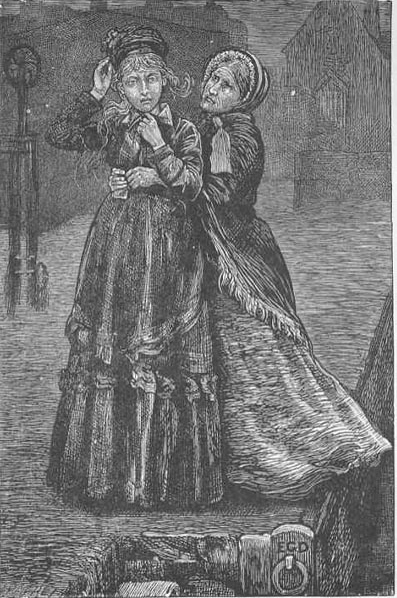

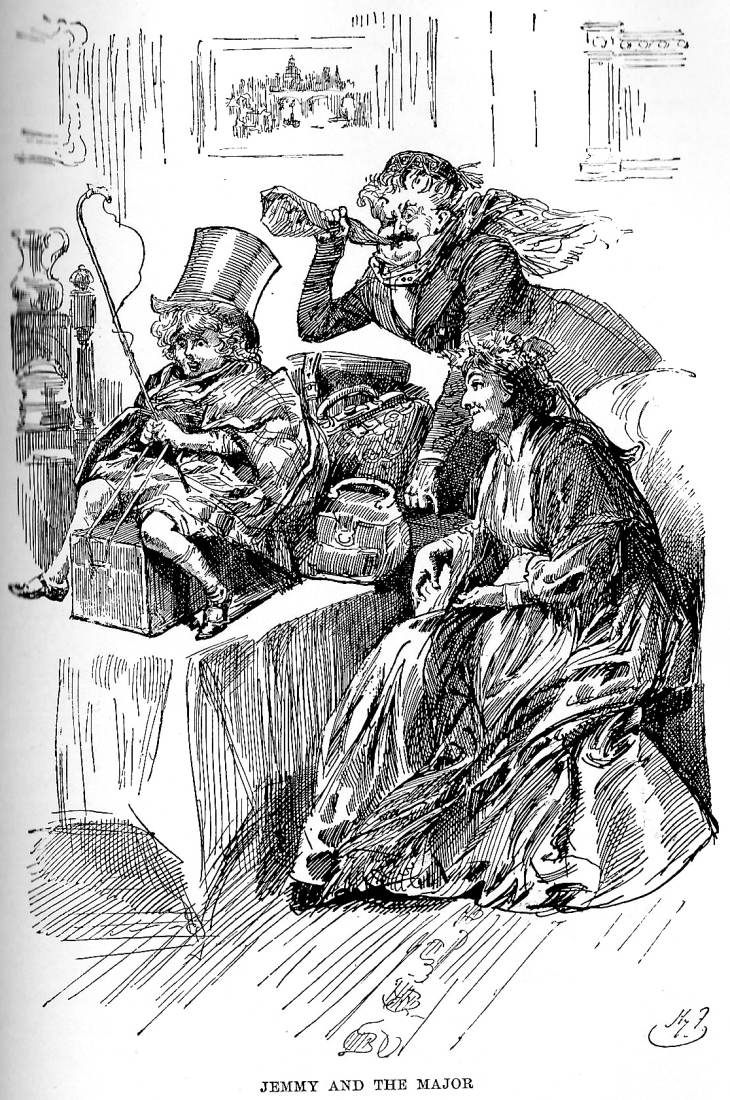
Left: E. G. Dalziel's Mrs. Lirriper's Lodgings (1868). Centre: Sol Eytinge, Juniors's Mrs. Lirriper and The Major (1867). Right: Harry Furniss's energetic character study, Jemmy and the Major (1910). [Click on the images to enlarge them.]

Above: E. A. Abbey's 1876 engraving of the sentimental passage describing the death of Jemmy's mother in "She prayed a good good prayer and I joined in it poor me." [Click on the image to enlarge it.]
Bibliography
Bentley, Nicolas, Michael Slater, and Nina Burgis. The Dickens Index. New York and Oxford: Oxford U. P., 1990.
Darley, Felix Octavius Carr. Character Sketches from Dickens. Philadelphia: Porter and Coates, 1888.
Davis, Paul. Charles Dickens A to Z: The Essential Reference to His Life and Work. New York: Facts On File, 1998.
Dickens, Charles. The Uncommercial Traveller and Additional Christmas Stories. Illustrated by Sol Eytinge, Junior. The Diamond Edition, XIV vols. Boston: Ticknor and Fields, 1867. Vol. XIV.
Dickens, Charles. Christmas Stories from "Household Words" and "All The Year Round". Illustrated by Townley Green, Charles Green, Fred Walker, F. A. Fraser, Harry French, E. G. Dalziel, and J. Mahony. The Illustrated Library Edition. London: Chapman and Hall, 1868, rpt. in the Centenary Edition of Chapman & Hall and Charles Scribner's Sons (1911). 2 vols.
Dickens, Charles. Master Humphrey's Clock and Additional Christmas Stories. Illustrated by F. O. C. Darley. in the Hurd and Houghton (New York) 55-vol. Household Edition, 1870.
Dickens, Charles. Christmas Stories. Illustrated by E. A. Abbey. The Household Edition. 16 vols. New York: Harper and Brothers, 1876. Vol. V.
Dickens, Charles. Christmas Stories from "Household Words" and "All the Year Round". Illustrated by E. G. Dalziel. The Household Edition. 22 vols. London: Chapman and Hall, 1877. Vol. XXI.
Dickens, Charles. Christmas Stories. The Charles Dickens Library Edition. 18 vols. London: Educational Book Co., 1910. Vol. XVI.
Thomas, Deborah A. Dickens and The Short Story. Philadelphia: U. Pennsylvania Press, 1982.
Vann, J. Don. Victorian Novels in Serial. New York: Modern Language Association, 1985.
Created 2 November 2015 Last updated 20 July 2026