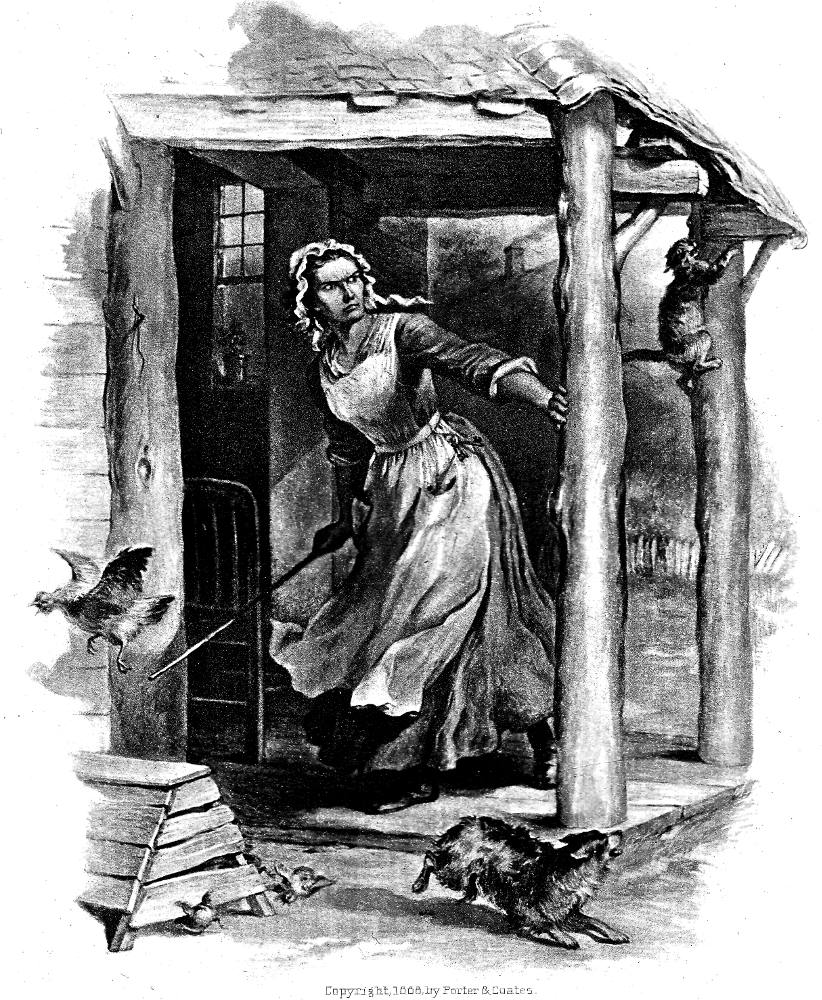
Mrs. Gargery on the Ram-page
Felix O. C. Darley
1888
Photogravure
12.4 cm by 9.9 cm (5 by 3 ¾ inches) vignetted
F. O. C. Darley's Character Sketches from Dickens, No. 5.
[Click on image to enlarge it.]
Scanned image and text by Philip V. Allingham.


[Victorian Web Home —> Visual Arts —> Illustration —> F. O. C. Darley —> Next]
Mrs. Gargery on the Ram-page
Felix O. C. Darley
1888
Photogravure
12.4 cm by 9.9 cm (5 by 3 ¾ inches) vignetted
F. O. C. Darley's Character Sketches from Dickens, No. 5.
[Click on image to enlarge it.]
Scanned image and text by Philip V. Allingham.
My sister, Mrs. Joe, with black hair and eyes, had such a prevailing redness of skin that I sometimes used to wonder whether it was possible she washed herself with a nutmeg-grater instead of soap. She was tall and bony, and almost always wore a coarse apron, fastened over her figure behind with two loops, and having a square impregnable bib in front, that was stuck full of pins and needles. She made it a powerful merit in herself, and a strong reproach against Joe, that she wore this apron so much. Though I really see no reason why she should have worn it at all; or why, if she did wear it at all, she should not have taken it off, every day of her life. . . . .
“Mrs. Joe has been out a dozen times, looking for you, Pip. And she’s out now, making it a baker’s dozen.”
“Is she?”
“Yes, Pip,” said Joe; “and what’s worse, she’s got Tickler with her.”
At this dismal intelligence, I twisted the only button on my waistcoat round and round, and looked in great depression at the fire. Tickler was a wax-ended piece of cane, worn smooth by collision with my tickled frame.
“She sot down,” said Joe, “and she got up, and she made a grab at Tickler, and she Ram-paged out. That’s what she did,” said Joe, slowly clearing the fire between the lower bars with the poker, and looking at it; “she Ram-paged out, Pip.”
“Has she been gone long, Joe?” I always treated him as a larger species of child, and as no more than my equal.
“Well,” said Joe, glancing up at the Dutch clock, “she’s been on the Ram-page, this last spell, about five minutes, Pip. She’s a-coming! Get behind the door, old chap, and have the jack-towel betwixt you.” [Chapter II]
Darley did not include any of the novel's female characters in his two frontispieces for the two-volume Sheldon and Company Great Expectations (1861). This vigorous portrait of Pip's severe sister may represent a piece that he developed as a possible frontispiece, but rejected almost three decades before the publication of his folio of photogravures entitled Character Sketches from Dickens (1888). Published without commentary or text, the image of Mrs. Joe, caught in the midst of the action on her front porch, requires that the reader supply the "Text Illustrated." Darlay implies her "ram-paging" nature by the rooster and the dog whom she has terrified as she sweeps out of the door, looking for the errant Pip. Ironically, since she dominates the action of the early chapters of the novel, that she makes relatively few appearances in the various programs of illustration (1860-1910) is rather surprising.
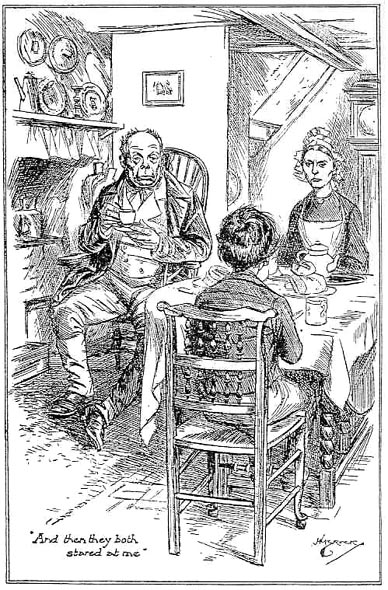


Left: H. M. Brock's study of the twin dictators of Pip's childhood, his sister and Uncle Pumblechook: And then they both stared at me (1901). Centre: In the first American serialisation, periodical illustrator John McLenan emphasizes Uncle Pumblechook's self-importance: "Leave this lad to me, Ma'am; leave this lad to me." (22 December 1860). Right: Sol Eytinge, Junior, in the Diamond Edition depicts Mrs, Joe berating her much-put-upon husband: Joe Gargery and Mrs. Joe< (1867).
Darley, Felix Octavius Carr. Character Sketches from Dickens. Philadelphia: Porter and Coates, 1888. [Folio of prints]
Davis, Paul. Charles Dickens A to Z: The Essential Reference to His Life and Work. New York: Facts On File, 1998.
Dickens, Charles. Great Expectations. Il. John McLenan. Harper's Weekly: A Journal of Civilization 4 (8 December 1860): 773.
_______. Great Expectations. Illustrated by F. O. C. Darley. Volume 1. The Household Edition. New York: James G. Gregory, 1861.
_______. Great Expectations. Illustrated by John McLenan. Philadelphia: T. B. Peterson, 1861.
_______. Great Expectations. Illustrated by Marcus Stone. The Illustrated Library Edition. London: Chapman and Hall, 1864.
_______. Great Expectations. Illustrated by Sol Eytinge, Junior. Diamond Edition. 14 vols. Boston: Ticknor & Fields, 1867. XIII.
_______. Great Expectations. Illustrated by F. A. Fraser. Volume 6 of the Household Edition. London: Chapman and Hall, 1876.
_______. Great Expectations. Illustrated by F. W. Pailthorpe. London: Robson & Kerslake, 23 Coventry Street, Haymarket, 1885.
_______. Great Expectations. Volume 19 of the Edition de Grande Luxe. Ed. Richard Garnett. London: Merrill and Baker, 1900.
_______. Great Expectations. Illustrated by H. M. Brock. Imperial Edition. 16 vols. London: Gresham Publishing Company [34 Southampton Street, The Strand, London], 1901-3.
_______. Great Expectations. Illustrated by A. A. Dixon. Collins Pocket Edition. London and Glasgow: Collins' Clear-Type Press, 1905.
_______. Great Expectations. Illustrated by Harry Furniss. Charles Dickens Library Edition. 18 vols. London: Educational Book Company, 1910. Vol 14.
_______. Great Expectations. Illustrated by Edward Ardizzone. Heritage Edition. New York: Heritage Press, 1939.
Created 26 February 2014 Last updated 12 July 2026