

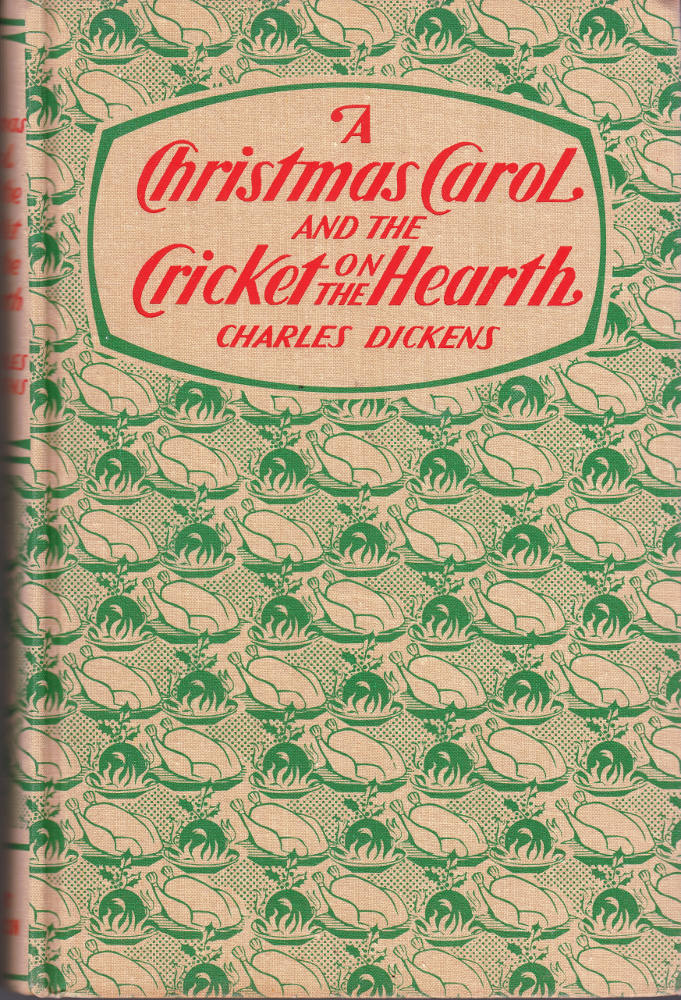
"He had been Tim's blood horse all the way from church": the covers for the 1905 Dent edition. [Image.] Framed lithograph 12.3 by 7.9cm (4 ¾ by 3 ¼ inches).
Commentary: The Hungry Forties and The Christmas Books
The ghosts of Christmas Past, Christmas Present and Christmas Yet to Come are with us still as we turn the pages of this unforgettable Christmas Book of Dickens. These Christmas pieces, as examples of story-telling 'in the fashion of the old nursery tales', have become a part of the tradition of England and Christmas. A Christmas Carol is set in the London of more than a century ago, when poverty and starvation were often the lot of the unfortunate, a London Dickens knew well and tried to reform in this and other books. In this city of cobbled streets, which could mete out such cruelty to those dependent on its charity, Dickens understood the feeling which animated the Bob Cratchits and Tiny Tims of its narrow ways. The depth of his belief in them as the salt of the earth deserving much better of the world made Scrooge's conversion completely convincing.
The Cricket on the Hearth is not so well known [as A Christmas Carol]. Dickens gave the book the subtitle 'A Fairy Tale of Home'. It is an example of the fantasy element that was never long absent from Dickens's imagination when directed towards Christmas. [Alexander H. Williamson's commentary on the fly-leaf for both Christmas Books]
Note
The dust-cover identifies both novellas as part of a series intended for children: "The Children's Illustrated Classics." "This volume is number 59 in the series."
Scanned images and text by Philip V. Allingham. [You may use these images without prior permission for any scholarly or educational purpose as long as you (1) credit the person who scanned the images and (2) link your document to this URL in a web document or cite the Victorian Web in a print one.]
Bibliography
Dickens, Charles. A Christmas Carol and The Cricket on the Hearth. Edited by Alexander H. Williamson; illustrated by C. E. [Charles Edmund] Brock. London: J. M. Dent, 1905; New York: Dutton, rpt., 1963.
Created 31 March 2026