

n October 1817, William Swainson (1789-1855), a London-born customs clerk turned naturalist and adventurer, was heading toward Feira de Santana, in Brazil's Bahia region, when he noticed clusters of orchids blossoming amongst dense vegetation on a hillside. Stopping to investigate, he took many samples, boxed and shipped them to William Hooker (1785-1865), an entrepreneurial brewer with botanical interests in Suffolk. Among these specimens, writes Sarah Bilston in The Lost Orchid, a lavishly illustrated and detailed study of the Victorian craze for these exotic plants, was "almost certainly" (38) a bushy-rooted Cattleya labiata, a large, rare, and exceptionally beautiful variety of orchid. Hooker propagated it, and its beauty (and lovely scent) prompted a popular mania. Named for William Cattley, a merchant and collector, the fascinating Brazilian orchid came to the attention of orchid fanciers all over Britain after Cattley bankrolled an illustrated catalog in which the flowers prominently featured. With Victorian society in the throes of what came to be called "orchidomania," nurserymen were soon besieged by customers wanting Cattleyas of their own.
Which posed a problem, as the orchid was difficult to source and harder still to ship without damaging or killing it. Worse yet, no sooner had the flower been identified than it became shrouded in ambiguity. Few people had actually seen the orchid in situ; the specimens that had been shipped could also have been interbred with other varieties. No one could be sure that their orchid they had was the right one. As the ambiguity grew, a legend rose up, of the "lost orchid." Spurred by this intrigue (and the chance for a paid adventure), so-called orchid hunters returned repeatedly to Brazil over the course of the century. Their efforts culminated in a chase across Brazil in the early 1890s as several orchid hunters, employed by growers and investors, competed to find specimens of the elusive plant. With this book, Bilston shows how the import of these gorgeous organisms to Britain and elsewhere exemplified some of the worst excesses of Victorian imperialism, a "self-perpetuating cycle" (296, n. 14) in which plants were extracted from their original settings and brought to market in Europe and the United States via a process that exploited virtually every participant. "Understanding orchidomania," Bilston writes, "begins with tracing the networks of a globalizing world that advantaged some and exploited much and many" (7).
This beautifully designed book — even the endpapers are stunning, done in an appropriately hot pink — consists of four parts as well as a prologue and an epilogue. The first three parts, consisting of five or six chapters and roughly similar in length, are discursive sections in which Bilston enriches the adventure story of the hunt with excursions into the economics of nineteenth-century plant nurseries and the vicissitudes of marketing plants to Victorians. There are also interludes focused on botanical science, including a consideration of the role of the orchid in the founding moments of Victorian botany, and of the relevance, at mid-century, of the plant to Charles Darwin, who was fascinated by the Cattleya orchid's mysterious mechanism of pollination. Of particular interest is the insert of full-color plates showing early illustrations of Cattleya labiata as well as reproductions of the luscious advertisements with which Victorians were bombarded, stoking the desire to own these plants.

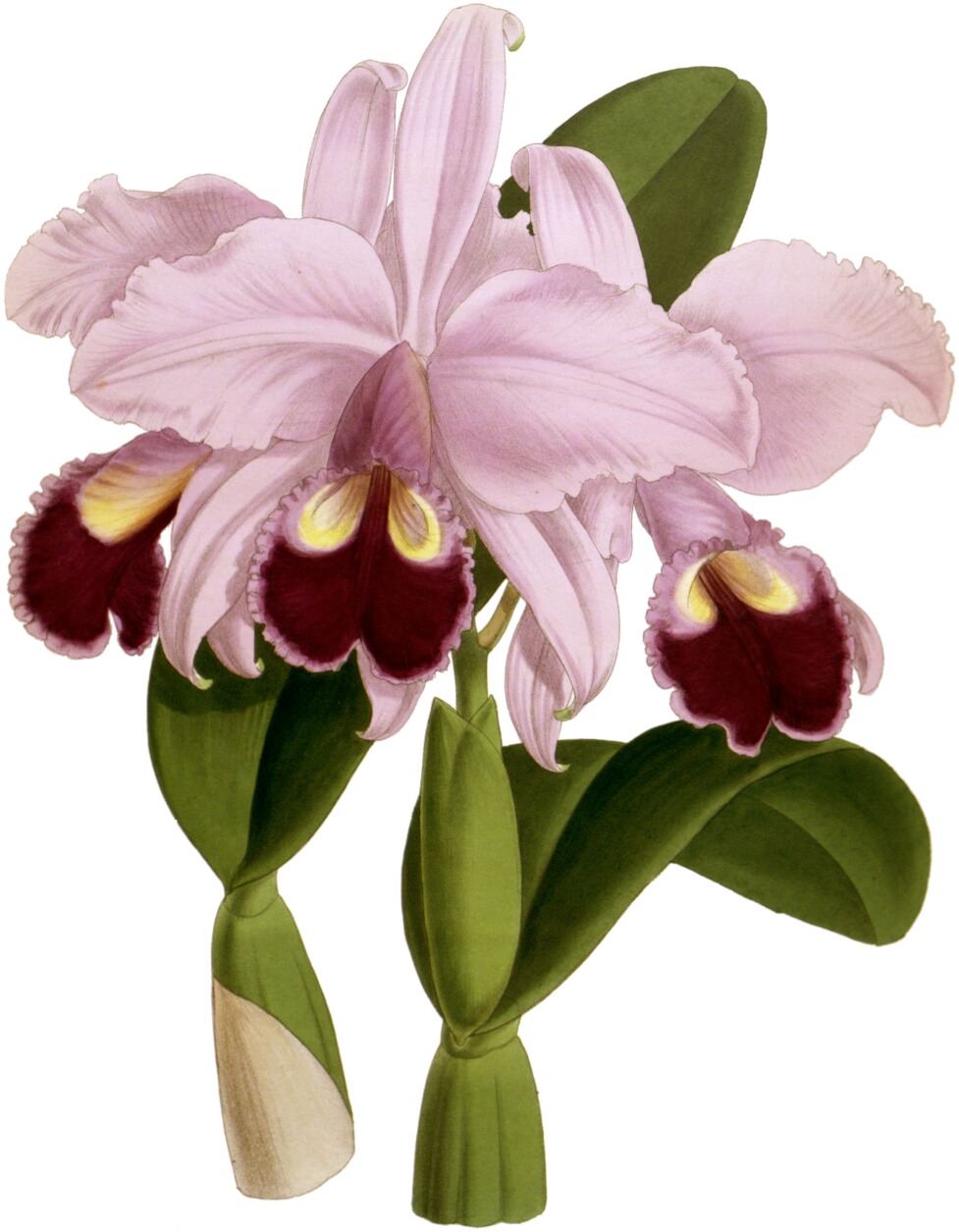
Left: "Cattleya Labiata, var. Measuriana." Chromolithograph by J.L. McFarlane, FRHS; from Frederick Boyle, The Woodlands Orchids Described and Illustrated with Stories of Orchid-Collecting. London: Macmillan, 1901. Page 142. Right: "Cattleya Labiata, Lindley." Chromolithograph by John Nugent Fitch. Plate 88 of Robert Warner, et al. The Orchid Album, vol. 2. London: B. S. Williams, 1883. Both images courtesy of Project Gutenberg. [Click the images to enlarge them.]
Bilston begins her story at nearly its chronological end, with the departure of Claes Ericsson, a Swedish "plant hunter," for Pernambuco, in northeast Brazil (1). Bilston describes his project and its backer, Sander & Co., one of several large nurseries competing for plant market dominance in Europe and North America. Bilston's first chapter, "Origins," also surveys nineteenth-century Pernambuco and its inhabitants while offering a brief history of European colonizers of the region. Brazil's diverse and varied flora and fauna were among the many desirable things these colonizers encountered. The remarkable orchid thrived at high altitudes and grew on many substrates — on other plants, even on stones — with its bright white roots visible and extended, the better to absorb the dew.
With the next chapter, "A Naturalist Arrives," Bilston rolls back in time several decades, to 1816, at the moment when Swainson, on his expedition to Pernambuco, first found the specimen that would arrive in Hooker's Suffolk nursery two years later. Bilton explores Swainson's relationships with local Portuguese authorities and explains how later British arrivals, like Swainson, worked their way into positions of trust and power within the colony's brutal plantation system, in which enslaved people were forced to work fields of sugarcane and cotton.
While Bilston's general intention is to show how orchidomania connected with the spoliation of Brazil, the pickings here, while intriguing, are somewhat slim. Swainson's arrival coincided with a slave revolt. It seems not to have bothered him much, at least not compared with the bowel illness he contracted around the same time. Both kept him from his orchid-seeking. He did write about the violence he witnessed, of both the revolt and the counter-revolt. But soon enough, he recovered his health sufficiently to box up his specimens and send them back to Britain, where their story continued, providing most of Bilston's material in the chapters that follow. Later on, Bilston notes that deforestation of Brazil made orchid hunting even more difficult and dangerous, as the loss of habitat made Cattleya specimens rarer than ever. For the orchid hunters who documented this devastation, the problem was not the rape of the ecosystem but what that did to their working conditions and their economic hopes (248-250).
Swainson's orchid finally arrived at Hooker's nursery in 1818. In the next chapter, "Trouble Brewing," Bilston offers insight into Hooker's frustrations as a scientific outsider with an incurable passion for plants. Hooker coupled this interest with his minute attentiveness to his specimens and their documentation. His description of the "lost orchid" on a herbarium specimen sheet, still extant at Kew, noted, in Latin, that the plant had blossomed under his care in 1818.
At which point, Swainson vanished, leaving behind a mystery along with his many debts. Chapter 4 catalogues those debts before returning to Hooker, whose prospects in the 1820s were on an upswing. He moved his family to Glasgow, having been offered a position as the Regius Professor of Botany at the university there. His orchids, too, were doing well. Two offsets, one in London and another with him in Glasgow, had bloomed. In the next chapter, "Old Antiquity," Bilston traces the path from these two specimens to a larger market. To do this, she shifts the focus to John Lindley (1799-1865), a horticulturist who sold plants and seeds from his family's nursery in Norwich. He too came into Hooker's orbit as well as that of Joseph Banks (1743-1820), the prominent London naturalist who hired Lindley to work in his herbarium. Spread across several luxurious rooms in Soho Square, the facility was effectively ground zero for the burgeoning "discipline of botany in Britain" (55).
Lindley didn't last long at Banks's place, but he eventually found a more secure position in Barnet, at the home of William Cattley, who maintained a large nursery that included one of Swainson's orchids. Lindley arrived just as that flower came into bloom. The section concludes with a chapter on Lindley's role in naming the orchid, a move that acknowledged Cattley's patronage while gesturing toward the web of meanings that were associated with orchidomania generally. "And so Lindley named the orchid," Bilston writes, and in the next breath deftly contextualizes this development, locating its significance in a larger Victorian impulse to name and define:
As George Eliot would put it, 'The mere fact of naming an object tends to give definiteness to our conception of it—we have then a sign that at once calls up in our minds the definitive qualities which mark out for us that particular object from all others.' The name Lindley chose for the genus -- Cattleya -- recognized his merchant patron; to designate Swainson's plant specifically, Lindley used the term labiata, referencing the orchid's pronounced crimson lip—and hinting perhaps that, from the very moment of '[marking] that particular object from all others,' Lindley correlated the orchid, soon to be the focus of such intense pursuit, with women, sexuality, and desire. (67)
So intense was the rage for orchids that the Cattleya could not be propagated fast enough, far enough to satisfy the massive demand. Substitutes and alternatives soon emerged, and they too competed to be recognized as the real thing. In Part II, "Exotic," Bilston traces the various attempts that Victorians made -- virtually, on paper, and in reality, on scientific voyages -- to come to grips with the orchid and its habits, including the ease with which it could be propagated, though not always with equally fabulous results. Along the way, Bilston also draws out the connection between the intensity of popular demand and the arrival of cheaply printed, mass distributed nursery catalogs, featuring sumptuous descriptions as well as increasingly beautiful and colorful floral illustrations. Chapter 10, "Orchids for the Million," delves into the marketing and advertising strategies that created and sustained the Cattleya as an object of desire for a wide swathe of the Victorian upper and middle classes.

Orchids so captured the imagination that they even appeared in objects intended for personal adornment, such as this hair comb designed by René Lalique (1860-1945). Orchid Comb, Paris. c. 1902.. [Click the image to enlarge it.]
In the third part of The Lost Orchid, Bilston turns her attention to the business and science of Victorian horticulture. Ambitious Victorian businessmen sought advice from expert botanists, notably Hooker, on the best way to go about plant hunting in Brazil. But there were other options for making a play for extraordinary specimens. Those with neither the means nor the inclination to undertake such expensive and speculative ventures could instead invest in hybridization, the focus of Chapter 11. Though it was still suspect from a theological point of view, "hybridizing," or the blending of distinct species, "became increasingly popular in the nineteenth century," starting from its first use as a way to improve crops (135). But even horticulturalists struggled to raise orchids from seed, and the general problems of hybridization were as complex as any other part of the orchid business, as Bilston shows.
Of course hybridization and propagation were also of interest to Charles Darwin and his colleagues, and Bilston balances her focus on the adventurous orchid hunters with a consideration of the orchid as it figured in the more sedate world of Victorian plant research. The remaining chapters in this section deal with Darwin and his interest, which was passionate if not always clearly recognized by historians, in the Cattleya orchid. "In the early years of the 1860s," Bilston writes, "Darwin was staring down the barrel of a new problem. His great idea was out before the world, but the world was not convinced. It needed more; a new narrative, with evidence" (159). To find this narrative and the evidence for it, Darwin sought help from Joseph Dalton Hooker (1817-1911), son of William, who suggested to Darwin that perhaps the orchid could provide what he needed (159; 161). Darwin did not prove difficult to convince. "I much want a cattleyea [sic]," Darwin wrote to Hooker in the summer of 1861, a disarmingly frank (and charmingly misspelled) confession of longing that provides the title for Chapter 16. Bilston provides a clear and engaging discussion of Darwin's interest in the plants, tracing Darwin's unfolding understanding of the differences between British and Brazilian varieties as well as his observations with respect to their different forms and their reproductive functions. The morphology of Brazilian orchids, he noted, made it especially hard for insects to reach the pollen masses. To Darwin, the plant seemed "determinatively contrived" so that it "should never be fertilized" (qtd. on 164). Working on this problem through the spring of 1862, Darwin carefully studied how bees manage to fertilize these plants, resulting in his "orchid book," On the Various Contrivances by Which British and Foreign Orchids Are Fertilised by Insects (1862), in which he used his orchid studies to bolster his case for natural selection.
In the book's substantial final section, cheekily titled "Survival of the Fittest," Bilston pivots from the sedate world of Darwin's naturalist studies to the fast-paced adventures of late-century orchid hunters. The section consists of ten short chapters focused tightly on the search for the pink Cattleya as it heated up in the early 1890s. By this time orchidomania had gripped the public for decades, part of a wider enthusiasm for exotic plants to ornament the home and garden. Such exotic plants were a big business. Yet these fortunes were made, as Bilston shows, on the backs of enslaved people and at the cost of environmental degradration in places like Brazil, where the orchid hunters continued to rush in search of the elusive Cattleya. The transformation of the plant into a commodity is the theoretical focus of these pages, the ways in which marketing and advertising of the plant transformed it from a neutral, if lovely, biological object to the stuff of greedy dreams.
Links to Related Material
- The Horticultural Revolution
- "The Late Professor Lindley," Illustrated London News, 1865
- Orchid Comb by René Lalique, 1902
- "Orchids" (1896), a poem by Theodore Wratislaw
- A review of Elizabeth Hope Chang's Novel Cultivations: Plants in British Literature of the Global Nineteenth Century
Bibliography
[Book under review] Bilston, Sarah. The Lost Orchid: A Story of Victorian Plunder and Obsession. Cambridge: Harvard University Press, 2026. Hardcover. ISBN: 978-0-674-27260-6.
Created 17 August 2026
Last modified 18 September 2026