
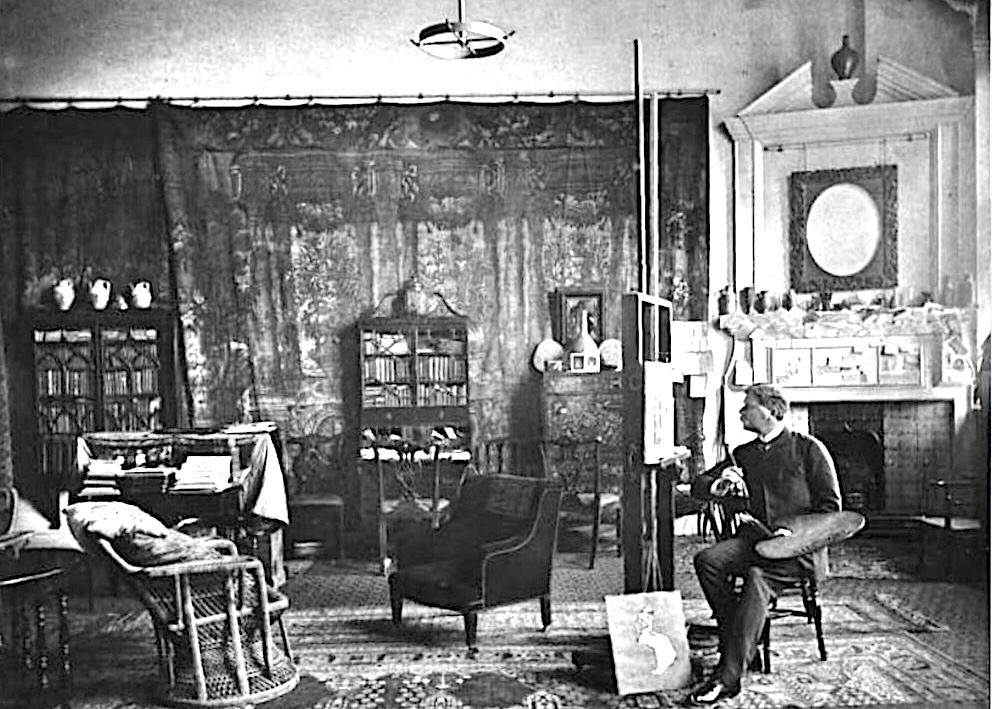
Marcus Stone, ARA, photo-engraving from a photograph by J.P. Mayall (1839-1906). Source: Stephens, facing p. 28.
The artist is shown at work in his studio, a conventional enough scenario. But Stone had put a great deal of thought into planning the room, and was proud of the result. Its north-facing oriel windows, high dormers, white woodwork and sheer length took care of light and perspective: as for the latter, it also had folding doors opening into a glasshouse. No wonder Stone saw it as the first studio that really allowed the artist to paint as if he was outdoors. Then, it catered for all his particular needs as a history painter: the furniture and fittings shown above were not typically Victorian, but had been carefully selected to represent different periods. Further thought had gone into the heavy tapestry hangings seen at the back here; and just outside the studio, we learn, there was a great costume wardrobe (see Dakers 166-67).
Image download, caption and formatting by Jacqueline Banerjee. You may use this image without prior permission for any scholarly or educational purpose as long as you (1) credit the person who scanned the image and (2) link your document to this URL. [Click on the image to enlarge it.]
Links to Related Material
- Marcus Stone, RA (1840-1921): Painter and Illustrator
- Marcus Stone's home at 8 Melbury Road, Kensington (exterior views)
Bibliography
Dakers, Caroline. The Holland Park Circle. New Haven and London: Yale University Press, 1999.
Stephens, F. G. Artists at Home. New York: Appleton, 1884. Google Books. Free to read. Web. 22 March 2026.
Created 22 March 2026