
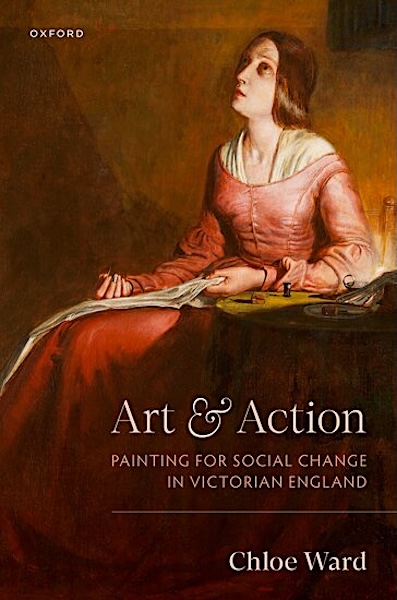
Front cover of the book under review (showing Richard Redgrave’s The Sempstress).

he phrase “social painting” might well evoke the horrors of Socialist realism, as it was practised in the Soviet Union under Stalin; fortunately, its application to Victorian art is extremely different, and can even include some of the best-loved works of the period (or, at least, some of the most famous). A Senior Lecturer in the History of British Art at Queen Mary, University of London, Chloe Ward very convincingly describes and analyses the various discourses which flourished in nineteenth-century England in relation to the consequences which the enjoyment of art was supposed to have on our attitudes and behaviours.
Even though Ruskin is often mentioned in her book, Carlyle is even more present: while the author of Sartor Resartus was no art critic, he definitely had a considerable influence on a number of painters of his time, who adopted his ideas on the social role of thinkers (and artists) as prophets. Without necessarily sharing our ancestors’ belief in the material effects of art on society, Chloe Ward even goes as far as to show that narrative painting, though relegated to the status of non-art by modernist writers, was not only at the core of the aesthetic debates of the Victorian age, but that its transformative ambitions were actually echoed by later discourses which claimed to reject everything that reeked of the past. The volume is divided into four main chapters plus a conclusion, which follow a chronological order, the most fascinating case studies appearing in the last two chapters.

Illustration from the Children’s Employment Commission in 1842. [Click on this and the following illustrations for more information.]
The birth of Victorian social painting seems to coincide with the illustrated report of the Children’s Employment Commission in 1842. The engravings which accompanied this widely read publication caused a sensation, raising concerns not only for the health of the young miners, but also for their morality, because of the nakedness of female workers. Even though some people considered it wrong to appeal to the senses rather than to pure reason, the public outcry proved that pictures could awake the viewers’ capacity for compassion, and thus accelerate the pace of reform. As the illustrations of the 1842 publication were criticised for their lack of reliability, the following reports relied on text alone to convey their message, but “fine artists stepped in, finding answers to the critiques levied at social reportage through the artistic freedoms presented by the practices of painting” (19).
In the first months of 1844, Richard Redgrave’s The Sempstress was exhibited at the Royal Academy in 1844 (the original canvas was apparently lost and is now only known through its 1846 version, shown on the front cover of Ward's book, as seen above), the aim being to attract attention on the sad pledge of the “white slaves” of the millinery trade – rather than “millenary,” as spelt on page 14. Painting could overcome the objections addressed to the accuracy of journalistic illustrations, as high art could reach a greater reality, a higher degree of truth: suppressing the signs of dirt and disease, providing a “beautified – even beatified” (143) vision of the poor working-girl, Redgrave made her pledge as pitiable as possible by resorting to pathos, “simultaneously garnering sympathy for the individual while revealing that individual’s representativeness of a broader cause” (49) and therefore stimulating action against the social evil depicted.
Most probably in 1847, having recently come back from Italy, G.F. Watts produced his own highly topical Needlewoman, one of four social paintings which he only exhibited several decades later. A passionate reader of Carlyle, Watts was particularly sensitive to his denunciation of greed as the source of the gulf between the rich and the poor (later in his career, he would paint an allegory of Mammon, directly inspired by Past and Present). Chloe Ward uses Thackeray’s novel Our Street to confirm the dating of Watt’s canvases – even though Thackeray [spelt “Thackery” on four occasions…] had misinterpreted the background of Redgrave’s Sempstress (51), and even though the resemblance between Famine in Ireland and Fuseli’s Ugolino is not quite as striking as she claims (65-66). Ward contends that, far from being anomalies or exceptions in his career, Watts’s four social paintings already expressed the political and artistic philosophy which he displayed in his later works, for which he created a whole set of symbolical figures: The Minotaur was inspired by W.T. Stead’s “The Maiden Tribute of the Modern Babylon,” the artist being always ready to use the grotesque or the monstrous in order to enlist the imagination of viewers so as to compel them to reject sin and inspire an effort toward reform.
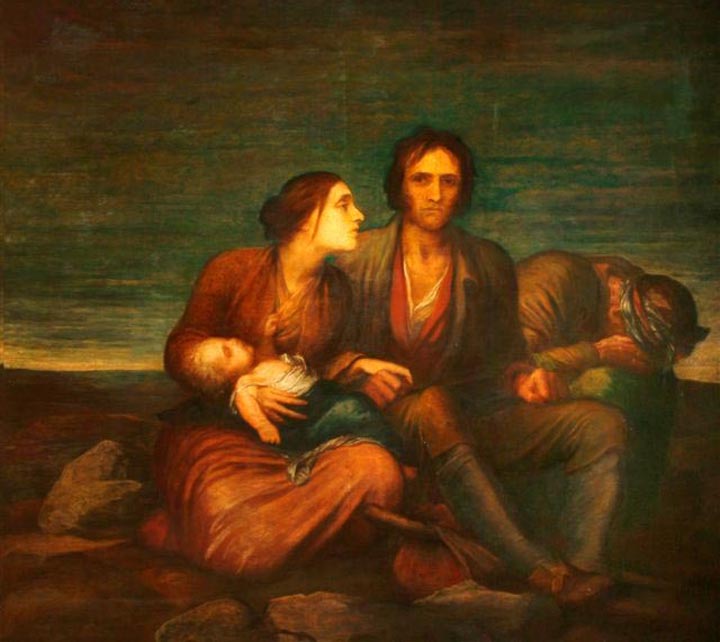


Paintings by G.F. Watts. Left: Famine in Ireland (1850). Middle: Mammon (1884-85). Right: Famine in Ireland (1896).
The third chapter is devoted to the action undertaken in the 1880s by Samuel Barnett, the vicar of Whitechapel, and his wife Henrietta, once a collaborator of Octavia Hill: they decided to offer art exhibitions to the inhabitants of their parish, a practise that would result in the creation of the Whitechapel Gallery in 1901. Influenced by Carlyle, F.D. Maurice and Matthew Arnold’s Culture and Anarchy, the Barnetts practised what they called “the nationalisation of luxury”: art should be shown where it could be admired by the greatest number, even in the East End, rather than in the private houses of millionaires. Without modifying the existing hierarchies of society, it was possible to alleviate the geographical divisions between classes. For Ruskin, art was a moral force; for the Barnetts, art was primarily a social force, which could improve lives, not just characters. Barnett himself being colour-blind, his approach to art was mainly intellectual and focused on the highest purpose of art. Watts lent many of his allegorical paintings to the Whitechapel exhibitions, the subjects of his works being obviously the expression of thoughts whose aim was to create ideas in the spectator.
The last chapter is devoted to the reaction of critics to the work which launched Luke Fildes as a painter, Casuals, or, to be precise, Applicants for Admission to a Casual Ward, a huge canvas showing, in front of a police station, “a queue of vagrants waiting for tickets to the workhouse’s temporary night shelter” (131). When it was exhibited at the RA in 1874, it went with a subtitle borrowed from a letter dated November 1855 in which Charles Dickens described the Whitechapel Workhouse: “Dumb, wet, silent horrors! Sphinxes set up against that dead wall, and none likely to be at the pains of solving them until the general overthrow” (quoted on page 132). The painting itself was based on Houseless and Hungry, an engraving Fildes had published in The Graphic in 1869, representing a scene he had witnessed several years earlier, the title being a phrase used by journalist James Greenwood, who had first-hand knowledge of vagrants, in his book Seven Curses of London, a “tract campaigning against the ill treatment and ill conditions endured by the urban poor” (149).


Two works by Luke Fildes. Left: Houseless and Hungry (illustration, 1869). Right: Applicants for Admission to a Casual Ward (oil painting, 1874).
When he had seen the picture in The Graphic, Dickens had hired Fildes to illustrate the never-to-be-completed Mystery of Edwin Drood. In the early 1870s, the young artist turned to painting, and Millais dissuaded him from exhibiting gloomy works. Nevertheless, Fildes and his colleagues at The Graphic, Frank Holl and Hubert von Herkomer, took the Royal Academy by storm with their realism.
When Casuals was exhibited, it was such a huge success that a barrier had to be erected before the canvas (as had been the case for William Powell Frith’s Derby Day some twenty years earlier). According to Chloe Ward, the critics were then divided into three categories, each having its own answer to the question whether extreme poverty could be a subject for a work of art. A first group thought Casuals was too ugly, that it showed criminals rather than vagrants, who could inspire no compassion to the viewer; there was no art in such a painting. For a second group, “beauty [would have been] redundant where human sympathy was so abundant” (159); the aim of art was not merely to please the eye, and Casuals made a direct appeal to charitable feelings, not mediated by picturesque beauty. Finally, a third group claimed to discern in the canvas a deeper form of beauty, enhanced by realism and favourable to human sympathy. Casuals proved that truth and art could coexist.
In 1914, Luke Fildes’s last social painting, The Doctor (RA 1891), was chosen by Clive Bell in “The Aesthetic Hypothesis” as a perfect example of non-art, “the emblem of falsely emotional Victorian pseudo-realism, rendering it the enemy of formal innovation that was by then actively promoted as art’s source of true emotion and meaning” (166). However, Bell’s conceptions, based on “significant form” and “aesthetic emotion,” might well have been inspired by Vernon Lee’s writings. Equally frustrated by Ruskin’s religious moralism and by Pater’s amoral formalism, Lee had decided that art did transform its viewers and improved their moral behaviour. Even though her theory of the physiological effects of art on the spectator’s body did not outlast her relation with Clementina Anstruther-Thompson, she later developed an appreciation of art in relation with its effect on our vitality, in relation of the German notion of Einfühlung, “to feel into,” translated as empathy. This brings us back to the “compassion” which Victorian artists aimed at arousing with their works — a satisfying note on which to conclude this thoughtful and thought-provoking discussion.
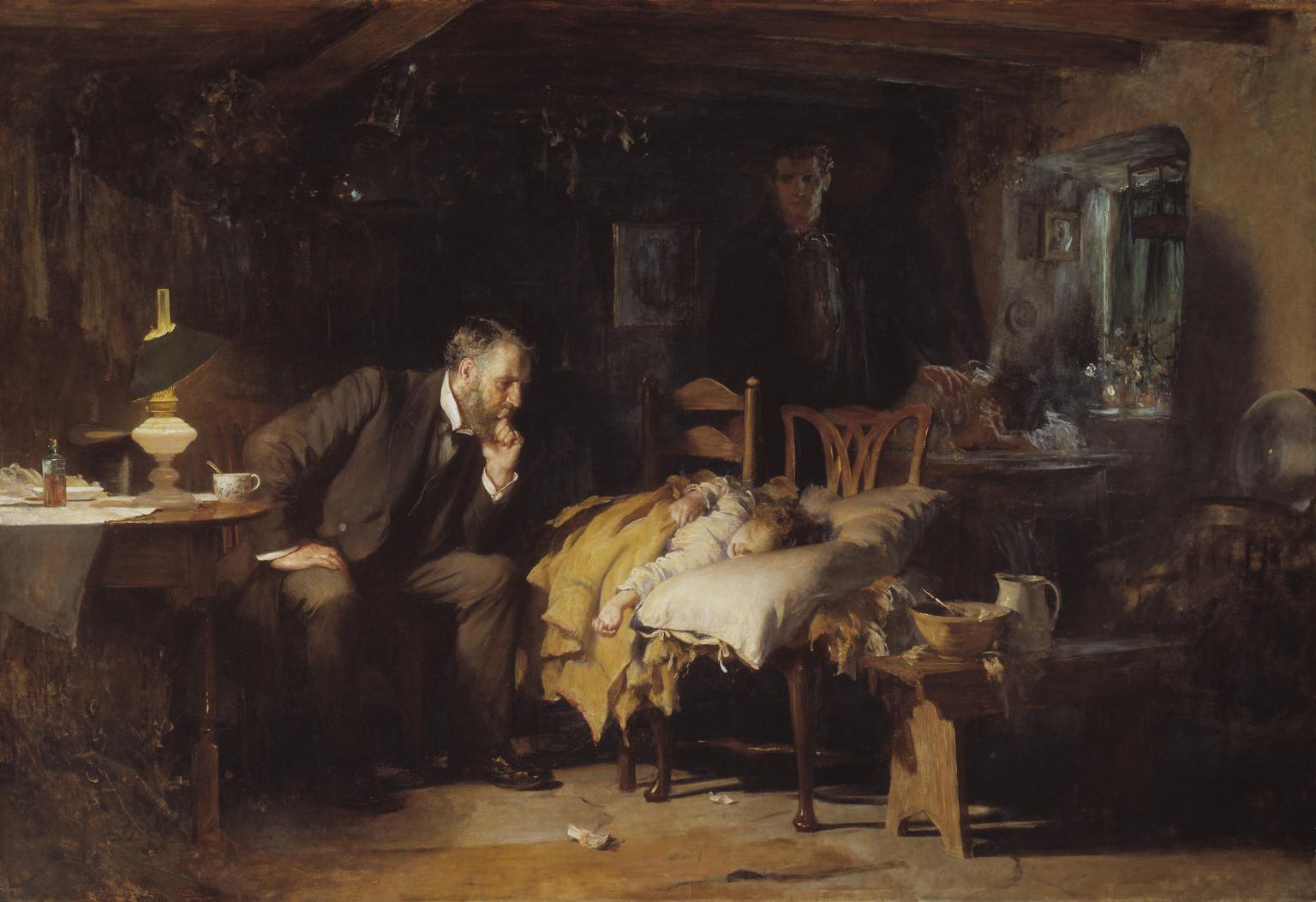
Fildes's The Doctor (1891).
Ward writes in her introduction,
Redgrave, Watts, the Barnetts, Fildes, and Lee were well known in their respective circles, but the ideas and writings they created or inspired had an out-size influence on wider public debates about both the purpose of art and methods of social reform. That said, the social theories associated with their work are rarely remembered today, evincing how little scholarship has been devoted to Victorian social painting, and how little of that has taken seriously its creators’ beliefs in the social purpose and potential political influence of their work. Far more familiar are the philosophies of socialist artists like William Morris, Walter Crane, C.R. Ashbee, and other members of the Arts and Crafts movement who promoted handcraftsmanship in the decorative arts as an antidote to pernicious factory labour practices. [3]
Ward has done much to correct this imbalance.
Bibliography
Ward, Chloe. Art and Action: Painting for Social Change in Victorian England. Oxford: Oxford University Press, 2026. hbk. (also available as an E-book). pp. 224. £81.00. ISBN: 9780198992806.
Created 30 October 2026