

A Summer Night by Albert Moore. 1884-1890. Oil on canvas. 52 x 90 inches (132 x 228.5 cm). Collection of the Walker Art Gallery, Liverpool, accession no. WAG 2125. Image courtesy of the Walker Art Gallery via Art UK under the terms of the Creative Commons Attribution-NonCommercial licence (CC BY-NC). [Click on this and the image below to enlarge them.]
Moore exhibited A Summer Night, another of his late masterpieces, at the Royal Academy in 1890, no. 487, and then later that year in Liverpool. The painting features four young women in an open balcony in various stages of undress, three of which are seated or reclining on an orange couch and the fourth on an inlaid chest, The foreground is a blue carpet upon which rest two vases, one of Japanese and one of Persian design. The background is most unusual for Moore, a moonlit lagoon reminiscent of a nocturne by his friend James McNeill Whistler. The painting is primarily an arrangement in grey and yellow. Robyn Asleson has discussed the development of this work in Moore's oeuvre.
In A Summer Night, Moore at last dissolved the shallowly placed background wall long conventional in his paintings and replaced it with interlacing floral garlands and the silvery filigree of an openwork trellis. His hermetic, artificially constructed world now opens up to an atmospheric prospect of nature, but one which closely parallels the human scene in the foreground. The floral garlands are mirrored by pale clouds festooning the dark sky above a placid sea. Light seems to spill from the curved hip of the reclining figure, charting a shimmering path across the water to the echoing silhouette of a distant island. The orange ranunculus blossoms dotting the upper left of the trellis are similarly reflected in tiny lights twinkling along the horizon below. Moore had made preliminary experiments in integrating idealized figures within naturalistic landscape settings in two paintings exhibited in 1888, A Riverside and Waiting to Cross. But the specific inspiration for the shimmering moonlit seascape in A Summer Night is very likely the nostalgically revisited sketch of the Lake District mentioned earlier, Moonlight — sketched near Ullswater in 1858, finished 1886. [188]
Asleson has also pointed out that the overall composition of A Summer Night appears to have been derived from the famous Portland vase in the British Museum: "The balanced composition and restful theme of the vase would have held obvious appeal for Moore, as would the elegant outline created by silhouetting pale figures in low relief against a dark background. Moore mimicked the use of two half-draped, bookend-like figures to frame a reclining woman with sharply angled arms" (185). The evolution of Moore's design can be seen based on a preliminary compositional sketch that shows Moore changed the position and/or direction of the various figures. At one time the ebony and mother-of-pearl inlaid chest held a more dominant position in the foreground. The preliminary sketch at the Walker Art Gallery shows Moore had already decided on primarily a colour arrangement of grey and yellow.
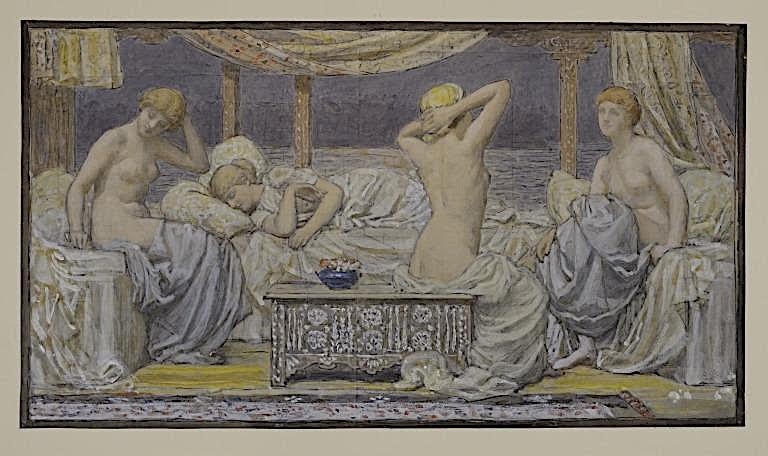
Study for A Summer Night. Watercolour on paper. 7 3/8 x 13 3/8 inches (18.8 x 34 cm). Collection of the Walker Art Gallery, accession no. WAG 8295. Image available to be shared, courtesy of the Walker Art Gallery.
Contemporary Reviews of the Painting
The painting was extensively reviewed when it was shown at the Royal Academy, but to very mixed reviews. Clude Philips in te Academy felt this work was highly successful and once again lamented that Moore had not been elected to his rightful place as a Royal Academician:
Mr. Albert Moore in our opinion attains a very high measure of success – assuming this and this only to be his stand-point – in his large and beautiful decoration, A Summer Night (487). On a terrace or balcony of rich and altogether fanciful design – made fresh and beautiful by hanging decorations of closely interwoven pansies of a pale yellow tint, and opening out upon a moonlit blue-grey sea – lie the half-draped rosy forms of statue-like women, with blonde rippling tresses loosely bound. Their draperies, and those of the couches upon which they recline are steely blue, pale primrose, or a more positive shadow of yellow; subtle connecting touches being provided by vases of green faience and other similar gear. The whole makes up an enchanting harmony – or, if you will, symphony – in which nocturnal blue, of every shade, and yellow are the main ingredients – or motives. It is the hand of a master of decoration, who has woven them into cunning and seemingly natural combinations of perfect balance. English-born limners possess undoubtably many admirable qualities, but this particular subtlety of colour harmony is not, as a rule, one of them; and no artist of purely British origin has the same mastery over the keyboard of tints and tones as is achieved by Mr. Albert Moore. That such a painter, whatever may be the limitations of his art, should persistently be excluded from the ranks of the Academicians, while that august body contains so many crude, perfunctory, and unspeakably tiresome practitioners, is a riddle, the solution of which had, perhaps, better not be attempted. [326]
Claude Philips, this time in The Art Journal, gave a remarkably similar review to his previous one in the Academy, finding the work a feast for the eye:
Albert Moore, on the other hand, achieves an unquestionable success in his large and beautiful decoration, A Summer Night. It is a decoration, and nothing more, but as such it is exquisitely harmonious, and in its masterly weaving together of rare tints affords, as do very few other things in the galleries, a genuine feast to the eye. On classical couches, draped with steely blue, primrose, and deeper yellow draperies, lie in varied and harmonious attitudes several half-nude and wholly statuesque female forms, with blonde tresses loosely bound; the magnificent balcony or terrace on which they lie, breathing the air of the summer night;, is decorated with long woven wreaths of pale yellow pansies, and looks out upon a moonlit, altogether conventionalised sea; subtle touches of green and other tints in vases and similar gear almost imperceptibly complete the harmony. This might – if we adopt the well-worn, Whistlerian phraseology – be called a symphony, whose first theme is steel-blue, whose second is primrose; the two, with their tributaries, being woven together into artful combinations, in which the hand of the genuine master can be traced. [164]
F.G. Stephens in The Athenaeum considered this a fine piece of decoration but had a number of concerns, especially with the lighting:
A Summer Night (487), by Mr. A. Moore, marks an effort, as considerable as it is honourable, on the part of one of our ablest artists to prove that he is capable of painting as well as ever. If he works thus ambitiously he will by-and-by deserve success greater than attends this picture of four semi-nude damsels imperfectly grouped, whose sculpturesque faces, isolated attitudes, and academical graces attest the influence of Greek statuary upon the artist. His notions of composition seldom rise above the principles of design inevitable in bas-relief. The figures are illuminated in an inexplicable manner, and from the front, but so that, although the illumination is bright, it casts no shadows to speak of – compare the shadows of the limbs and that of the Persian jar conspicuous in the foreground. The lighting of this interior is quite inconsistent with that of the landscape, against the brilliance of which the figures ought to stand out in much darker tones. Apart from this, Mr. Moore's work is remarkable for its style, the attitudes and easy grace of the girls, the beauty of their mannered faces, and the elevated types adopted throughout. The vermiculated flesh (due to coarse stippling) is a mistake in taste as well as in fidelity to nature; but the morbidezza at large of the nude forms inclines to the development of a fine style, which is very welcome at all times, and especially so when very different technical methods obtain popularity.
Reading Stephens's review further it is obvious he did not understand Moore's principles of geometric construction for his compositions. "The grace of the girls redeems the lack of composition in the picture and the bad arrangement of its dominating lines, which, it is evident, was never thought out by the artist. The picture is really an exercise in bright yellow, blue, and white, with the carnations, and such help as certain accessories of divers colours can afford to a fine and ambitious piece of decoration" (677-78).
A reviewer for The Builder found the picture decorative but of no intellectual interest: "Mr. Albert Moore's A Summer Night (487) is one of the largest and most elaborate of his paintings of women who have nothing to do but look decorative; we look from a terrace under a verandah festooned with yellow flowerets, on to a twilight sea; three or four women, half nude, half draped in saffron drapery, recline or sit in indolent attitudes on couches with a delicately designed stuff; it is very harmonious in its way, but totally devoid of intellectual interest" (356). The Building News did not find Moore's colour harmonies entirely successful: "Albert Moore in a Summer Night (487), is in a decorative scheme and key of colour – a symphony in yellow and grey. Under a loggia adorned by festoons of pale primroses, and facing a moonlit sea, five maidens, half-clad with diaphanous yellow draperies, recline on orange-coloured couches, the figures being set off by the grey moonlight sea of leaden hue. The harmony is indeed a rather trying one, and one figure doubtful in drawing" (648).
M. H. Spielmann in the Magazine of Art found the picture both beautiful and a scholarly design: "Mr. Albert Moore's A Summer Night is another picture of unusual merit and beauty – a decorative work in his well-known manner. These four maidens, sitting and reclining on a couch – a symphony in pink and predominating yellow – is as admirable in pose and drawing as in composition. Mr. Moore has never done anything better than the painting of the back that has turned to the spectator, and the drawing of the hands. The pity is, however, that the artist cannot correct the objectionable granular quality and dryness of his painting, the prerogative, surely, of fresco; but these are minor considerations in presence of so beautiful and scholarly a design" (258).
The critic of the Spectator, likely D. S. MacColl, considered the work a failure on many levels:
Albert Moore this year challenges criticism with a much larger work than usual, and unfortunately, because the scale of the picture brings out the defects of his method (A Summer Night No. 487). Mr. Moore always works on lines independent of popular approval, and by his own artistic instinct, which is considerable. He has done fine things in his time, but this is not one of them. The critic seems often glad to apply the adjective "decorative" to work like this, and pass on, absolved from further responsibility. "Decorative," however, is properly applied to paintings in which the amount of nature admitted is limited by some outer condition, that of the setting or surroundings of the painting. The alternative limit is the purely inner one of design, of pictorial pleasantness and coherence. The general reference to nature in work like Mr. Moore's is so slight, that it is by this test of self-justification or self-contradiction that he must be judged. And our quarrel with the picture in question is that while its general aim is not naturalistic, its methods in some parts are, and that not successfully. If they succeeded, there would be incoherence; as they fail, there is laborious ineffectiveness. The flesh painting, for instance, is to no purpose either of realization or of pleasantness. Either a simpler process should have produced something non-imitative but pleasing, or all this stippling should have made something which, if ugly, was like flesh. The unholy black of the sky, again, combined with the yellow of the pansies, is in itself unpleasant, therefore not decorative, nor has it the imperfect excuse of being natural. In parts of the picture, however, and chiefly in the foreground, there is fine colour. [694]
A reviewer for the Saturday Review found the work startling, if not precisely beautiful:
Albert Moore, although trained in a very different school, distinctly possesses intellectual affinities with Sir Frederick [sic] Leighton. It is many years since Mr. Moore has exhibited so large and important a composition as A Summer Night (487), or one which has been carried so far. In this work a group of women recline in various attitudes on an open terrace, which looks out on an expanse of sea, with an island and the twinkling lamps of a town in the distance. Outside it is night; but these "Primrose dames" – for everything about them is a pale yellow – or illuminated, one knows not how, by a light like the light of day. The draperies which hang about are of a primrose paleness, the cushions and sofas being upholstered with a deeper and more golden yellow. About their heads hangs a trellis-work of pale yellow pansies and golden ranunculuses. A great bunch of honesty stands in a green pot; some of the ornaments are inlaid with mother-o'-pearl. One needs to be very fond of primrose-yellow not to find the colour, on so large a scale, a little garish. Nor are the figures, it seems to us, painted with such a delicacy as Mr. Moore once possessed. At one time he suggested more than he now gives us, and in going further with him on the road of finish, we fare worse. Nevertheless, this is an important work. [568-69]
Bibliography
"Art. The Royal Academy." The Spectator LXIV (17vMay 1890): 693-95.
Asleson, Robyn. Albert Moore London: Phaidon, 2000. 184-89.
Baldry, Alfred Lys. Albert Moore. His Life and Works. London: George Bell and Sons, 1893. 63-64.
Blackburn, Henry. Academy Notes XVI London: Chatto and Windus (May 1890): 15.
"Further Notes on Academy Pictures." The Builder LVIII (17 May 1890): 355-57.
Philips, Claude. "Fine Art. The Royal Academy." The Academy XXXVII (10 May 1890): 325-26.
_____. "The Summer Exhibitions at Home and Abroad." The Art Journal LII (1890): 161-74.
The Pictures at the Royal Academy." The Building News LVIII (9 May 1890): 647-48.
"The Royal Academy." The Saturday Review LXIX (10 May 1890): 568-69.
Spielmann, Marion H. "Current Art. The Royal Academy." The Magazine of Art XIII (1890): 253-60.
Stephens, Frederic George. "Fine Arts. The Royal Academy." The Athenaeum No. 3265 (24 May 1890): 677-81.
Study for A Summer Night. National Museums Liverpool. Web. 5 October 2026.
A Summer Night. Art UK. Web. 5 October 2026.
Created 13 December 2004
Last modified 5 October 2026