
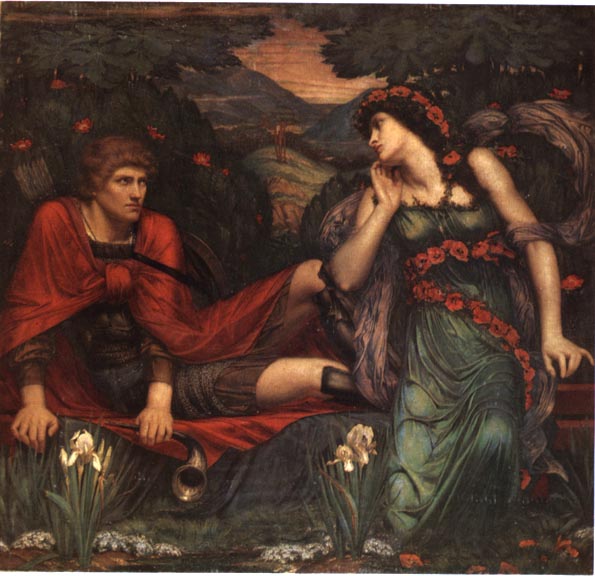
Venus and Adonis or Venus and Mars by Sidney Harold Meteyard (1868-1947). Oil on canvas. 41 1/2 x 43 1/2 inches (105.5 x 110.5 cm). Private collection. Image courtesy of Sotheby's, London. [Click on the image to enlarge it.]
This work has been variously known as Venus and Adonis or Venus and Mars, although the first title seems much more appropriate. The painting appears to be based on Shakespeare's poem "Venus and Adonis" rather than the earlier, quite different, version of the tale as told in Book X of Ovid's Metamorphoses. In Shakespeare's poem, Venus, the goddess of Love, falls in love with the handsome young hunter Adonis and attempts to seduce him. Kneeling beside him, and gazing at him, she talks of love; he, however, is not interested in love and would prefer to go hunting. She prevents him from doing so and then tells him she wants to meet him again the next day. He responds by informing her that he will go boar-hunting instead, and insists on doing so, taking no heed of her warning that she has had a vision in which he is killed by a boar. The vision is fulfilled, and the subsequent discovery of his body plunges Venus into profound grief.
In Meteyard's painting the young man has a quiver of arrows slung across his back and he carries a hunting horn in his left hand — accoutrements more suggestive of the hunter Adonis than the warrior Mars, although he does wear armour and a red cloak, and has a shield slung around his left shoulder. Venus is dressed in a green classical gown with purple drapery fluttering in the wind. She wears a crown of red poppies, which continue in a girdle which reaches down her body to her left thigh.
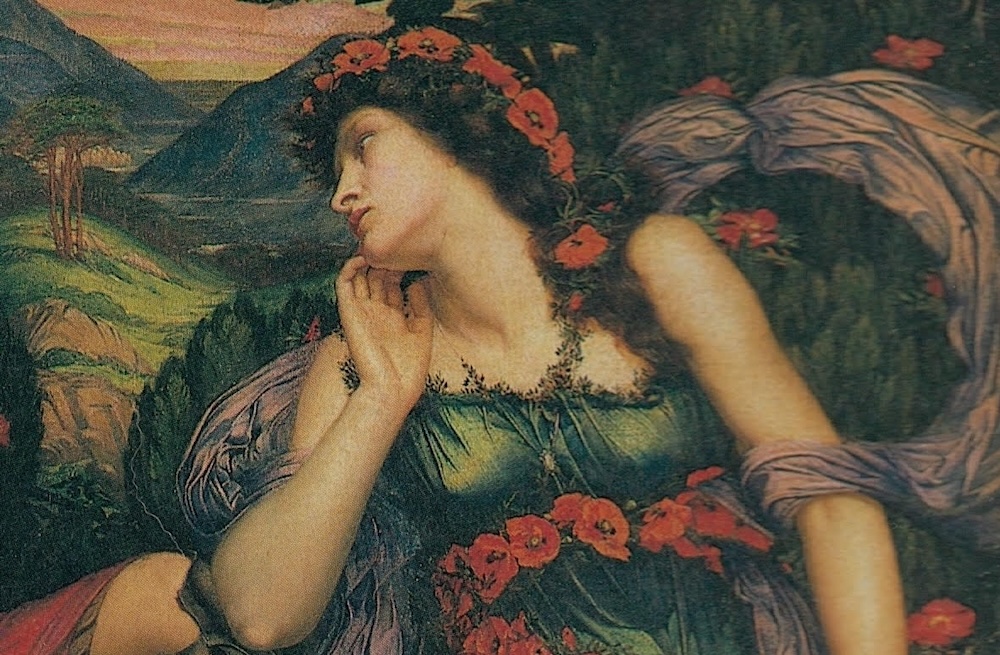
Closer view of Venus.
Probably these flowers were chosen for symbolic rather than simply decorative purposes. While red roses would seem more fitting for the story of Venus and Adonis, since they symbolize intense love and passion in the Victorian language of flowers, poppies could also be relevant here in a prophetic role, because of their association with mourning and death. Meteyard is less likely to have had in mind the use of red poppies in the Christian tradition, at Easter, to represent passion. The yellow irises in the foreground, however, can also symbolize passion.
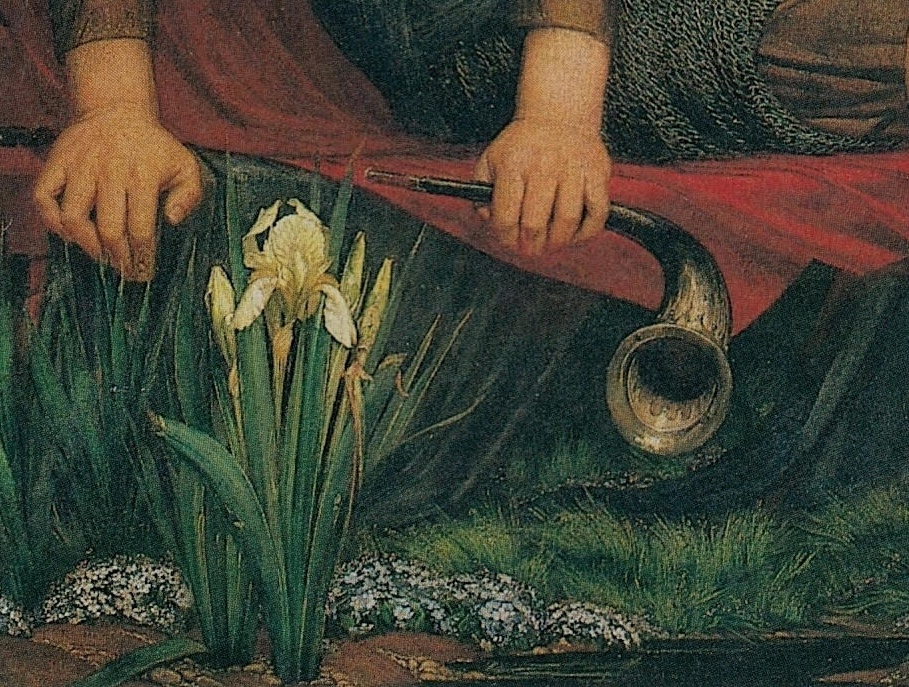
Detail — Adonis's hunting horn, and the irises.
Venus and Venus and Adonis are shown in the countryside with bushes and trees in the midground and a rocky landscape and hills in the background.
Bibliography
Christian, John. Burne-Jones and his Followers. Tokyo: Isetan Museum of Art, 1987, cat. 56, 135.
Highly Important Victorian Paintings and Drawings. London: Sotheby's Belgravia (18 April 1978): lot 54, 28-29.
Nineteenth Century European Paintings and Drawings. London: Sotheby's (19 June 1990): lot 70, 134-35.
Wood, Christopher. Olympian Dreamers, Victorian Classical Painters 1860-1914. London: Constable & Co. Ltd, 1983. 200.
Created 13 December 2004
Last modified (new images and commentary added) 23 March 2026