
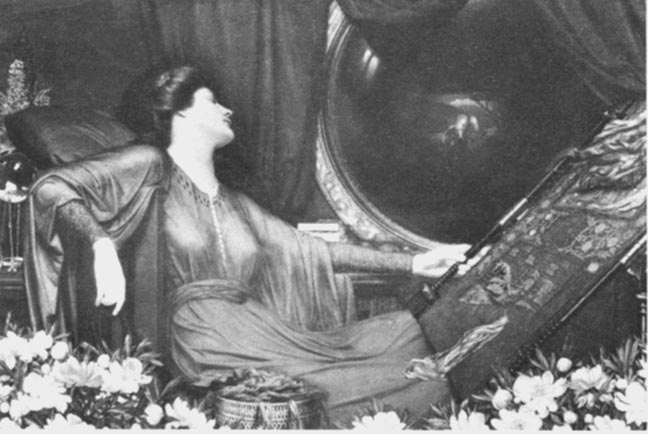
"I Am Half-Sick of Shadows," Said the Lady of Shalott. 1913. Oil on canvas. 30 x 45 inches (76 X 114 cm). Private collection on loan to the Birmingham Museum and Art Gallery. Image courtesy of the Birmingham Museum and Art Gallery. [Click on the image to enlarge it.]
This painting was exhibited at the Royal Academy in 1913, no. 909. It is considered the artist's masterpiece, particularly because of its sumptuous colour, which John Christian attributes to Meteyard's experience of working in stained glass and enamels (109). The model for the Lady was Meteyard's future second wife Kate Eadie. The subject is based on Alfred Tennyson's poem "The Lady of Shalott" first published in 1832 but then significantly revised for a later edition in 1842, which is now considered the standard version. Meteyard's title comes from the last two lines in the fourth stanza of Part II of the poem:
But in her web she still delights
To weave the mirror's magic sights,
For often thro' the silent nights
A funeral, with plumes and lights
And music, went to Camelot:
Or when the moon was overhead
Came two young lovers lately wed;
"I am half sick of shadows," Said
The Lady of Shalott.
Meteyard's painting features the lady clad in blue in a languid pose with her eyes closed and holding on to her embroidery frame with her left hand. Elizabeth Nelson has contrasted Meteyard's painting with a similar work by John William Waterhouse and has pointed out how Meteyard's version differs from many of the more conventional representations of the story:
Sidney Harold Meteyard's painting of the same subject and title, "I am Half-Sick of Shadows," Said the Lady of Shalott, differs entirely from Waterhouse's; Meteyard's art emphasizes the sensual mood of the Lady's newly awakened sexual desire. Meteyard confines his empowered Lady in a narrow, cramped space in which her semireclining figure, her tapestry, and her mirror fill the picture plane. His use of predominantly blue hues, the color of the mirror in the poem, further heightens the intense sensual atmosphere. Leaning back against satin pillows, with closed eyes and head turned away from the viewer, the Lady appears to be lost in erotic reverie. Her tapestry contains a picture of Lancelot, whom she has not yet seen. The magic mirror in the background, with its blue-gray tonality, has the characteristics of a crystal ball in which the young lovers appear as in a vision, an imaginary bridge between the picture of Lancelot and herself. The mirror does not reflect an image of the real world as a mirror should; and in fact since Meteyard makes no reference to the exterior world or to the world of nature in the mirror, he apparently reverses the original meaning and function of the mirror so that it reflects the Lady's thoughts rather than causes them. [9]
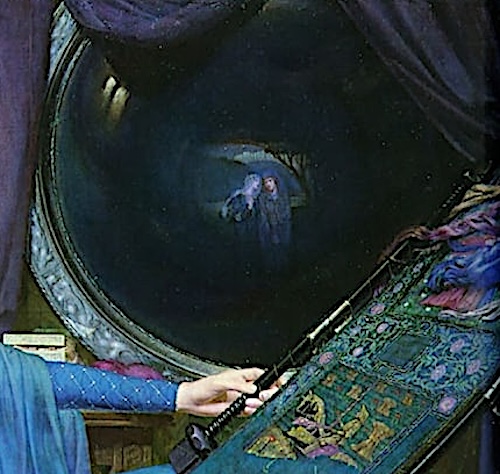
Closer view of the mirror and part of the embroidery frame.
Nancy Marshall and Stephen Wildman also discuss the ways in which Meteyard's painting differs from other more conventional paintings based on Tennyson's poem:
His best-known work is the 1913 "I am Half Sick of Shadows," Said the Lady of Shalott … is a languidly haunting scene showing the Lady of Alfred Tennyson's poem asleep at her accursed task of reproducing in tapestry all that she sees from her tower window via a mirror reflection. This subject proliferated among the Pre-Raphaelites and later nineteenth-century British painters, but Meteyard distinguished his version by replacing the usual loom with a piece of embroidery, on which we see the lady working in parts rather than producing the sequential imagery of a weaving. This enhances the image of the Lady as a creative artist able to revise and edit her work rather than being constrained merely to reproduce the narrative as she sees it pass by her window; in this light she is more of an agent, perhaps even a generator, of her own destiny. The Lady's slumber conflates the mirror with her dreams, suggesting that her pining for a mate is the catalyst that will lead to the moment of her story more often portrayed, when she looks directly at the beauty of Lancelot riding into her reflected view. This defiant act brings down her curse, and she dies while floating down the river to Camelot in her boat; there, reversing the act of looking, Lancelot gazes at her now-dead body. [3]
Meteyard has obviously been influenced by the Pre-Raphaelites here. Christian points out that the large circular mirror may derive from Holman Hunt's versions of this subject, or perhaps Edward Burne-Jones's well-known portrait of his daughter Margaret seated in front of a convex mirror (109). As Marshall and Wildman suggest, the subject of the Lady of Shalott was a favourite of artists within the Pre-Raphaelite circle, particularly pictures of her at her loom or of her dying and floating in her boat down to Camelot. Holman Hunt's versions of the Lady's mirror cracking include not just the wood engraving for the Moxon Tennyson in 1857 but also his two oil versions, the small one which dates to c.1887-92, and the large version which dates from c.1888-1905. Elizabeth Siddal's pen-and-ink drawing of the Lady at her loom and the mirror cracking dates to 1853. John William Waterhouse's I Am Half-Sick of Shadows was completed in 1915. Like Meteyard's version, it depicts the moment when the Lady glimpses the "two young lovers lately wed." In Waterhouse's version, however, the Lady is sitting upright with eyes open and gazing dreamily, her hands crossed behind her head. Meteyard produced another quite different version of The Lady of Shalott in tempera on paper.
Related Material
Bibliography
Christian, John. The Last Romantics. The Romantic Tradition in British Art. London: Lund Humphries, 1989, cat. 86, 109.
Marshall, Nancy Rose and Stephen Wildman. "Sidney Harold Meteyard." Yellow Nineties 2.0. ed. Lorraine Janzen Kooistra. https://1890s.ca/wp-content/uploads/meteyard_bio.pdf
Nelson, Elizabeth. "Tennyson and the Ladies of Shalott. " Ladies of Shalott: A Victorian Masterpiece and its Contexts. Providence: Brown University Department of Art, 1985, 7 & 9.
Wood, Christopher. The Pre-Raphaelites. London: Weidenfeld Nicholson, 1981. 140
Created 13 December 2004
Last modified (new images and commentary added) 23 March 2026