
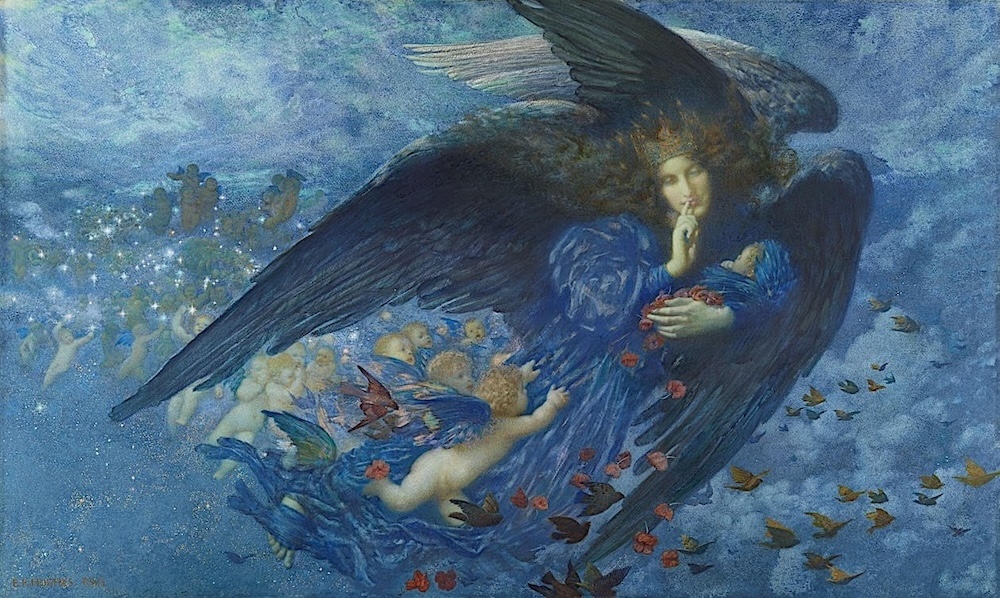
Night with her Train of Stars and her Great Gift of Sleep (Night with her Train of Stars). 1912. Watercolour, gouache and chalk, heightened with gum arabic and gold medium, on paper. 29 ¾ x 49 inches (75.5 x 124.5 cm). Collection of the Birmingham Museum and Art Gallery, image © Birmingham Museums Trust, reproduced under the terms of the Creative Commons 0 - Public Domain. [Click on the images on this page to enlarge them.]
This exceptional work, described by Diana Johnson as "a touching and sentimental Victorian Allegory on death" (71), is generally regarded as Hughes's masterpiece. It was shown at the Summer Exhibition of the Royal Society of Painters in Water Colours in 1912, no. 199. The painting derives its title from William Ernest Henley's poem "Margaritæ Sorori," numbered XXXV in his Echoes, and which expresses an acceptance of death and dying. The last two stanzas read,
The sun,
Closing his benediction,
Sinks, and the darkening air
Thrills with a sense of the triumphing night —
Night with her train of stars
And her great gift of sleep.
So be my passing!
My task accomplish'd and the long day done,
My wages taken, and in my heart
Some late lark singing,
Let me be gather'd to the quiet west,
The sundown splendid and serene,
Death.
Victoria Osborne has explained the symbolism of the picture: "The figure of Night bringing sleep is thus also a personification of Death bringing oblivion, and the child she cradles in her arms represents the departing soul. She scatters poppies from her hand, reinforcing the association between sleep, oblivion and death. This correlation between sleep and death – the implication that the oblivion of sleep prefigures that of death, and that death can in turn be seen as eternal sleep – was not a new one, but the dividing line between the two states became particularly blurred in Symbolist art. Hughes's personification of Night/Death is enigmatic yet reassuring, holding the sleeping child tenderly to her breast and smiling a soft, mysterious smile" (86-87).
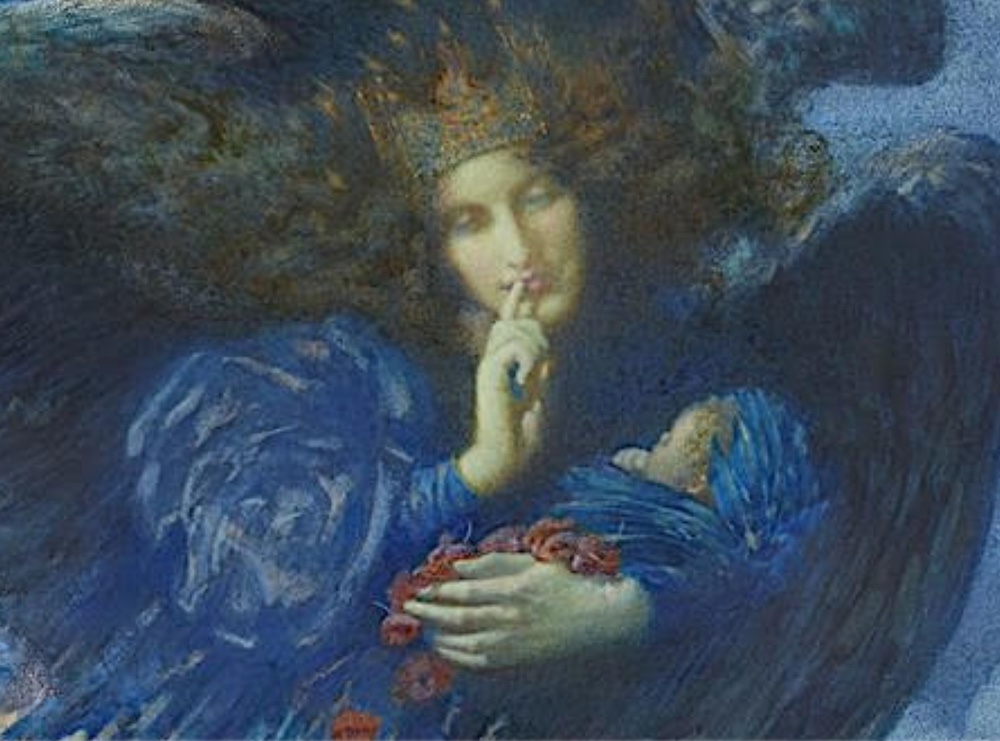
The picture shows the crowned and winged figure of Night symbolizing Death (shown more closely above), clad in a blue gown with her right index finger at her lips evoking quiet and her left hand clutching red poppies which spill from her grasp. She is surrounded by a train of winged dead infants and preceded by a flock of birds. Birds could be interpreted as symbolic of the soul's spiritual transition, an ascension towards an afterlife from the physical world. John Christian points out that the poppies, a symbol of oblivion and death, recall D. G. Rossetti's Beata Beatrix and T. C. Gotch's painting Death the Bride, while the dead infants recall William Holman Hunt's The Triumph of the Innocents (95). Hughes's work, like Hunt's, "served, in this period of shockingly high infant mortality, to solace and reassure an audience too frequently confronted with the harsh reality of a child's death" (Johnson 71).
Night with her Train of Stars also recalls the symbolic works of G.F. Watts such as his The Messenger or Death Crowning Innocence. Colin Cruise has pointed out as well that the principal figure of Night recalls the personifications of Night and Sleep in the late drawings and watercolours of Simeon Solomon (182). Osborne sees, in particular, the influence of the work of the French Symbolist artist Lucien Lévy-Dhurmer, whose work Hughes could have known through exhibitions at the Society of British Pastellists in London (87). Osborne also feels the central figure of Night in Hughes's watercolour draws on several prototypes, among them Burne-Jones's watercolour Night of 1870 depicting a floating figure against a deep blue sky studded with stars; she suggests, however, that the most direct precedent may be Arthur Hacker's A Cry in Egypt of 1897, which "provides a source for the horizontal composition and the personification of Death as a winged female figure clasping a child to her breast" (87). Hughes's figure of Night, as she smiles, puts her finger to her lips in a gesture that recalls the figure in Fernand Khnopff's painting Silence of 1891. As Osborne points out this is central to an interpretation of this watercolour: "It is through the central motif of the finger pressed to the lips that Night with her train of stars can be seen as, in one sense, the most quintessentially Symbolist of Hughes's watercolours. Through her simple gesture, in that ambiguous moment where one day is transformed into another, Night exhorts not only the putti but the viewer to be still and receptive to the possibility of revelations – to realities that lie beyond the visible world (89).
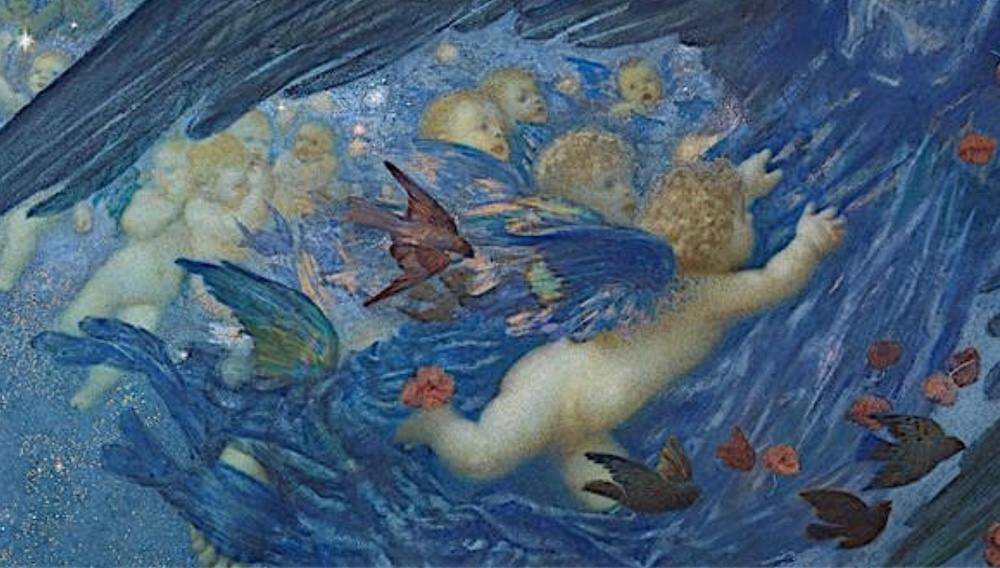
Closer view of the plump, curly-haired little putti, some of them clinging to Night's flowing robe, with birds flying around them, and poppy-heads falling from Night's hand — as they do in Evelyn De Morgan's Night and Sleep of 1878. The feathers at the edges of the puttis' wings are iridescent, with touches of brighter colours. — added by JB
Osborne has also commented on Hughes's use of blue tonality in his works, that this use of a "predominantly blue tonality became almost a trademark from 1902" (84). When the watercolour was shown at the Royal Society of Water Colours exhibition in 1912 a critic for The Onlooker drew specific attention to the work's colouration, identifying it as "another of those harmonies of deep, luminous blues of which [Hughes] seems to have the secret" (qtd. in Osborne 84).
Bibliography
Christian, John. The Last Romantics. The Romantic Tradition in British Art. London: Lund Humphries, 1989, cat. 49, 95.
Cruise, Colin. Love Revealed: Simeon Solomon and the Pre-Raphaelites. London: Merrell, 2005.
Johnson, Diana L. Fantastic Illustration and Design in Britain 1850-1930. Bulletin of Rhode Island School of Design LXV (April 1979), cat. 121, 71.
Night with her Train of Stars and her Great Gift of Sleep (Night with her Train of Stars). Birmingham Museums Trust. Web. 12 May 2025.
Osborne, Victoria Jean. "A British Symbolist in Pre-Raphaelite Circles: Edward Robert Hughes RWS (1851-1914)." M. Phil. thesis, University of Birmingham, 2009. 84, 86-89.
"The Royal Society of Water Colours Exhibition." The Onlooker (27 April 1912): 146.
Created 12 May 2026