
XXXV
I.M.
Margaritæ Sorori
A LATE lark twitters from the quiet skies:
And from the west,
Where the sun, his day's work ended,
Lingers as in content,
There falls on the old, gray city
An influence luminous and serene,
A shining peace.
The smoke ascends
In a rosy-and-golden haze. The spires
Shine and are changed. In the valley
Shadows rise. The lark sings on. The sun,
Closing his benediction,
Sinks, and the darkening air
Thrills with a sense of the triumphing night —
Night with her train of stars
And her great gift of sleep.
So be my passing!
My task accomplish'd and the long day done,
My wages taken, and in my heart
Some late lark singing,
Let me be gather'd to the quiet west,
The sundown splendid and serene,
Death.
1886
["Echoes," pp. 168-69]
This moving poem of reconciliation to death was the inspiration of E.R. Hughes's best-known painting, "Night with her Train of Stars and her Great Gift of Sleep," shown on the right here.
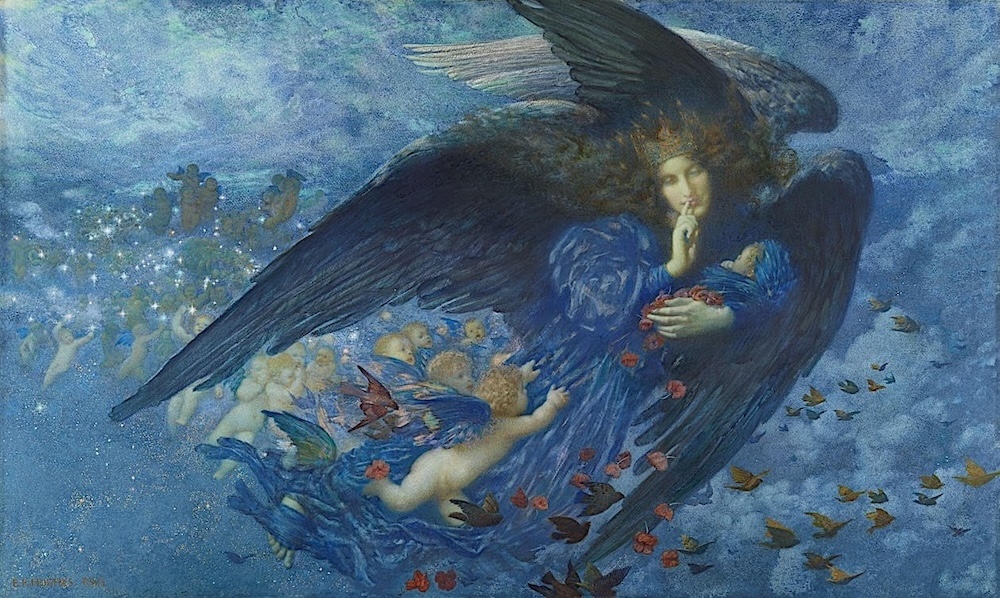
The great Victorianist Jerome Buckley called the poem "poignant" (91), and drew attention to Henley's effective and even revolutionary adoption of free verse here, pointing out that "in the 1870's this form was quite as much an innovation as the pattern of Henley’s first 'Ballade à double refrain.’ There was little else like it in English.... Its only structural analogy in nineteenth century poetry is, I believe, to be found in the descriptive passages of Heine's Nordee" (91-92). Buckley makes a convincing case for Heine's influence on Henley, while at the same time reminding the reader that "every free poem by definition must be a law unto itself; it must create its own tempo" (93).
The poem is dedicated to the memory of "Sister Margaret" — not the Henleys' little girl Margaret, as some sources say (she died in 1894), but his wife's sister Margaret, who died earlier, and after whom their daughter was probably named. The cadences here are certainly part of the poignant effect, evoking almost a slide or swoon or indeed soft flight into the depths of the one great sleep for which we are all destined. To go with a knowledge of having done one's best, still appreciating the beauty of the world, yet secure in the prospect of being gathered to a greater peace, is in itself a wonderful reward for a life well lived. — Jacqueline Banerjee
Bibliography
Buckley, Jerome. William Ernest Henley. London: Humphrey Milford, Oxford University Press, 1945.
Henley, W.E. Poems. I. London: David Nutt, 1908. Internet Archive, from a copy in Stanford University. Web. 12 May 2026.
Created 12 May 2026