
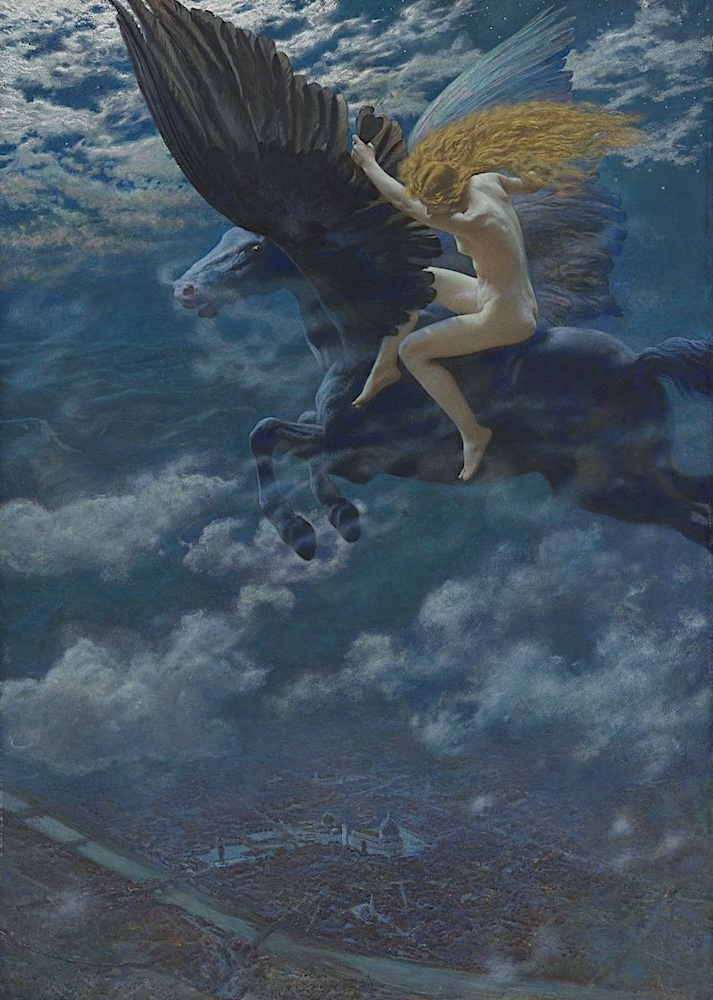
A Dream Idyll (A Valkyrie). 1902. Gouache and pastel on paper. 43 1/4 x 31 1/8 inches (109.5 x 79 cm). Private collection, image courtesy of Sotheby's, New York. [Click on the image to enlarge it.]
Hughes exhibited this work at the Royal Watercolour Society in 1902, no. 22. It was subsequently lent to the Louisiana Purchase Exhibition, the St. Louis World's Fair in 1904, no. 372, and then to the Franco-British Exhibition in London in 1908. When initially exhibited this picture bore the title A Dream Idyll and only later did it become known as A Valkyrie. Confusingly, it has also been referred to under the title The Witch. One would have thought the portrayal of a Valkyrie as a nude figure on a horse would be unusual. In Norse mythology, ihe Valkyries were divine female figures who selected the bravest warriors slain in battle who were worthy to enter the afterlife in Valhalla, ruled by the god Odin. Valkyries were powerful female figures, frequently shown as winged or horse-riding maidens, but they were generally portrayed clothed in armour, helmets and shields and not nude. Once in Valhalla the fallen warriors would become members of Odin's force, the Einherjer, who would fight for him against the giants in the final battle at the end of the world at Ragnarok.
When this watercolour was sold at Sotheby's, New York, in 2009 their specialists described the work and its connection to the Symbolist Movement:
Against an indigo sky, a nubile rider grasps the black wings of a flying steed, her body gleaming in the moonlight, her golden tresses let loose in the wind as she peers down at the stony structures of a city built along a river many miles below. Is this a goddess of antiquity, a fairy, a captured princess? This allusive, seductive, strange, Symbolist scene by Edward Robert Hughes immediately captivated audiences upon its 1902 exhibition at the London's Royal Watercolour Society…. Though dating in the decade following Symbolism's sweep through British galleries and exhibition halls, A Dream Idyll is a relatively early experiment in the style for Hughes, and one he would return to in works like The Valkyrie's Vigil (1909) and Burne-Jones' aesthetics are particularly present in A Dream Idyll with the delicate and otherworldly detachment of its mysterious female, its play with contrasting shapes and volumes, compositional space, and shifts in perspective…. The pegasus' great black, feathered wing shimmers with moonlight, extending out to the viewer at top-beat propelling the beast forward, soon revealing its rear legs and tail now cropped from view. The creature's physical effort is revealed in the wispy vapor streaming from his nose and mouth. The rider's ethereal skin stretches over a lithe body, its glowing, reflective tone a contrast to the supple, dark coat of her mount. The great blue-black, massive void of the atmosphere laced with a multitude of gauzy clouds and sparkling stars surround the flying pair, appearing to recede infinitely into the background while the landscape seen in miniature appears many miles below. The effect is breathtakingly vertiginous: save for the barely discernable bridges and buildings on the ground, there are few stable points of reference for the viewer. Overall, with his Dream Idyll, Hughes, like many master Symbolists, succeeds in creating an aesthetic mood rather than a particular story…. Such a question reveals that, ultimately, Dream Idyll as its title suggests, was intended to serve as a starting point for the imagination, a way to bring out what was hidden in the subconscious.
Contemporary Reviews of the Painting
The major review of this picture when it was shown at the Royal Society of Painters in Water Colours in 1902 was by a critic from The Builder:
Among the larger works of the year is one of importance both in subject and in style of execution. It represents a kind of work seldom undertaken in water-colour and seldom seen at the exhibitions of the Society. This is Mr. E. R. Hughes' large and striking picture entitled A Dream Idyll (22), in which a black winged horse soars in the air in a moonlight sky, above the domes and turrets of a city seen below. On his back sits a nude figure of a beautiful woman with long yellow hair streaming behind her on the wind. No meaning or legend is assigned to the "picture""; it is simply a tour de force of execution, and as such most remarkable. The figure is finely and firmly drawn and modelled; the light effect is most powerfully managed, the nearer wing of the flying horse, between the spectator and the moon, being dark, the further wing shimmering in full moonlight, which also falls full on the nude figure, brought out in startlingly bright contrast to the dark steed. The effect of the moonlight and the fleecy clouds is also given with great power and reality. Whether the result on the spectator's mind is commensurate with the ability displayed — whether so much brilliant workmanship was worth bestowing on such a mere fantasy — may perhaps be questioned; but of the splendid success of the execution there can be no doubt. [544]
When the painting was shown in the British Section at the St. Louis World's Fair in 1904 Isidore Spielmann in the Journal of the Society of the Arts praised the painting:
A Valkyrie, by Edward R. Hughes, R.W.S. This Valkyrie leaves her Valhalla, and is soaring above a city formerly the scene of strife and heroism, but now at rest from warfare and asleep in the moonlight. The artist intends her to seem peering into the depths from the back of her winged war-horse, as though she had a great longing to live with mortals in their beautiful city, through whose heart flows for ever a life-giving river. [400-01]
Related Material
Bibliography
19th Century European Art including British Paintings. New York: Sotheby's (22 October 2009): lot 37. https://www.sothebys.com/en/auctions/ecatalogue/2009/19th-century-european-art-including-important-british-paintings-n08580/lot.37.html
Huish, Marcus Bourne. British Water-Colour Art. London: Adam and Charles Black, 1904. 140.
"Modern Water-Colour Art," The Builder LXXXIII (13 December 1902): 543-44.
Spielmann, Isidore. "The British Art Section of the St. Louis Exhibition," Journal of the Society of the Arts LIII (3 March 1905): 389-403.
Created 6 May 2026