
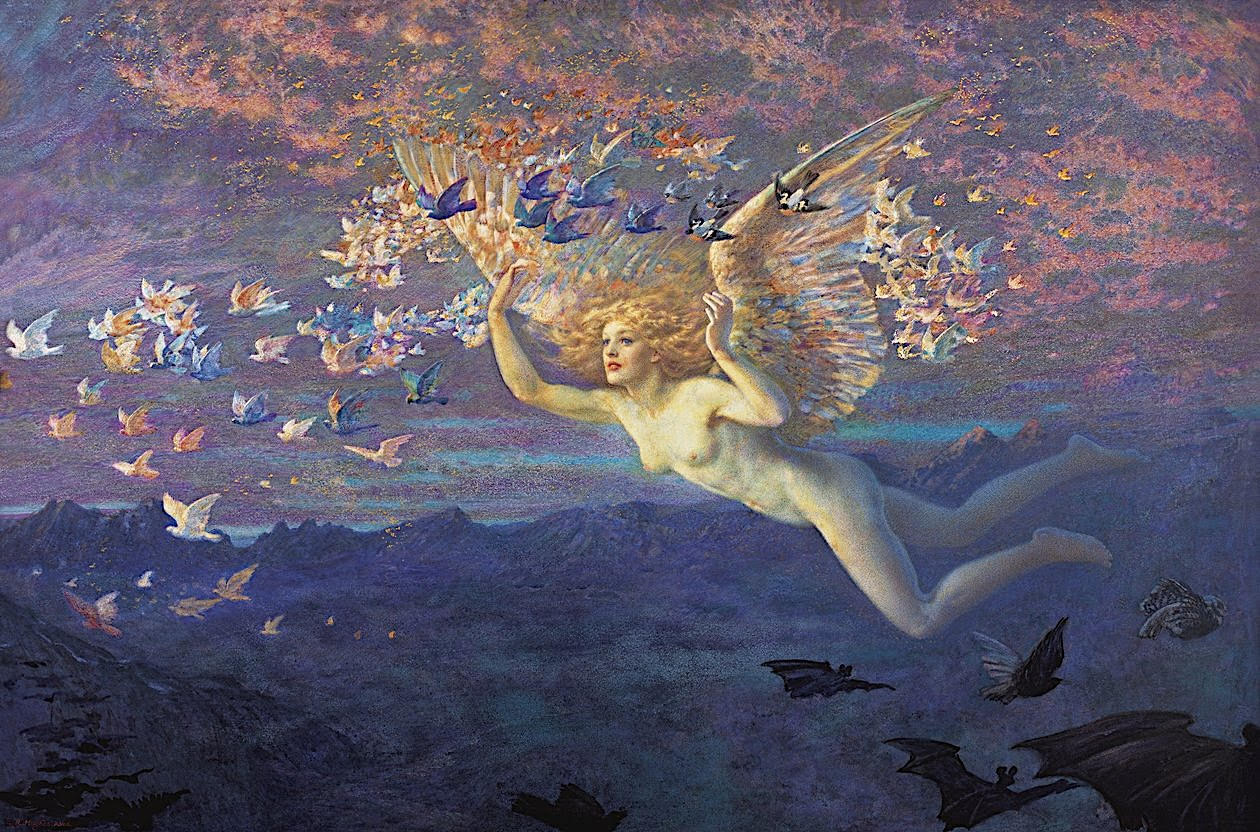
Wings of the Morning. Watercolour, heightened with touches of gouache and gold, on paper. 27½ x 41 inches (69.9 x 104.2 cm). Private collection, image courtesy of Sotheby's, London. [Click on the image to enlarge it.]
Hughes exhibited this work at the Royal Society of Painters in Water Colours in 1905, no. 78. Its title is derived from Psalms 139: 7-10.
"Whither shall I go from thy spirit?
Or whither shall I flee from thy presence?
If I ascend up into heaven, thou art there:
If I make my bed in hell, behold, thou art there.
If I take the wings of the morning,
And dwell in the uttermost parts of the sea;
Even there shall thy hand lead me,
And thy right hand shall hold me.
When this watercolour sold at Sotheby's, New York, in 2011 their experts felt: "As a vision of this passage, Wings of the Morning soars beyond allegory and revels in an invented world of make-believe."
This painting is similar in its composition to Hughes's later masterpiece Night with Her Train of Stars but it is not nearly as beautiful or as successful a work. Victoria Osborne has compared and contrasted the two works:
In Hughes's Wings of the Morning and Night with Her Train of Stars the transition between day and night becomes itself the subject of the picture. Both watercolours depict a flying female figure personifying a time of day, and each focuses on a moment of change, the coming of dawn or the coming of evening. In Wings of the Morning, a "radiant floating figure" representing Morning crosses the sky; bats flee and the coming dawn is "heralded by rosy clouds and flights of doves with brilliant plumage." In Night with Her Train of Stars, the winged, blue-robed figure of Night brings the end of the day. Light-bearing putti, the "train of stars," follow in her wake, while birds fly home to roost. [84]
When the work sold at Christie's in 2014 Osborne further elaborated on the connection between these two paintings: "In its theme and composition, the picture provides a counterpoint to Hughes's Night with Her Train of Stars, painted seven years afterwards, though the latter watercolour is slightly larger and the two were not intended to be seen as pendants. The pair complement one another in tone and mood: while the luminous nude in Wings of the Morning suggests innocence and optimism, the robed figure of Night, although gentle and benign, is more grave, bearing the weight of time and experience. [26]
Wings of the Morning was painted for the collector Edward William Knox of Sydney, Australia. On 24 February 1905 Hughes wrote in a letter to him:
The time is come to fulfill my part of our pact, which is to send for your inspection a sketch made from the picture I am now painting. My idea in this picture is to make these creatures welcome the dawn, which is slowly creeping over a range of mountains for the most part in shadow, and only the highest peaks being touched by rosy light. The sky, however, is a mass of cirrus clouds high enough to be well coloured by this same light - so making a kind of confusion with the many coloured and fluttering birds' wings, surrounding and accompanying the huge wings of the supernatural girl flying towards the dawn. Below and beneath all this welcome gaiety & light as though fleeing from them into the darkness that lingers are the winged things of night – owls, bats &c. All this gives me the chance of calling my picture The Wings of the Morning that beautiful expression in the psalms. The colour of all the wings is very opalescent – mountains deep blue – the valley has signs of a river & mists, but that part is rather obscure. [qtd. Beresford 116]
Osborne has described the imagery of this picture as:
Wings of the Morning depicts a floating, fair-haired nude, whose joyous arrival heralds the victory of dawn and light over the darkness. As she sweeps across the sky, bringing with her a train of doves and songbirds, she scatters the creatures of the night, including fluttering bats and a solitary owl…. Wings of the Morning is a spectacular example of the major exhibition pieces that Hughes showed at the Royal Watercolour Society between 1902 and 1913. Lyrical or mystical in mood, they typically featured winged or floating figures in glowing skies, often personifying times of day or phases of the moon. Hughes became particularly associated with these allegorical watercolours, which were praised by contemporary critics for their poetic qualities, colour sense and extraordinary technical skill…. The imagery of Wings of the Morning reveals the influence of the second generation of Pre-Raphaelites, most notably Simeon Solomon and Edward Burne-Jones, both of whom were well-known to Hughes both socially and professionally. The motif of a floating female figure in a night sky can be linked to compositions such as Burne-Jones's The Evening Star (1870, private collection), while Hughes's personification of an abstract concept is also paralleled by the many variations on themes such as Morning, Evening, Night and Sleep in Solomon's later drawings. When Wings of the Morning was shown at the Royal Watercolour Society in spring 1905 it was hung on the end wall of the gallery, a place traditionally reserved for the star pieces in the exhibition. The picture was commended by the reviewer in The Queen for "imaginative quality of a high order," while the Morning Post observed that it "claims praise likewise for the skill with which it has been devised. The figure is gracefully drawn and ably modelled." Critics were, as ever, particularly struck by Hughes's mastery of colour, with The Standard remarking on the "peaks violet-blue, and grey-blue clouds and a flight of birds – in the rose-grey dawn." [qtd. in Osborne, Christie's, 26]
Bibliography
19th Century European Art. New York: Sotheby's (4 November 2011): lot 61. https://www.sothebys.com/en/auctions/ecatalogue/2011/19th-century-european-art-n08783/lot.61.html
Beresford, Richard. Victorian Visions. Sydney: Art Gallery of New South Wales, 2010, no. 32, 116-17.
Osborne, Victoria Jean. "A British Symbolist in Pre-Raphaelite Circles: Edward Robert Hughes RWS (1851-1914)." M. Phil. thesis, University of Birmingham, 2009. 84.
Osborne, Victoria. Victorian, Pre-Raphaelite & British Impressionist Art. London: Christie's (11 December 2014): lot 14, 24-27. https://www.christies.com/en/lot/lot-5857441
The Morning Post (8 April and 15 April 1905).
The Queen (15 April 1905).
The Standard (7 April 1905).
Created 6 May 2026