
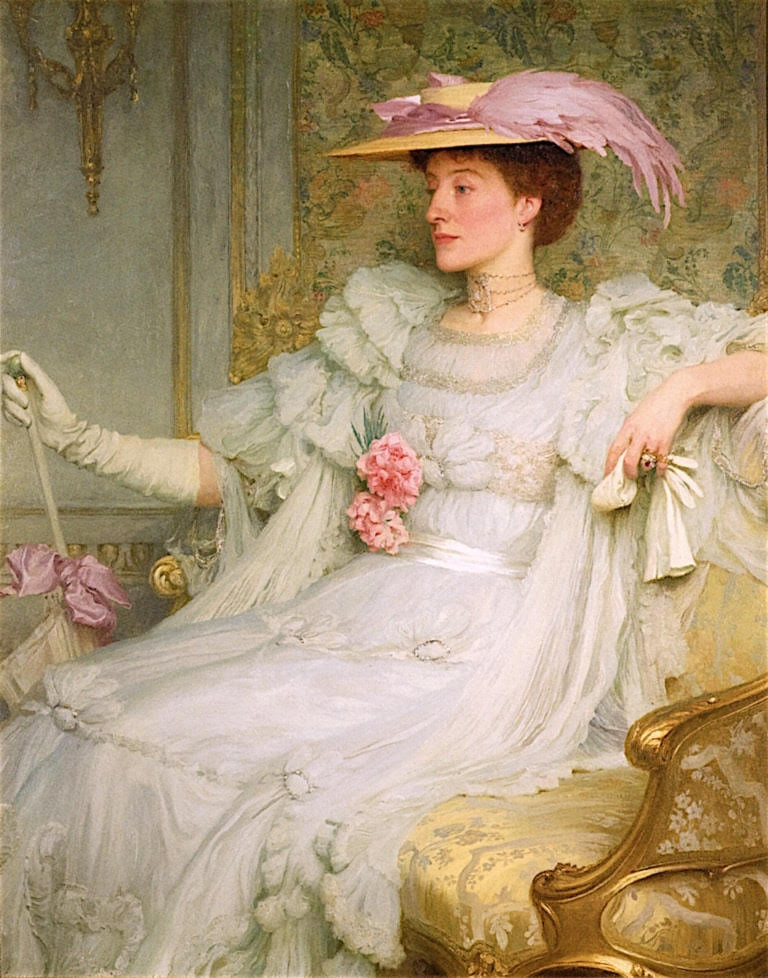
Portrait of Mrs. Hillingdon, by Sir Frank Dicksee (1853–1928). 1905. Oil on canvas. 50 x 40 inches (127 x 102 cm). Private collection. Image courtesy of Sotheby's.
Dicksee exhibited his Portrait of Lady Hillingdon at the Royal Academy in 1905, no. 158. It had been commissioned by the sitter, Alice Marion Mills (née Harbord 1857-1940) and her husband Charles William Mills, 2nd Lord Hillingdon of Vernon House in London, Hillingdon Court and Overstrand Hall in Norfolk, and is another example of Dicksee's turning to portraiture as narrative works fell out of fashion. When this portrait came up for auction in 2015 the expert at Sotheby's explained that the artist now hoped to rival John Singer Sargent and the Hungarian Philip de László as the major portraitist: "He gained a reputation for flattering his female sitters and for emphasising their beauty with accessories and glorious fabrics… Dicksee painted the wealthy wives and daughters of men of industry, politics and aristocracy with a technical panache which captured the lustre of high society, of polished mahogany and the sparkle of diamonds and shimmer of fine silk…." The Edwardian era was the perfect time for such commissions, when the newly rich wanted to consolidate their class credentials, especially their fine taste, very much as had happened previously in the in the eighteenth century. Dicksee hoped to emulate the portraiture of that period in his own work, recognising, as Sotheby's note puts it, "that the aristocratic families of Britain wanted portraits that complimented, rather than contrasted, the 'Swagger Portraits' of their forebears by Gainsborough, Reynolds and Romney" (52-54).
Lady Hillingdon herself was of true-blue aristocratic descent: her father was the 5th Baron Suffield. And although her husband, the 2nd Lord Hillingdon, was a wealthy banker and businessman, he too was by no means nouveau riche. Indeed, his father owned an exceptional collection of eighteenth century portraits. Dicksee's portrait bears witness to her class, fashionable taste, and wealth. She is shown, as Sotheby's comment explains,
dressed for a summer garden party and seated on a curvaceous sofa upholstered in golden silk. Her extended gloved hand is resting on the handle of a parasol whilst the other is bare to reveal her substantial ruby and diamond rings glittering on her long white fingers. Her fashionable straw-hat is decorated with mauve feathers and a silk ribbon that harmonises with the bow on her parasol and at her throat she has a spectacular diamond choker. These accessories compliment the wonderful cascade of her taffeta gown which is an exceptionally fine example of drapery painting. The setting and pose suggest that the sitter has rested momentarily before greeting her guests at an elegant society soiree.
However, the Sotheby's note points out, "this is artistic artifice and the truth is that Dicksee had carefully controlled every aspect of the portrait and few of the elements had been chosen by Lady Hillingdon." He has exercised his control in a variety of ways that few would have realised at the time, and perhaps no one would suspect now:
The setting is not one of the Hillingdons' homes; the portrait was painted at Dicksee's studio at Greville Place in St John's Wood. The sofa was one that appears in many of his portraits, part of a suite of chairs that he purchased in his first years of living at Greville House. The tapestry was also his and the gilt candle-bracket was also part of the studio decoration. These elements had been carefully arranged to reflect the Rococo splendour of the frame which was integral to the portrait as a work of art. Lady Hillingdon could not even claim credit for choosing the gown which was a dress that Dicksee had amongst his collection of costumes that had been made for various pictures. The ruffled sleeves and long pelmets had been taken from a dress originally made for One of Our Conquerors of 1903 (Manchester City Art Gallery) which depicted the modern-day heroine of a popular play. [54]
At least the corsage might have been Lady Hillingdon's own choice, though, since she loved roses and indeed a variety of rose was later named after her.
The portrait probably graced Overstrand Hall, the grand home which Alice's father had given the couple in 1898, on their marriage, and which was altered by Edwin Lutyens. It is sad to learn from the Sotheby's accunt that the marriage was an unhappy one.
Bibliography
Dibdin, E. Rimbault. "Frank Dicksee - His Life and Work," special issue of The Art Annual, 1905, 20 & 27.
Toll, Simon. Frank Dicksee 1853-1928, His Art and Life.Woodbridge: ACC Art Books, 2016, cat. no. FD.1905.1, 137-40 & 235.
Victorian, Pre-Raphaelite & British Impressionist Art. London: Sotheby's (December 17, 2015): lot 27, 52-55.
Wood, Christopher. Dictionary of Victorian Painters. Illustrated. Woodbridge: Antique Collectors' Club, 1978 (unpaginated).
Created 9 July 2026