
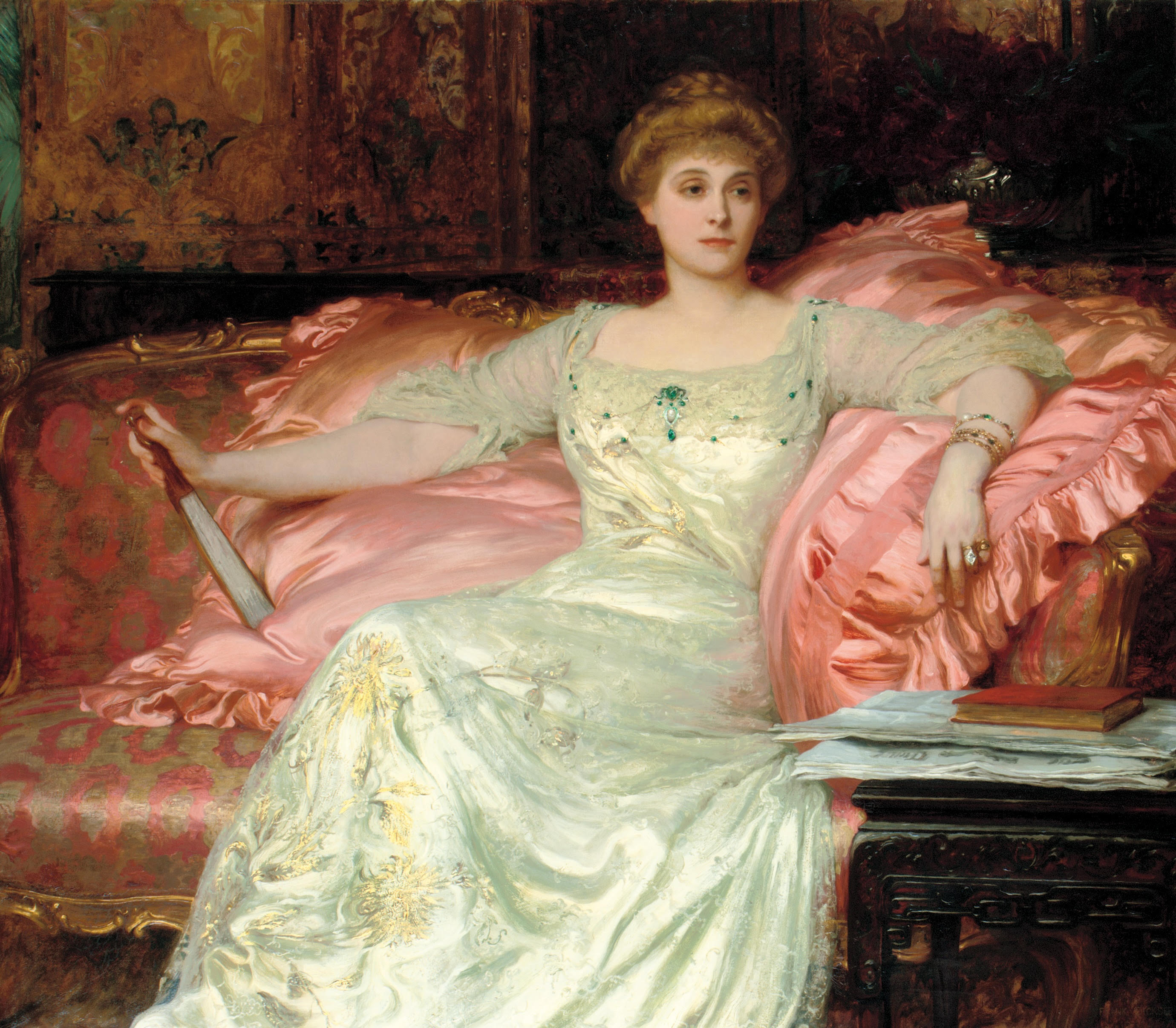
Portrait of Mrs. W. K. D'Arcy, by Sir Frank Dicksee (1853–1928). 1902. Oil on canvas. 54 x 61½ inches (137.2 x 156.2 cm). Private collection, image ©2011 Christie's Images Limited. [Right click disabled; not to be reproduced.]
Dicksee exhibited this three-quarter length portrait of Nina D'Arcy, elegantly dressed in a sumptuous interior, at the Royal Academy in 1902, no. 139. Henry Blackburn described the portrait in his Academy Notes as showing her in "white silk gold-patterned evening dress, seated on a sofa with salmon-pink cushion. Dark red roses in a silver bowl behind" (14).
When the portrait sold at Christie's in 2011 their experts noted it was executed near the beginning of Dicksee's major turn away from painting narrative works towards portraiture:
Frank Dicksee belonged to that unfortunate generation of late Victorian artists who found themselves marooned in mid-career. Making their names as painters of literary or historical subject pictures, they were suddenly faced around the turn of the century with the uncomfortable fact that such works were no longer in vogue…. Younger men could not evade the issue, and portraiture was their great resource. J.W. Waterhouse, Dicksee's senior by four years, painted many portraits in later life, mainly of young women happy to see themselves immortalised as ethereal neo-Pre-Raphaelite maidens. Dicksee, too, had a style that was readily adaptable, his lush, upholstered idiom being perfectly tailored to the depiction of upper-crust Edwardian womanhood in all her handsome and corsetted glory. It is fascinating to analyse a list of his Royal Academy exhibits. Between 1876, when he made his debut, and 1898, he showed nothing but subject pictures except one double portrait with a strong narrative element and a few landscapes. From 1899 until his death in 1928 he exhibited no fewer than sixty-seven portraits and only a handful of subject pictures, often with titles that suggest they were little more than fanciful likenesses of pretty models of the kind that Lord Leighton had exhibited in Dicksee's youth. Dicksee's sitters did not exclude men; indeed he was quite sought after in military circles during and shortly after the Great War. He also found himself painting the daughters of several of his artist friends, Hedley Fitton, Sutton Palmer and others. But the overwhelming impression given by the list is that he had built up an extensive, and no doubt lucrative, practice painting the womenfolk of the aristocracy and nouveaux riches. [67]
Nina D'Arcy was the second wife of William Knox D'Arcy of Stanmore Hall, near Harrow. D'Arcy was born at Newton Abbot in Devon in 1849: "the son of a solicitor.... He was educated at Westminster School but left England with his family at the age of seventeen in 1866 when his father’s firm went bankrupt" (Toll, Catalogue Note, 8). He eventually amassed a fortune in land speculation, gold mining, and oil exploration, married and returned to England with his family in 1897, remarrying in 1899 after the failure of his first marriage. His second wife, the subject of this painting, was an Australian widow, Nina Bourcicault, the daughter of A. L. Bourcicault, the proprietor of the Rockhmpton Argus. Dicksee was already well known to D'Arcy by this time: in 1891 the multi-millionaire had purchased the artists's large mythological painting The Mountain of the Winds to hang in his dining room at his home Stanmore Hall. He also owned Dicksee's Paolo and Francesca of 1894 that hung in his music room; and in 1900, Simon Toll tells us, Dicksee was commissioned to paint D'Arcy's youngest daughter Ethel Anastasia. Now, in his portrait of Nina, Dicksee clearly puts the couple's wealth and class on record: "His sitter's discreetly opulent dress of white embroidered silk sewn with emeralds, the rococo sofa and pink satin cushions on which she reclines, the hints of old silver and lacquered furniture behind her, and above all her aloof and mildly disdainful expression - all leave us in no doubt that here is someone in command of a very nice income and for whom servants come running" (Toll, Catalogue Note, 67).
Christie's describes the portrait in much the same way, as showing Nina "dressed in ivory silk embroidered in gold and bedecked in glittering emeralds, diamonds and opals," all testifying to "D'Arcy's extravagance and his success in business to pay for them."
Bibliography
Blackburn, Henry. Academy Notes. London: Chatto and Windus (May 1902): 14.
Royal Academy Pictures 1902. London: Cassell and Company Ltd., 1902. 163.
Toll, Simon. Frank Dicksee 1853-1928, His Art and Life. Woodbridge: ACC Art Books, 2016, cat. no. FD.1902.2, 124-25 & 235.
_____. Catalogue Note: "Paolo and Francesca." London: Martin Beisley Fine Art. Web. 9 July 2026. https://martinbeislyfineartcatalogues.co.uk/PDF-Flip/PDF/Dicksee%20-%20Paolo%20and%20Francesca.pdf
Victorian and Impressionist Art. London: Christie's (15 June 2011): lot 79, 67. Web. 9 July 2026. https://www.christies.com/en/lot/lot-5451347.
Created 9 July 2026