
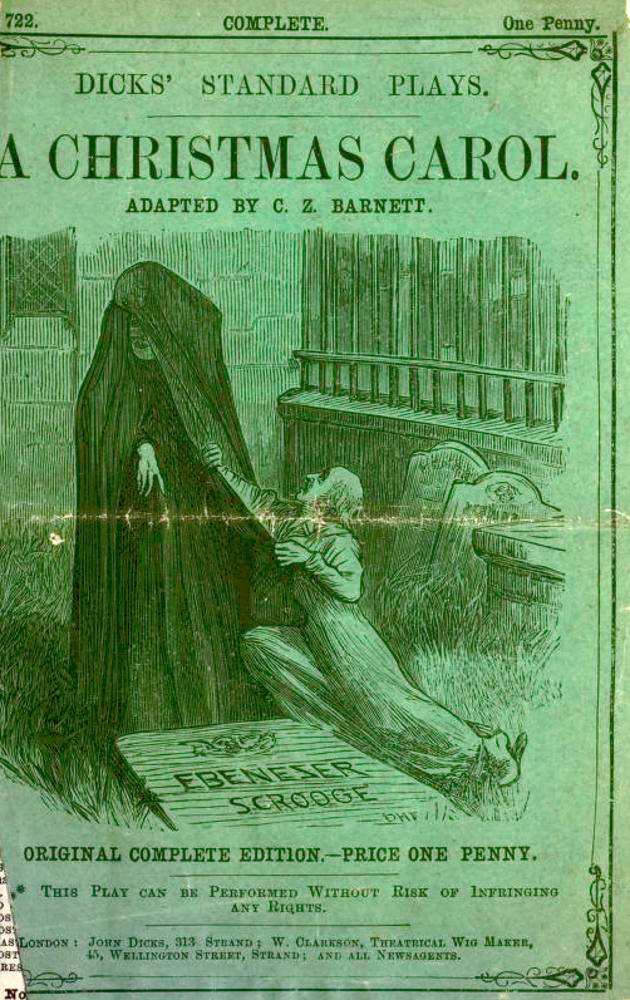

A Christmas Carol: or, the Miser's Warning. A Drama in Two Acts — title-page vignette for C. Z. Barnett's two-act adaptation in Dicks' Standard Plays, No. 722, and Duncombe (XLVIII); first produced on 5 February 1844. [Click on the images to enlarge them.]
Passage Illustrated from the Novella: The Name "Ebenezer" inscribed on the Tomb
The Spirit stood among the graves, and pointed down to One. He advanced towards it trembling. The Phantom was exactly as it had been, but he dreaded that he saw new meaning in its solemn shape.
"Before I draw nearer to that stone to which you point," said Scrooge, "answer me one question. Are these the shadows of the things that Will be, or are they shadows of things that May be, only?"
Still the Ghost pointed downward to the grave by which it stood.
"Men's courses will foreshadow certain ends, to which, if persevered in, they must lead," said Scrooge. "But if the courses be departed from, the ends will change. Say it is thus with what you show me."
The Spirit was immovable as ever.
Scrooge crept towards it, trembling as he went; and following the finger, read upon the stone of the neglected grave his own name, EBENEZER SCROOGE.
"Am I that man who lay upon the bed?" he cried, upon his knees.
The finger pointed from the grave to him, and back again.
"No, Spirit! Oh no, no!"
The finger still was there.
"Spirit!" he cried, tight clutching at its robe, "hear me. I am not the man I was. I will not be the man I must have been but for this intercourse. Why show me this, if I am past all hope?"
For the first time the hand appeared to shake.
"Good Spirit," he pursued, as down upon the ground he fell before it: "Your nature intercedes for me, and pities me. Assure me that I yet may change these shadows you have shown me, by an altered life."
The kind hand trembled. ["Stave Four: The Last of the Spirits," pp. 149-151]
Passage from the Adaptation: A Monologue (Act Two, Scene VII)
The medium is worked off, and discovers,
SCENE VII.— A Churchyard. On slab centre, is engraved "Ebenezer Scrooge."
Scr. A churchyard! Here then, the wretched man whose name I have now to learn, lays underneath the ground! (The Spirit points to centre slab. Scrooge advances, trembling, towards it. ) Before I draw nearer to the stone to which you point, answer me one question. Are these the things of the shadows that will be, or are they the shadows of the things that may be only? (The Spirit still points downward to the grave. ) Men's courses will foreshadow certain ends, to which, if persevered in, they must lead — but if the courses be departed from, the ends will change — say is it thus with what you show me? Still as immovable as ever! (Draws nearer to grave.) "Ebenezer Scrooge!" My own name! (Sinks on his knees.) Am I that man who lay upon the bed? (The Spirit points from the grave to him, and back again.) No, Spirit! Oh. no. no! (See Plate. The figure remains immovable.) Spirit! (Clutching its robe.) Hear me ! I am not the man I was — I will not be the man I must have been but for this intercourse! why show me this if I am past all hope? (The hand trembles. Scrooge sinks on his knees. ) Good Spirit, your nature intercedes for me — assure me that I yet may change these shadows you have shown me, by an altered life! (The hand trembles still. ) I will honour Christmas in my heart, and try to keep it all the year — I will live the past, the present, and the future — the spirits of all three shall strive within me — I will not shut out the lessons that they teach. Oh, tell me I may sponge away the writing on this stone?
(In his agony he catches the Spectre's hand — it seeks to free itself — his struggles become stronger in his despair — the Spirit repulses him — he sinks prostrate to the earth. The Spirit disappears as the medium is worked on. Clouds roll over the stage — they are worked off, and discover [Scene VIII] [Pages 10-11 in Duncombe]
Commentary
As the play reaches its climax, Marley's Ghost and the three Spirits of Christmas have effected Scrooge's social reintegration; his spiritual reclamation is complete once he has gained spiritual and social insight from the periphrastically-named "Last of the Spirits," the only character in the original production for whom the actor was not identified in the published script.
By the 23rd of April, 1844, according to Philip Bolton, numerous dramatic adaptations of the best-selling novella had appeared in various London playhouses: The Adelphi, Sadler's Wells, The Royal Surrey (Barnett's version), The Strand, The Victoria, The Britannia, and The City of London, as well as early adaptations by Edward Stirling at The Theatre Royal, Hull; at The Theatre Royal, York; at Sheffield; and at Edinburgh's Theatre Royal. Although Stirling alone enjoyed Dickens's approval and assistance, it was Barnett's that was widely published: in Lacy, French's, Duncombe (XLVIII), and Dicks' (No. 722). In the stage scene depicted, The Ghost of Christmasses to Come (actor unidentified) has just shown Scrooge (enacted by Robert Honner) his own gravestone.
Related Illustrations from Various Editions of the Novella (1843 to 1910)


Left: Sol Eytinge, Jr.'s In the Churchyard (1868); centre: Harry Furniss's's The Last of the Spirits (1910); right: the most likely source of the play's title-page vignette, John Leech's The Last of the Spirits (1843). [Click on the images to enlarge them.]
Scanned images and text by Philip V. Allingham. [You may use the images without prior permission for any scholarly or educational purpose as long as you (1) credit the person who scanned them and (2) link your document to this URL.]
Bibliography
Barnett, C. Z. A Christmas Carol: or, the Miser's Warning. A Drama in Two Acts. London: John Duncombe and Dicks' Standard Plays, n. d. [c. 1844].
Bolton, Philip H. "A Christmas Carol." Dickens Dramatized. Boston: G. K. Hall, 1987. Pp. 234-267.
Davis, Paul. The Lives and Times of Ebebnezer Scrooge. New Haven and London: Yale University Press, 1990.
Dickens, Charles. A Christmas Carol in Prose, Being a Ghost Story of Christmas. Illustrated by John Leech. London: Chapman and Hall, 1843.
Created 6 December 2002
Last modified 20 December 2025