
This article has been peer-reviewed under the direction of Kristen Guest (University of Northern British Columbia) and Ronja Frank (Memorial University, St John's, Newfoundland). It forms part of the Equine Breed and the Making of Modern Identity project, funded by the Social Sciences and Humanities Research Council of Canada.
fter the Anglo-Boer War, Secretary of State for War, St. John Broderick, wrote that Lord Kitchener would "go down in history as the largest horse killer of your or any other age" (Yarwood 172). During the postwar investigation, the Army determined that most horses perished due to poor management, disease, or starvation rather than from combat wounds. In his postwar report, M. F. Rimington advised the military to make training in good horse-management a top priority, as it could save the establishment millions of pounds in future wars (12). Mobile veterinary hospitals had been attempted during the Anglo-Boer War (1899-1902); however, due to staff shortages these programs remained ineffective until 1914 (Anglesey 338). The British Government and Army also worked to establish a breeding program for potential war horse stock, establishing a Horse-breeding Committee within the Board of Agriculture and Fisheries to reinvigorate the health of Britain’s horse supply (Board of Agriculture 1). In 1911 the Government ordered the first horse census in Western history, which compiled data on the number of horses and breeds within the British Isles for the purpose of assessing potential war horse stock. The census was compiled in 1911-1912, and was prepared with the creation of an Emergency Army Act empowering the military to impress British horses quickly in the event of future wars (Singleton 183).
The news of the enormous waste of "British" war horse stock in South Africa reached Great Britain during the war, prompting public outcry about the mismanagement and sacrifice of the war horses (Esher 175). Under pressure from the Royal College of Veterinary Surgeons and the Royal Society for the Prevention of Cruelty to Animals, the Army responded with policy changes aimed at reducing future equine wastage, reorganizing and professionalizing the Veterinary Corps, instituting a new policy of acclimatization for war horses, establishing new training programs in horse management for officers and soldiers of various Corps, and implementing new policies to encourage soldier-horse bonding. The Army Veterinary Corps formally professionalized between 1902 and 1919, despite experiencing the growing pains of constant reorganization and innovation (Smith 161). In 1903, the Army officially created the Army Veterinary Corps (AVC); three years later, the Army Veterinary Department and the Army Veterinary Corps were combined to form one organization (Forgrave 8). The Army, upon the advice of numerous animal welfare organizations, formulated a cohesive veterinary service system for the AVC, with provisions for mobile veterinary units, evacuation hospitals, convalescent hospitals, and veterinary hospitals on the front lines. Each of these provisions was to be enhanced by the latest equine medicine and technology, with the new evacuation and treatment processes (Smith NA). Major General Sir Frederick Smith was appointed the Director of the Army Veterinary Corps in 1907 and was influential in introducing modern veterinary equipment to the Corps. To help streamline the veterinary services, the Remount Department became separate from the AVC, under the Quartermaster General, in 1913 (Forgrave 9).
One of the most important lessons of the Anglo-Boer War was the importance of acclimatizing military horse populations in war. During the war, British forces had not followed one simple rule: the "commander must suit his campaign to his horses, not his horses to his campaign. The horse has no hope when he gets tired, hungry, and beaten. He does not know when he will halt or get food ever again" (Rimington 13). In his exposé, Sydney Galvayne suggested that the Army needed to establish a standardized system for testing equine "hardiness" as well as to place importance both on acclimating war horses prior to deployment and training soldiers based on their horsemanship skill levels (184-89). John Moore stated that the military had been too "apt to look upon horses as machines" in South Africa, leading to wastage, noting that one cannot place a Waler — a breed of horse originating from New South Wales in Australia — in a northern climate without allowing it to acclimate to the change in seasons and environmental conditions (55-56).
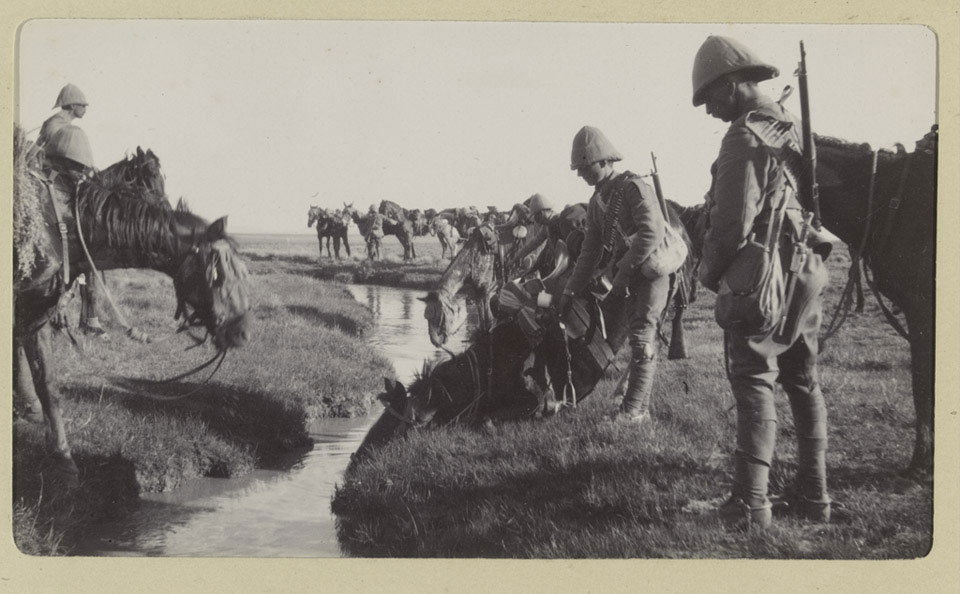
"Mounted Infantry watering their horses, South Africa, 1901." National Army Museum, London. CC BY-NC-ND 4.0.
Both officers and soldiers needed to be trained in effective horse management and care. Major General L.J. Blenkinsop concisely summarized this new focus on education in the military: "At one time animal management was looked upon as entirely separate from veterinary science, just as in the dawn of human medicine there was little recognition of the essential connection of [veterinary science] with the principles of hygiene. [...] Modern science, however, has bridged the gulf. [...] Animal management, in short, is preventative veterinary medicine" (59). Rimington wrote that most military animal cruelties, in both war and peace, were "nine times of out ten the result of ignorance," adding that teachit good horse management "may save us many millions of pounds and the horrible cruelties" to war horses (12). Prior to 1903, the main goal of the Army was to teach men to ride their horses, not to care for them (Esher 186). According to John Singleton, one of the most important results of the Anglo-Boer War was that the "War Office accepted that horses were delicate and valuable military assets, which provided excellent service when properly maintained, but soon broke down when neglected as a result of poor training or a false sense of economy" (200). Rimington further stated that veterinary surgeons were crucial to the war effort because "[a] man can call out when anything is wrong with him, but the wretched horse cannot." Therefore, he concluded, veterinary surgeons not only help the animal but also the army by saving assets in the field (11). In an effort to educate soldiers in proper horse management, the Army began to publish standardized training manuals that included all of the information necessary for the care and treatment of war horses at the front and on the march. For example, a 1904 army training manual provided information on everything from the care of horses in stables and on marches, to first-line veterinary treatments and basic feeding and watering requirements (War Office NA). Field manuals also provided detailed instructions about the precise amount of feed and water for each breed of horse; the amount of daily exercise, grooming, shoeing and foot care required; and the correct maintenance of stables and billets (War Office NA).
Increased emphasis on the cultivation of a personal bond between soldiers and their equine charges was a major feature of these new training manuals. The 1904 manual states that "every mounted man should regard his horse as a part of himself, and should remember that his efficiency, and his safety on service, depends on the fitness of his horse" (War Office 5). Rimington criticized previous army policies, saying that "I am not sure that the system on which we teach our men to ride is one that makes them love their horses. A recruit who has never been on a horse before he joined has a very rough time in learning to ride; it is a very difficult process to that under which you learn to ride; it is not one by which a man learns to love his horse and regard him as his best friend" (13). Compared to previous years when soldiers rarely rode the same horse regularly, men after 1904 were expected to "ride and tend the same horse for months on end, sleeping in the open only a few yards behind the picket lines at night, and suffering the same privations." Prior to 1904, the Army believed that allowing soldiers and their animals to bond would become a "source of weakness" within the army, because troops could become too attached to their mounts, worrying more about the animal’s safety than the advancing against the enemy. In a complete shift from this earlier view, soldiers were instructed to follow a new golden rule: "Look after the horses first, then the men, and then yourself" as part of their formal army training (Edwards 157). The implementation of new policy led to a significant change in attitude, in that "the soldier came to regard his horse as almost an extension of his own being" (Brereton 128-129). Ultimately, this new policy played an important role in shaping the bond between soldiers and horses in the twentieth century and was foundational to the process of veteranization for British war horses.
Related Material
- The Boer War
- The Carabiniers Memorial (sculpture) by Adrian Jones
- The Flankers Outflanked. Cavalry under General French (watercolor) by Frank Feller
Bibliography
Anglesey, Marquess of. A History of the British Cavalry, 1816–1919. Vol. 4. London: Leo Cooper, 1981.
Blenkinsop, L. J., Major-General, and J. W. Rainey, Lieutenant-Colonel. History of the Great War Based on Official Documents: Veterinary Services. London: HMSO, 1925.
Board of Agriculture and Fisheries, Horsebreeding Committee. Report of the Committee Appointed by the President of the Board of Agriculture and Fisheries to Consider and Advise What Steps Should Be Taken in England and Wales to Secure an Adequate Supply of Horses Suitable for Military Purposes. London: HMSO, 1915.
Brereton, J. M. The Horse in War. London: Arco Publications, 1976.
Derry, Margaret E. Horses in Society: A Story of Animal Breeding and Marketing Culture, 1800–1920. Toronto: University of Toronto Press, 2006.
Edwards, Elwyn Hartley. Horses. New York: Dorling Kindersley, 1994.
Esher, Viscount. The Influence of King Edward, and Essays on Other Subjects. London: John Murray, 1915.
Forgrave, William. A History of the Royal Army Veterinary Corps, 1919–1961. London: J. A. Allen, 1962.
Galvayne, Sydney. War Horses Present and Future; or, Remount Life in South Africa. London: R. A. Everett & Co., 1902.
Hyland, Ann. The Warhorse in the Modern Era: The Boer War to the Beginning of the Second Millennium. Stockton-on-Tees, UK: Black Tent Publications, 2010.
"Mounted Infantry Watering Their Horses, South Africa, 1901." National Army Museum. London. Accession number: NAM. 2011-08-17-35. Accessed 18 August 2026.
Rimington, M. F. The Horse in Recent War. London: William Blackwood and Sons, 1914.
Singleton, John. "Britain’s Military Use of Horses 1914–1918." Past & Present 139 (May 1993): 178–203.
Smith, Frederick, Major-General. A History of the Royal Army Veterinary Corps, 1796–1919. London: J. A. Allen, 1983.
War Office. Manual of Horse and Stable Management. London: Harrison and Sons, 1904.
Yarwood, A. T. Walers: Australian Horses Abroad. Melbourne: Melbourne University Press, 1989.
Created 10 August 2026
Last modified 27 August 2026