


The story covers the period in English and French history from 1757 to 1793, that is, from the Seven Years War (1756-1763) between France and England to the middle of the French Revolution. Book I, consisting of six chapters, is set in 1775; Book II, of twenty four chapters, is set between 1780 and 1789; the events of the fifteen chapters of Book III take place between 1792 and 1793.
The expository book reveals political corruption and social discontent in both countries. Mr. Jarvis Lorry of Tellson's Bank (which has offices in both capitals) travels to France with Miss Lucie Manette, whose father, Dr. Alexandre Manette, is to be released from the Bastille after eighteen years' imprisonment.
In Book II, "The Golden Thread," the wasted Dr. Manette has been somewhat restored by his daughter's care. Charles Darnay, a French emigré, is acquitted of a treason charge owing to the likeness between himself and the dissolute attorney, Sydney Carton, which discredits testimony that he has been seen passing information to the French, with whom the English are currently at war. The similarity between the two is further enhanced by their both being in love with Lucie. Meantime, back in France, Darnay's aristocratic uncle, the ruthless and cruel Marquis St. Evremonde, under the wheels of his speeding carriage kills the child of Gaspard, a peasant in the Saint Antoine district of Paris. The next morning the Marquis is found murdered in his bed; a year later, Gaspard is himself found and executed for the murder. Madame Defarge, wife of Dr. Manette's former servant (who had befriended his old master upon his release from the Bastille), registers in her knitting the whole St. Evremonde family as marked for destruction — including the late Marquis' democratically-minded nephew, Charles Darnay.
After the storming of the Bastille on 14 July 1789, Darnay unwisely returns to France to assist an old family servant in distress. Imprisoned for a year, Darnay is retried. A document written by Manette reveals that the late Marquis and his brother (Charles's father) were responsible for both the deaths of Madame Defarge's entire family. Charles is unexpectedly saved by the second intervention of Carton, who, out of unrequited love for Lucie, is prepared to sacrifice his life for the man she loves.
Publication History
The novel consists of forty-five chapters published originally in serial form (note the cliff-hangers) in Dickens' new magazine venture All the Year Round, from April 30 to November 26, 1859, in thirty-one weekly numbers. It was also published in monthly parts with accompanying illustrations by Phiz (Hablot Knight Browne).
General Features of the Narrative
- The London-Dover, Calais-Paris road connects not only the two locations, but also all the characters.
- Parallels are offered by the two Tellson's banks and the French-speaking Englishman, Sydney Carton, and the English-speaking Frenchman, Charles Darnay.
- Red, particularly the colour of fire and of blood, evokes sympathy.
- Footsteps are an ominous foreshadowing.
- The river here, as in Our Mutual Friend, is a symbol of life.
- The guillotine and time (note the fifty-two victims) dominate Book III.
Reading Questions and a Quiz
Bibliography
Bentley, Nicolas, Michael Slater, and Nina Burgis. The Dickens Index. Oxford and New York: Oxford U. P., 1988.
Clark, Kenneth. Civilisation: A Personal View. London and New York: Harper and Row, 1969.
Davis, Paul. Charles Dickens A to Z: The Essential Reference to His Life and Work. New York: Facts On File, 1998.
Dickens, Charles. A Tale of Two Cities. All the Year Round. 30 April through 26 November 1859.
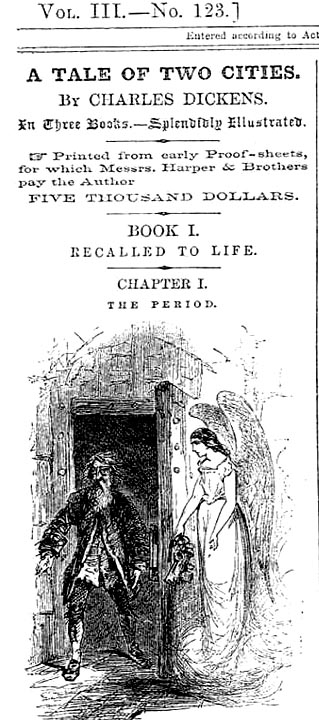
Dickens, Charles. A Tale of Two Cities. Illustrated by John McLenan. Harper's Weekly: A Journal of Civilization. Vol. III, Nos. 123 through 164. 7 May through 3 December 1859.
Dickens, Charles. A Tale of Two Cities. Illustrated by Hablot Knight Browne. London: Chapman and Hall, 1859.
Dickens, Charles. A Tale of Two Cities and Great Expectations. Illustrated by Sol Eytinge, Jr. The Diamond Edition. 16 vols. Boston: Ticknor and Fields, 1867. Vol. XIII.
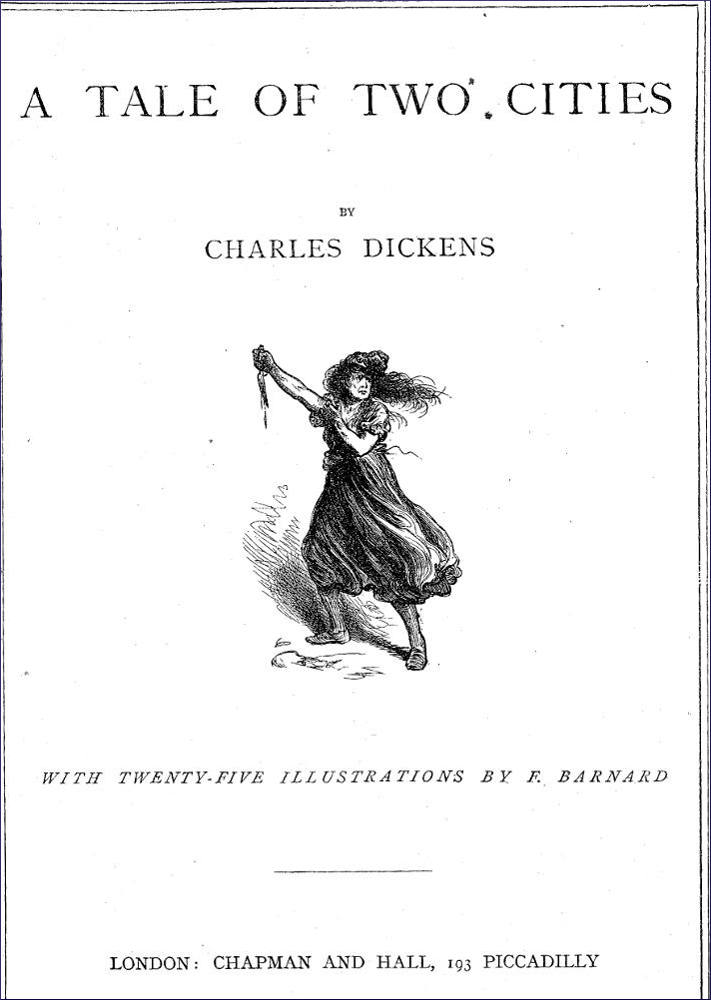
Dickens, Charles. A Tale of Two Cities. Illustrated by Fred Barnard. The Household Edition. 22 vols. London: Chapman and Hall, 1874. Vol. XIII.
Dickens, Charles. A Tale of Two Cities. Illustrated by A. A. Dixon. London: Collins, 1905.
Dickens, Charles. A Tale of Two Cities, American Notes, and Pictures from Italy. Illustrated by Harry Furniss. Charles Dickens Library Edition. 18 vols. London: Educational Book Co., 1910. Vol. XIII.
Dickens, Charles. A Tale of Two Cities. Illustrated by Hablot Knight Browne. Intro. George Woodcock. Penguin Classics. Harmondsworth: Penguin, 1994.
Sanders, Andrew. A Companion to "A Tale of Two Cities." London: Unwin Hyman, 1988.
Created 4 September 2004.
Last updated
18 January 2026