
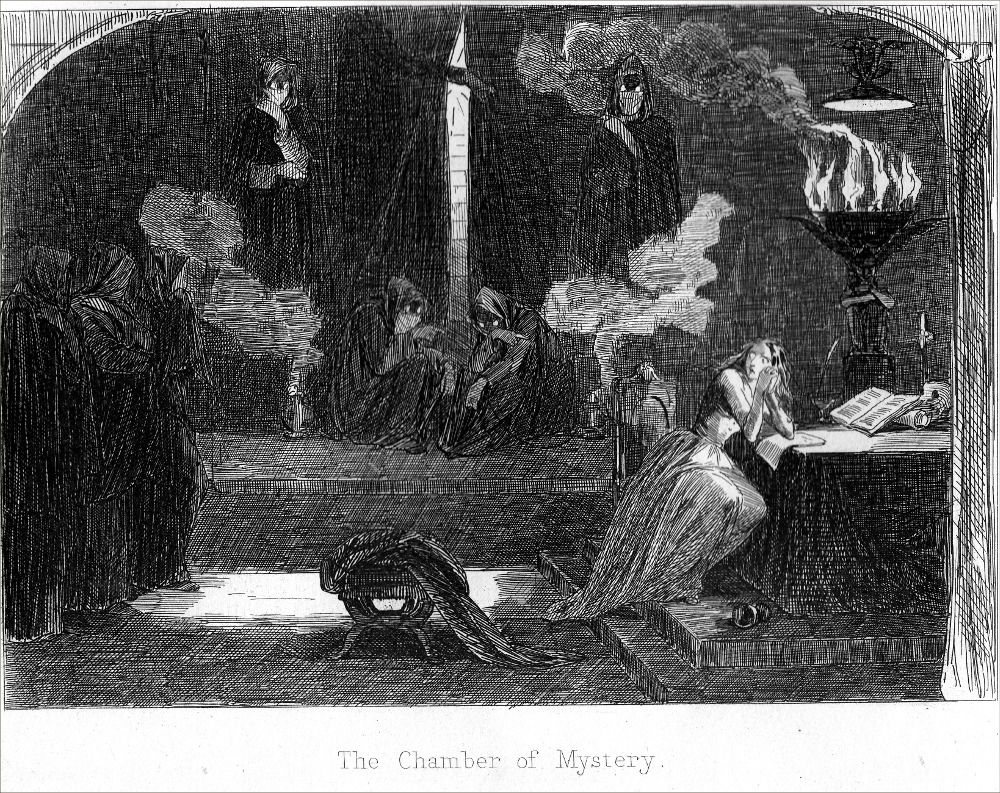
The Chamber of Mystery by Phiz (Hablot K. Browne), tenth serial illustration for William Harrison Ainsworth's Revelations of London, Part 5 (February 1845), "Book the First — Ebba," Chapter XII. "The Chamber of Mystery," facing page 228 (page 126 in volume). Steel-plate etching; 9.6 cm high by 13.8 cm wide (3 ¾ by 5 ⅜ inches), framed.
Passage Illustrated: Ebba as Rougement's Prisoner in the Chamber of Mystery
Forcibly averting her gaze, Ebba covered her eyes with her hands, but looking up again after a brief space, beheld an ebon door at the side revolve upon its hinges, and give entrance to three female figures, robed in black, hooded and veiled, and having their hands folded, in a melancholy manner, across their breasts. Slowly and noiselessly advancing, they halted within a few paces of her.
"Who and what are ye?" she cried, wild with terror.
"The victims of Auriol!" replied the figure on the right. "As we are, such will you be ere long."
"What crime have you committed?" demanded Ebba.
"We have loved him," replied the second figure.
"Is that a crime?" cried Ebba. "If so, I am equally culpable with you."
"You will share our doom," replied the third figure.
"Heaven have mercy upon me!" exclaimed the agonised girl, dropping upon her knees.
At this moment a terrible voice from behind the curtain exclaimed, "Sign, or Auriol is lost for ever."
"I cannot yield my soul, even to save him," cried Ebba distractedly. ["Book the First — Ebba," Chapter XII. "The Chamber of Mystery," pp. 126-127 in volume]
Commentary: Abducted by fast-moving carriage and Imprisoned, Ebba meets three female figures
Whisked away from Auriol in a carriage, Ebba is then carried along a winding passage and thrown into "a gloomy chamber of vast extent" (123). Her abductor, "the mysterious and terrible stranger" in the black cloak, forces her to drink a potent liquid, apparently a stimulant; the remainder of the goblet's contents she dashes to the ground, suspicious of its effects. Phiz takes his cue from Ainsworth in describing the forbidding subterranean chamber:
It was vast and gloomy, and seemed like the interior of a sepulchre — the walls and ceiling being formed of black marble, while the floor was paved with the same material. Not far from where she sat, on an estrade, approached by a couple of steps, stood a table covered with black velvet, on which was placed an immense lamp, fashioned like an imp supporting a caldron on his outstretched wings. In this lamp were several burners, which cast a lurid light throughout the chamber. Over it hung a cap equally fantastically fashioned. A dagger, with a richly wrought hilt, was stuck into the table; and beside it lay a strangely shaped mask, an open book, an antique inkstand, and a piece of parchment, on which some characters were inscribed. Opposite these stood a curiously carved ebony chair.
At the lower end of the room, which was slightly elevated above the rest, hung a large black curtain; and on the step, in the front of it, were placed two vases of jet.
"What is behind that curtain?" shudderingly demanded Ebba of her companion.
"You will see anon," he replied. "Meanwhile, seat yourself on that chair, and glance at the writing on the scroll."
Ebba did not move, but the stranger took her hand, and drew her to the seat.
"Read what is written on that paper," he cried imperiously.
Ebba glanced at the document, and a shudder passed over her frame. "By this," she cried, "I surrender myself, soul and body, to you?" (pp. 124-125)
Commentary: Ebba Confronts the Shades of Three of Auriol's Former Loves, but Refuses to Sign
Ainsworth appears to write himself into a corner here as Ebba, to preserve Auriol from eternal confinement in the pit, throws herself into it, even as she refuses to give up her soul as the other three spirits of his departed lovers have done. Using intense cross-hatching, Phiz creates a suitably suspenseful and mournful atmosphere in the last plate before the "Intermean (1800)." Afterwards, having attempted suicide to save Auriol from his terrible fate, Ebba becomes another mere hooded "figure, shrouded in black habiliments" (128) who signs her name — "EBBA THORNEYCROFT" — on the devil's parchment accompanied by "a roar of diabolical laughter." She then joins the other veiled forms, as Auriol is dragged through the doorway with "a terrible clangour." Ginger's rescue plan, therefore, seems doomed to failure before he has even initiated it at the Turk's Head tavern.
Related Material
- Hablot Knight Browne, 1815-1882; A Brief Biography
- William Harrison Ainsworth (1805-1882)
- William Harrison Ainsworth (1805-1882) — King of the Historical Potboiler: A Brief Biography
Scanned image and text by Philip V. Allingham. [You may use these images without prior permission for any scholarly or educational purpose as long as you (1) credit the person who scanned the image and (2) link your document to this URL in a web document or cite the Victorian Web in a print one.]
Bibliography
Ainsworth, William Harrison. Auriol; Or, The Elixir of Life. London: Chapman and Hall, 1850; George Routledge and Sons, 1865.

Ainsworth, William Harrison. Revelations of London. Ainsworth's Magazine. Vol. VIII (January — May 1845).
Lester, Valerie Browne. Phiz: The Man Who Drew Dickens. London: Chatto and Windus, 2004.
Steig, Michael. Dickens and Phiz. Bloomington & London: Indiana U. P., 1978.
Sutherland, John A. "Auriol." The Stanford Companion to Victorian Fiction. Stanford, Cal.: Stanford U. P., 1989, rpt. 1990, 33.
Vann, J. Don. "Auriol; Or, The Elixir of Life in Ainsworth's Magazine, October 1844 — May 1845." Victorian Novels in Serial. New York: Modern Language Association, 1985. Pp. 24-25.
7 October 2026