
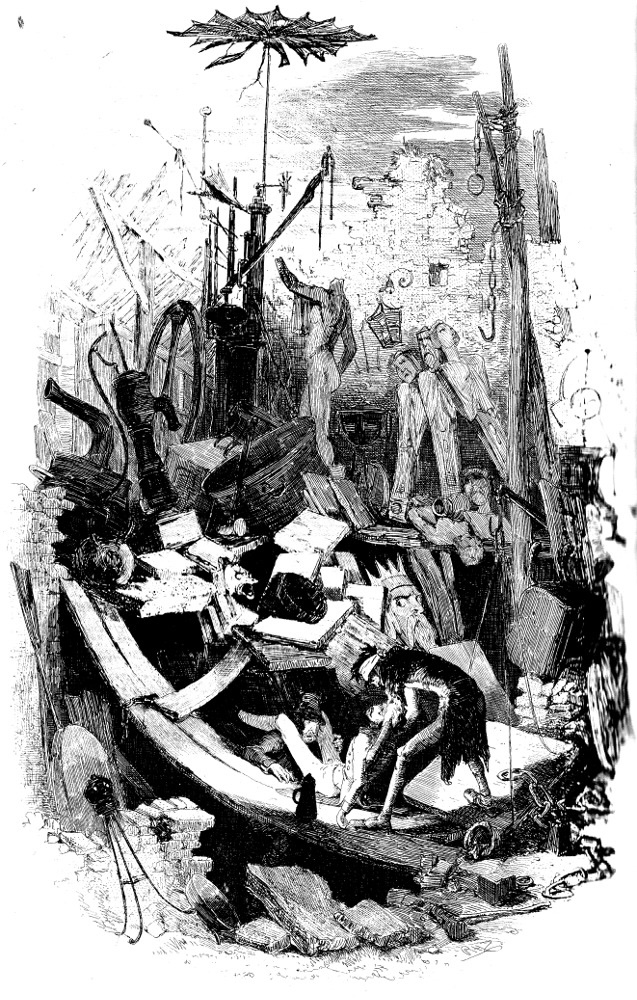
The Ruined House in Vauxhall Road
Phiz
October 1844
16.8 cm high by 11.3 cm wide (6 ⅝ by 4 ⅜ inches), vignetted
Facing page 34 in volume, p. 295 in serial; second serial engraving for William Harrison Ainsworth's Auriol; Or, The Elixir of Life (London: Chapman and Hall, 1850; rpt., 1865)
[Click on the image to enlarge it and mouse over text for links.]
Scanned image & text by Philip V. Allingham.
[You may use this image without prior permission for any scholarly or educational purpose as long as you (1) credit the person who scanned the image and (2) link your document to this URL in a web document or cite the Victorian Web in a print one.]

Passage Illustrated: A run-down slum, London, in the Nineteenth Century
After some time spent in this way, he began to fear the young man must have departed, when all at once a piercing scream resounded through the dwelling. Some heavy matter was dislodged, with a thundering crash, and footsteps were heard approaching the window.
Hastily retreating to their former hiding-place, the Tinker and his companion had scarcely regained it, when the young man again appeared on the plank. His demeanour had undergone a fearful change. He staggered rather than walked, and his countenance was even paler than before. Having crossed the plank, he took his way along the top of the broken wall towards the door.
"Now, then, Sandman!" cried the Tinker; "now's your time!"
The other nodded, and, grasping his mallet with a deadly and determined purpose, sprang noiselessly upon the wall, and overtook his intended victim just before he gained the door.
Hearing a sound behind him, the young man turned, and only just became conscious of the presence of the Sandman, when the mallet descended upon his head, and he fell crushed and senseless to the ground.
With this, he placed the wounded man's legs over his own shoulders, and, aided by his comrade, was in the act of heaving down the body, when the street-door suddenly flew open, and a stout individual, attended by a couple of watchmen, appeared at it.
"There the villains are!" shouted the new-comer. "They have been murderin' a gentleman. Seize 'em — seize 'em!"
And, as he spoke, he discharged a pistol, the ball from which whistled past the ears of the Tinker.
Without waiting for another salute of the same kind, which might possibly be nearer its mark, the ruffian kicked the lantern into the vault, and sprang after the Sandman, who had already disappeared. ["Book the First — Ebba," Chapter I, "The House in Vauxhall Road," pp. 30-31 in volume; p. 295 in serial]
Commentary: "Browne's Versatility" and the Contemporary Setting
Most impressive is Browne's handling of small dark and light shapes — building materials, iron objects, sections of interior architecture — to create striking compositions. Perhaps the best of all, and the one which foreshadows Phiz's handling of shading and form in his dark plates, is The Ruined house in the Vauxhall Road, where the stones, ornaments and contents of the house form a phantasmagorical surrounding for the light-bathed figure of Auriol, being lifted out of the ruins; not least effective are the ominous faces of broken stone ornaments, which appear to be glowering at the novel's protagonist. [Steig, Chapter 7, p. 307]
Phiz has caused some confusion by showing just two figures, the unconscious Auriol and his deliverer. In the text, a whole party of the watch comes to the rescue: "Preceded by Mr. Thorneycroft, the watchmen carried the wounded man across the road towards a small house, the door of which was held open by a female servant, with a candle in her hand" (31).
Related Material
- Hablot Knight Browne, 1815-1882; A Brief Biography
- William Harrison Ainsworth (1805-1882)
- William Harrison Ainsworth (1805-1882) — King of the Historical Potboiler: A Brief Biography
Bibliography
Ainsworth, William Harrison. Auriol; Or, The Elixir of Life. London: Chapman and Hall, 1850; George Routledge and Sons, 1865.
Ainsworth, William Harrison. Revelations of London.. Ainsworth's Magazine. Vol. VII (October — December 1844).
Lester, Valerie Browne. Phiz: The Man Who Drew Dickens. London: Chatto and Windus, 2004.
Steig, Michael. Dickens and Phiz. Bloomington & London: Indiana U. P., 1978.
Sutherland, John A. "Auriol." The Stanford Companion to Victorian Fiction. Stanford, Cal.: Stanford U. P., 1989, rpt. 1990, 33.
Vann, J. Don. "Auriol; Or, The Elixir of Life in Ainsworth's Magazine, October 1844 — May 1845." Victorian Novels in Serial. New York: Modern Language Association, 1985. Pp. 24-25.
Victorian
Web
Illus-
tration
Phiz
Auriol
Next
Created 5 August 2002 Last updated 5 October 2026