
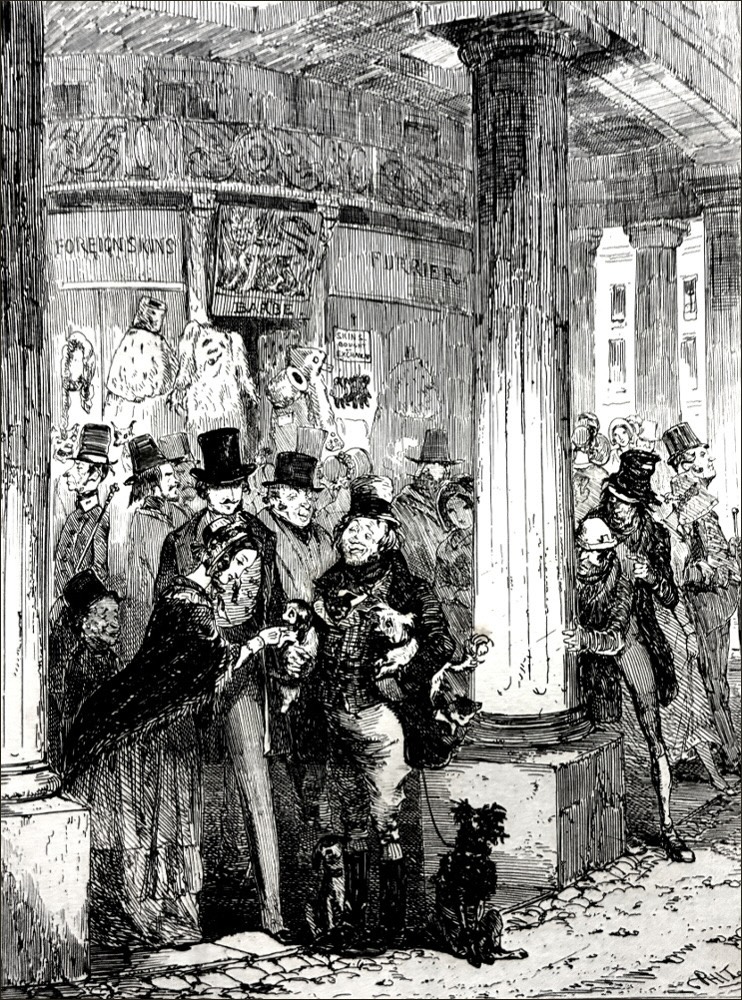
The Dog-fancier
Phiz
November 1844
13.5 cm high by 10.3 cm wide (5 ¼ by 4 inches), framed
Facing page 38, for William Harrison Ainsworth's Auriol; Or, The Elixir of Life (London: Chapman and Hall, 1850); facing p. 381 in serial.
[Click on the image to enlarge it and mouse over text for links.]
Scanned image & text by Philip V. Allingham.
[You may use this image without prior permission for any scholarly or educational purpose as long as you (1) credit the person who scanned the image and (2) link your document to this URL in a web document or cite the Victorian Web in a print one.]

Passage Illustrated: A Portrait of "Ginger," the London Underworld's "Dog-Fancier"
He was the waiter. The principal light was afforded by a candle stuck against the wall, with a tin reflector behind it. Before the fire, with his back turned towards it, stood a noticeable individual, clad in a velveteen jacket with ivory buttons, a striped waistcoat, drab knees, a faded black silk neckcloth tied in a great bow, and a pair of ancient Wellingtons ascending half-way up his legs, which looked disproportionately thin when compared with the upper part of his square, robustious, and somewhat pursy frame. His face was broad, jolly, and good-humoured, with a bottle-shaped nose, fleshy lips, and light grey eyes, glistening with cunning and roguery. His hair, which dangled in long flakes over his ears and neck, was of a dunnish red, as were also his whiskers and beard. A superannuated white castor, with a black hat-band round it, was cocked knowingly on one side of his head, and gave him a flashy and sporting look. His particular vocation was made manifest by the number of dogs he had about him. A beautiful black-and-tan spaniel, of Charles the Second's breed, popped its short snubby nose and long silken ears out of each coat-pocket. A pug was thrust into his breast, and he carried an exquisite Blenheim under either arm. At his feet reposed an Isle of Skye terrier, and a partly cropped French poodle, of snowy whiteness, with a red worsted riband round his throat. This person, it need scarcely be said, was a dog-fancier, or, in other words, a dealer in, and a stealer of, dogs, as well as a practiser of all the tricks connected with that nefarious trade. His self-satisfied air made it evident he thought himself a smart, clever fellow, — and adroit and knavish he was, no doubt, — while his droll, plausible, and rather winning manners helped him materially to impose upon his customers. His real name was Taylor, but he was known among his companions by the appellation of Ginger. On the entrance of the Sandman and the Tinker, he nodded familiarly to them, and with a sly look inquired —"Vell, my 'arties — wot luck?"
"Oh, pretty middlin'," replied the Sandman gruffly.
And seating himself at the table, near the fire, he kicked up the lad, who was lying fast asleep on the coals, and bade him fetch a pot of half-and-half. The Tinker took a place beside him, and they waited in silence the arrival of the liquor, which, when it came, was disposed of at a couple of pulls; while Mr. Ginger, seeing they were engaged, sauntered towards the card-table, attended by his four-footed companions.
"And now," said the Sandman, unable to control his curiosity longer, and taking out his pocket-book, "we'll see what fortun' has given us."
So saying, he unclasped the pocket-book, while the Tinker bent over him in eager curiosity. But their search for money was fruitless. Not a single bank-note was forthcoming. There were several memoranda and slips of paper, a few cards, and an almanac for the year — that was all. It was a great disappointment. ["Book the First — Ebba," Chapter II. "The Dog-Fancier," pp. 337-38]
Commentary
Phiz, taking his cue from Ainsworth's own description of the dog-napper while rejecting his disgusting surroundings, provides a vigorous realisation of Ainsworth's scene from London's nineteenth-century underworld in St. Giles. The young woman examining the dog and the classical column are entirely Phiz's invention. With the criminal cant that The Tinker and The Sandman exchange with the cunning Dog-Fancier, we seem to have entered the sordid underworld of John Gay's The Beggar's Opera, or perhaps a thieves' den in Dickens's Oliver Twist. After discussing the virtues of the dog-napper's trade, the recent arrivals examine the pocketbook which they have just extracted from the pockets of the unconscious Auriol at the ruined house on the Vauxhall Road. Their pal, Ginger, advises them to use it as the basis of an extortion scheme, since within it the writer refers to numerous murders that he has committed, going back fifty years.
Related Material
- Hablot Knight Browne, 1815-1882; A Brief Biography
- William Harrison Ainsworth (1805-1882)
- William Harrison Ainsworth (1805-1882) — King of the Historical Potboiler: A Brief Biography
Bibliography
Ainsworth, William Harrison. Auriol; Or, The Elixir of Life. Lcndon: Chapman and Hall, 1850; George Routledge and Sons, 1865.
Ainsworth, William Harrison. Revelations of London.. Ainsworth's Magazine. Vol. VII (October — December 1844).
Lester, Valerie Browne. Phiz: The Man Who Drew Dickens. London: Chatto and Windus, 2004.
Steig, Michael. Dickens and Phiz. Bloomington & London: Indiana U. P., 1978.
Sutherland, John A. "Auriol." The Stanford Companion to Victorian Fiction. Stanford, Cal.: Stanford U. P., 1989, rpt. 1990, 33.
Vann, J. Don. "Auriol; Or, The Elixir of Life in Ainsworth's Magazine, October 1844 — May 1845." Victorian Novels in Serial. New York: Modern Language Association, 1985. Pp. 24-25.
Victorian
Web
Illus-
tration
Phiz
Auriol
Next
25 September 2026