
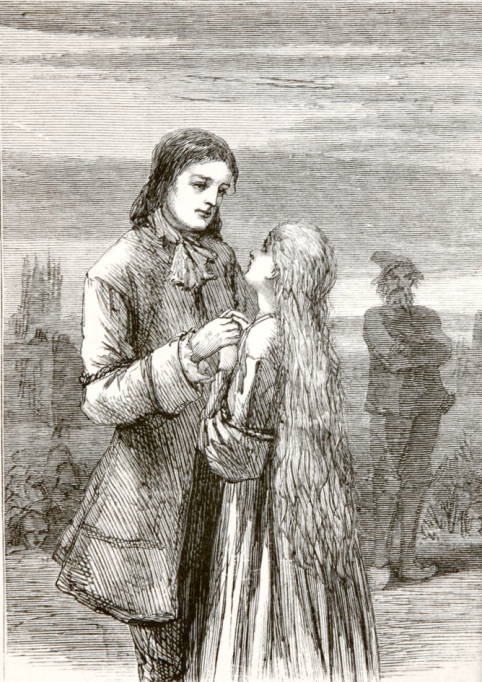
Sydney Carton and The Seamstress (frontispiece)
Sol Eytinge
Wood engraving, approximately 10 cm high by 7.5 cm wide (4 inches by 3 inches), framed.
1867
Charles Dickens, A Tale of Two Cities frontispiece for the Diamond Edition, Vol. XIII.
Scanned image and text by Philip V. Allingham.

Passage Realised: Carton's tenderness towards another blameless victim
The supposed Evremonde descends, and the seamstress is lifted out next after him. He has not relinquished her patient hand in getting out, but still holds it as he promised. He gently places her with her back to the crashing engine that constantly whirrs up and falls, and she looks into his face and thanks him.
"But for you, dear stranger, I should not be so composed, for I am naturally a poor little thing, faint of heart; nor should I have been able to raise my thoughts to Him who was put to death, that we might have hope and comfort here today. I think you were sent to me by Heaven."
"Or you to me," says Sydney Carton. "Keep your eyes upon me, dear child, and mind no other object."
"I mind nothing while I hold your hand. I shall mind nothing when I let it go, if they are rapid."
"They will be rapid. Fear not!"
The two stand in the fast-thinning throng of victims, but they speak as if they were alone. Eye to eye, voice to voice, hand to hand, heart to heart, these two children of the Universal Mother, else so wide apart and differing, have come together on the dark highway, to repair home together, and to rest in her bosom.
"Brave and generous friend, will you let me ask you one last question? I am very ignorant, and it troubles me — just a little."
"Tell me what it is."
"I have a cousin, an only relative and an orphan, like myself, whom I love very dearly. She is five years younger than I, and she lives in a farmer's house in the south country. Poverty parted us, and she knows nothing of my fate — for I cannot write — and if I could, how should I tell her! It is better as it is."
"Yes, yes, better as it is."
"What I have been thinking as we came along, and what I am still thinking now, as I look into your kind strong face which gives me so much support, is this: — If the Republic really does good to the poor, and they come to be less hungry, and in all ways to suffer less, she may live a long time: she may even live to be old."
"What then, my gentle sister?"
"Do you think"; the uncomplaining eyes in which there is so much endurance, fill with tears, and the lips part a little more and tremble: "that it will seem long to me, while I wait for her in the better land where I trust both you and I will be mercifully sheltered?"
"It cannot be, my child; there is no Time there, and no trouble there." [Book the Third, “The Track of a Storm,” Chapter XV, “The Footsteps Die out Forever”]
Commentary: Carton's Climactic Self-Sarifice Shown ahead of the Narrative
In this full-page dual character study in the compact American publication, a bearded Jacobin, arms crossed as if waiting, regards the couple, who seem oblivious to the context of their meeting, their impending execution at La Place de la Guillotine. Apparently they are already on the platform, if we may judge by the myriad of anonymous heads in the left-hand register. Perhaps inserted for the sake of irony, the spires of a Gothic church tower rise in the background, the only distinct feature of the urban setting.
For Eytinge, a student of human nature bent on revealing character through realistic portraiture, nothing must distract the Diamond Edition's reader from focussing on the characters' attitudes, and the moment of tenderness in the face of certain death. Thus, Eytinge has omitted even the instrument of their execution to realize Carton, dressed in the fashion of the young Marquis Ste. Evrémonde, Charles Darnay (with whom he has exchanged clothes) and the simply dressed seamstress, her hair tumbling down her back. This frontispiece, which was also the first full-page illustration in the 1867 Ticknor and Fields A Tale of Two Cities, differs from those that follow because it has an urban backdrop that conveys, if ever so sketchily, the revolutionary events that form the novel's historical context.
Compare Eytinge's Sydney Carton and The Seamstress to the climactic scene to Fred Barnard's 1874 sequence, The Third Tumbrel and John McLenan's American magazine serial plate The Two Stand in the Fast-thinning Throng of Victims," etc. (26 November 1859).
Relevant Illustrations from Other Editions: 1859, 1874, and 1910


Left: McLenan's 3 December 1859 depiction of Carton's comforting the little seamstress on the scaffold, The two stand in the fast-thinning throng of victims. Right: A slightly later British interpretation of the intimarte scene on the scaffold, Fred Barnard's sentimental dual portrait which concludes the Household Edition, The Third Tumbrel (Vol. VIII, 1874).
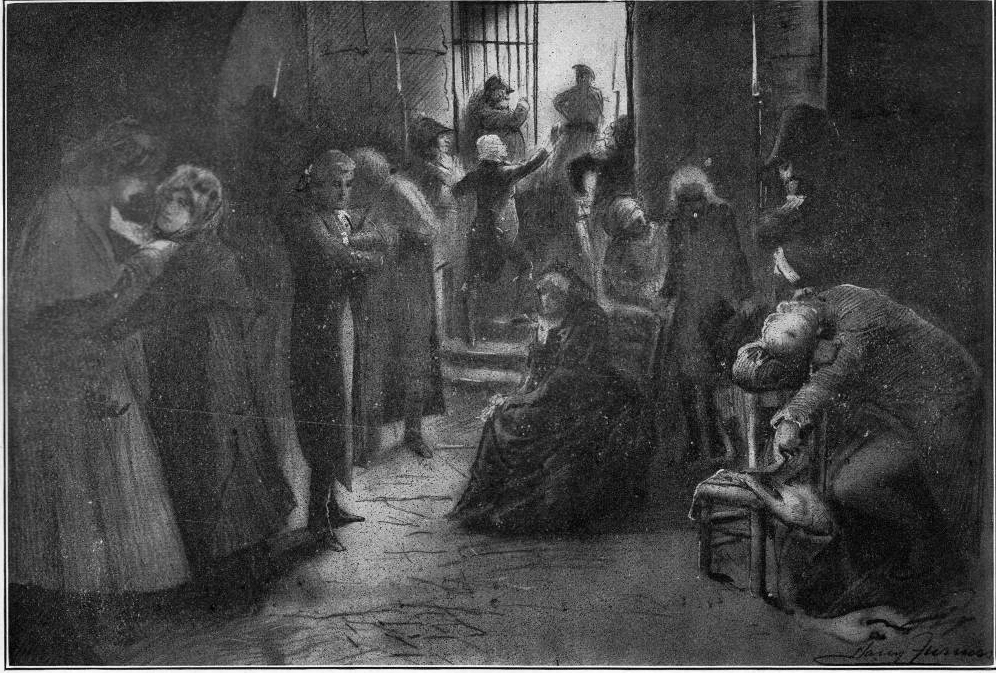
Above: Harry Furniss's atmospheric dark plate of the scene inside the prison in the Charles Dickens Library Edition, Book Three, Chapter Thirteen, Sydney Carton and the Little Seamstress (1910).
Bibliography
Allingham, Philip V. "'Charles Dickens's A Tale of Two Cities (1859) Illustrated: A Critical Reassessment of Hablot Knight Browne's Accompanying Plates." Dickens Studies Annual. 33 (2003): pp. 109-158.
Dickens, Charles. A Tale of Two Cities. Illustrated by John McLenan. Harper's Weekly. (26 November 1859): 765.
Dickens, Charles. A Tale of Two Cities. Illustrated by Hablot Knight Browne ("Phiz"). London: Chapman and Hall, November 1859.
Dickens, Charles. A Tale of Two Cities and Great Expectations. Illustrated by Sol Eytinge, Jr. The Diamond Edition. 14 vols. Boston: Ticknor and Fields, 1867. Vol. XIII.
Dickens, Charles. A Tale of Two Cities. Illustrated by Fred Barnard. The Household Edition. 22 vols. London: Chapman and Hall, 1874. Vol. VIII.
_____. A Tale of Two Cities. Illustrated by A. A. Dixon. London: Collins, 1905.
_____. A Tale of Two Cities, American Notes, and Pictures from Italy. Illustrated by Harry Furniss. Charles Dickens Library Edition. 18 vols. London: Educational Book Co., 1910. Vol. XIII.
Hammerton, J. A. The Dickens Picture-Book. The Charles Dickens Edition of the Works of Charles Dickens. London: Educational Book, 1910.
Maxwell, Richard, ed. "Appendix I: "On The Illustrations." Charles Dickens's A Tale of Two Cities. London: Penguin, 2003. Pp. 391-396.
Sanders, Andrew. "Introduction" to Charles Dickens's A Tale of Two Cities. Oxford: Oxford University Press, 1988.
Created 25 June 2011
Last modified 24 January 2026