
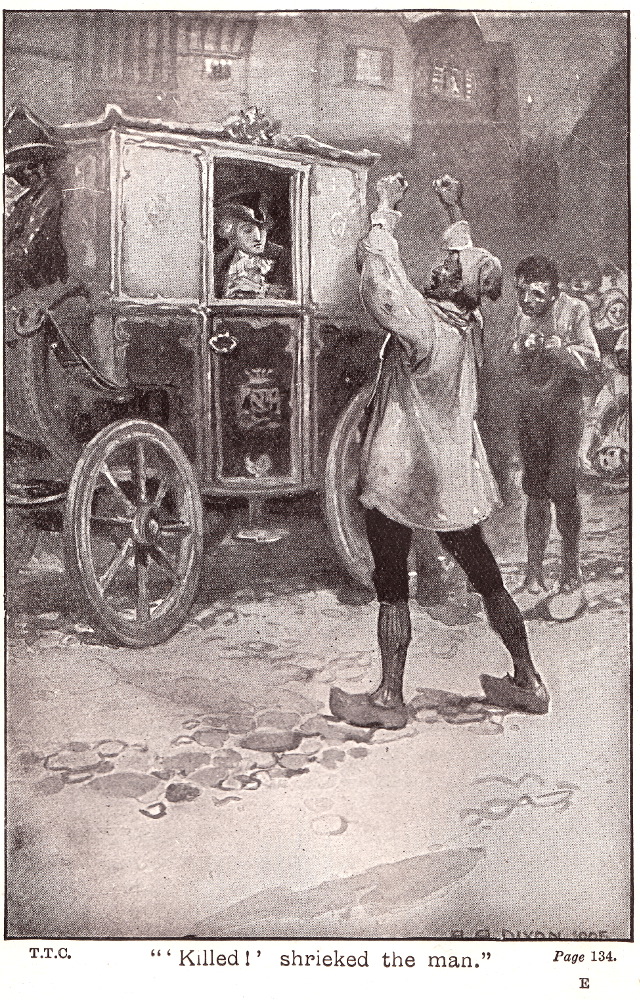
“Killed!” shrieked the man.
A. A. Dixon
1905
Watercolour as lithograph
11.9 cm by 8 cm, or 4 ⅝ by 3 ⅛ inches, framed
Fifth illustration for Collins edition, facing p. 129.
Book II, “The Golden Thread,” Ch. 7, “Monsiegneur in Town,” in the Collins edition, text p. 134; Text: Penguin edition p. 141. Oxford World's Classics edition p. 131. Gaspard confronts the Marquis over the death of his child in a Paris street.
Scanned image and text by Philip V. Allingham.

Passage Realised
“Pardon, Monsieur the Marquis!” said a ragged and submissive man, “it is a child.”
“Why does he make that abominable noise? Is it his child?”
“Excuse me, Monsieur the Marquis — it is a pity — yes.”
The fountain was a little removed; for the street opened, where it was, into a space some ten or twelve yards square. As the tall man suddenly got up from the ground, and came running at the carriage, Monsieur the Marquis clapped his hand for an instant on his sword-hilt.
“Killed!” shrieked the man, in wild desperation, extending both arms at their length above his head, and staring at him. “Dead!”
The people closed round, and looked at Monsieur the Marquis. [Book II, “The Golden Thread,” Ch. 7, “Monsiegneur in Town,” p. 134]
Relevant Illustrations of the Accident from Other Editions: 1859 and 1874
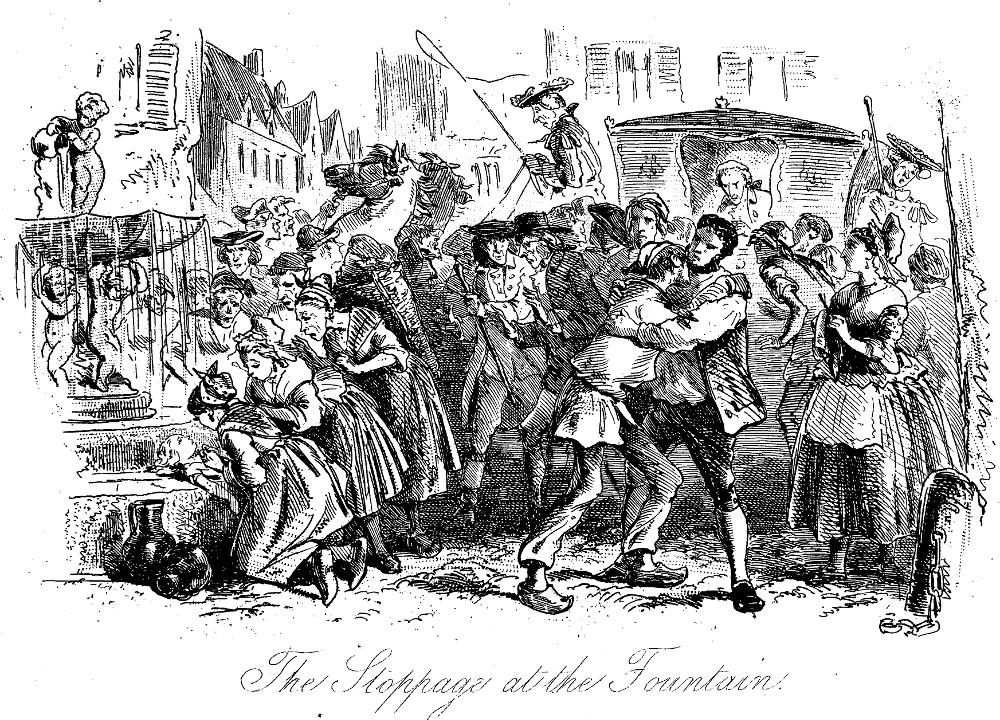

Left: Phiz's August 1859 Baroque depiction of the emotionally overwrought Gaspard in Defarge's arms at the fountain, Stoppage at the Fountain. Right: A somewhat less dramatic interpretation of the carriage accident in St. Antoine: Fred Barnard's scene of the urban poor confronting the Marquis in the Household Edition, He stooped a little, and with his tattered blue cap pointed under the carriage. All his fellows stooped to look under the carriage. (Vol. VIII, 1874).
Commentary: Contrasting Emotions in a Scene Depicting the Death of a Child
The utter aloofness of the fashionably dressed Marquis, just having come from Monsieur's reception for the elite, is despicable, but wholly consistent with the reader's previous experience of him: cold, aloof, and emotionally detached. Gaspard, one of the Defarges' customers, displays a set of completely contrasting emotions: his despair, grief, and rage have all been engendered by the sudden loss of his child under the merciless wheels of the callous Marquis' carriage, all completely understandable. But there is one other figure whom the reader at first does not take into account: the peasant who has doffed his cap, and bows in all humility and awe to the great nobleman, his eyes on the cobblestones of St. Antoine. Since the picture occurs some five pages ahead of the passage illustrated, the reader has had plenty of time to consider the three figures, and undoubtedly has very different responses towards each. Since the Marquis berates the boy's father for negligence as he worries about whether his horses have been hurt, the reader is least sympathetic to St. Evreacute;monde.
In what is manifestly not a crowd scene but a study in contrasting responses, Dixon has done away with such significant figures as Phiz's nervous driver (upper centre), Ernest Defarge (comforting the distraught father, down centre (right), and the foregrounding of the crowd of lamenting women (left in the August 1859 steel engraving). Dixon has, moreover, created an entirely new figure to represent the normative response of the entire crowd in the street (off right). He perhaps is to be taken as the "ragged and submissive man" (134) of Dickens's letterpress. The wrenching event (which the Marquis attempts to resolve with a gold coin) occurs immediately before the Marquis learns that his nephew, Charles, has just returned from England.
No longer under the carriage, the body of the child is already being attended to by the women in the right margin. The Marquis, surveying the scene from above in his ornate carriage, contrasts in facial expression with the distraught father in his simple wooden shoes in the lithograph entitled “Killed!” shrieked the man, virtually a tableau vivant or "freeze" from a stage production. The picture pits the irresponsible privilege of the aristocracy (St. Evrémonde in the ornate carriage) against the powerlessness of the common man (Gaspard in wooden shoes).
John McLenan in his 2 July 1859 wood-engraving for Harper's Weekly Magazine which bears the same title — "Killed!" shrieked the man. — depicts a decontextualised, distraught father, hands raised above his head, with St. Antoine's tragic chorus suggested by seven shadowy male figures. Dixon, however, moves in for the close-up, sharply contrasting the anguished parent and the mildly curious aristocrat. And, unlike Phiz in his August 1859 panoramic steel-engraving of the action-packed crowd scene — Stoppage at the Fountain, this telling early-twentieth-century image brings the adversaries face to face.
Other Illustrated Editions (1859-1910)
- Hablot K. Brown or 'Phiz'. No. 3 August: A Discussion of the August 1859 Plates
- John McLenan (64 illustrations, 1859)
- Sol Eytinge, Junior (8 illustrations, 1867)
- Fred Barnard (25 illustrations, 1874)
- Harry Furniss (32 illustrations, 1910)
Related Material
- How did Victorian critics define the historical novel? Cities 1859 — the last Dickens's novel "Phiz" Illustrated
- A Tale of Two Cities 1859 — the last Dickens's novel "Phiz" Illustrated
- A Tale of Two Cities (1859): A Model of the Integration of History and Literature
- Costume Notes on A Tale of Two Cities
- List of Phiz's Plates (21 November 1859) from the first volume edition.
- 25 Illustrations for Dickens's A Tale of Two Cities by Fred Barnard (from the Household Edition, 1874)
- The Fountain — An Allegory and The Marquis by Harry Furniss from Volume 13 in The Charles Dickens Library Edition (1910).
Bibliography
Allingham, Philip V. "Charles Dickens's A Tale of Two Cities (1859) Illustrated: A Critical Reassessment of Hablot Knight Browne's Accompanying Plates." Dickens Studies. 33 (2003): 109-158.
Dickens, Charles. A Tale of Two Cities. Illustrated by Phiz (Hablot Knight Browne). London: Chapman and Hall, 21 November 1859.
_______. A Tale of Two Cities. Illustrated by John McLenan. Harper's Weekly: A Journal of Civilization, 7 May through 3 December 1859.
_______. A Tale of Two Cities and Great Expectations. Diamond Edition. Illustrated by Sol Eytinge, Junior. Boston: Ticknor and Fields, 1867.
_______. A Tale of Two Cities. Illustrated by Fred Barnard. The Household Edition, 22 vols. London: Chapman and Hall, 1874. Vol. VIII.
_______. A Tale of Two Cities. Illustrated by A. A. Dixon with an engraved title by Harry Furniss. London: Collins, 1905. (From the personal collection of George Gorniak, Editor of The Dickens Magazine.)
_______. A Tale of Two Cities, American Notes, and Pictures from Italy. Illustrated by Harry Furniss. Charles Dickens Library Edition. 18 vols. London: Educational Book Company, 1910. Vol. XIII.
_______. A Tale of Two Cities: A story of the French Revolution. Project Gutenberg e-text by Judith Boss, Omaha, Nebraska. Release Date: September 25, 2004 [EBook #98].
Created 2 November 2013
Last updated 1 September 2026