
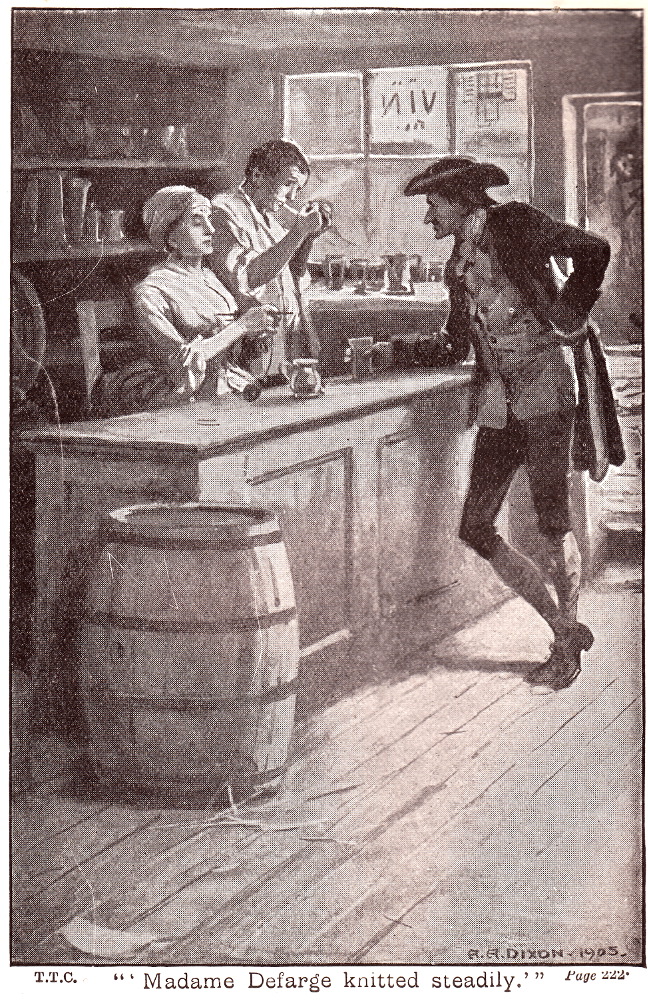
“Madame DeFarge knitted steadily.”
Arthur A. Dixon
1905
Watercolour as lithograph
12.1 cm by 8 cm, or 4 ¾ by 3 ⅛ inches, framed
Sixth illustration for Collins edition, facing p. 160.
Book II, “The Golden Thread,” Ch. 16, “Still Knitting,” p. 222. Penguin edition p. 214. Oxford World's Classics edition, p. 222. (The Defarges recognize the Spy, John Barsad.)
Scanned image and text by Philip V. Allingham.

Passage Realised: Is “The Admirable Woman” Ironic?
Next noontide saw the admirable woman in her usual place in the wine-shop, knitting away assiduously. A rose lay beside her, and if she now and then glanced at the flower, it was with no infraction of her usual preoccupied air. There were a few customers, drinking or not drinking, standing or seated, sprinkled about. The day was very hot, and heaps of flies, who were extending their inquisitive and adventurous perquisitions into all the glutinous little glasses near madame, fell dead at the bottom. Their decease made no impression on the other flies out promenading, who looked at them in the coolest manner (as if they themselves were elephants, or something as far removed), until they met the same fate. Curious to consider how heedless flies are! — perhaps they thought as much at Court that sunny summer day. [Book the Second, "The Golden Tread," Chapter XVI, "Still Knitting," p. 216-217]
Commentary: The Patient Spider records the arrival of another Fly in her Net
The precise meaning of "Defarge" is connected with the blacksmith's "forge," so that Dickens may merely be suggesting the couple's plebeian and commercial origins, — or he may be implying that their characters have been "forged in the fires" of adversity. Here, the Defarges entertain in their St. Antoine wine-shop an obviously un-plebeian visitor. Despite his fluent French, he is an Englishman — a police spy, in fact. And the former British undercover agent, John Barsad, who testified along with Roger Cly at the Old Bailey trial of Darnay, and who, subsequently thought dead, has now been "resurrected" at the St. Antoine Wine-Shop.
Madame Terese Defarge signals the presence of a police spy to the other customers by placing a rose in her hair. Although the cunning spy makes several leading remarks about royalist oppression and the redcent execution of Gaspard for the Marquis' murder, he fails to draw out treasonable responses from the careful publicans. She carefully knits his physical description and name into her record. As he sips his cognac, he surprises the attentive couple with the news that Lucie Manette has accepted the marriage proposal of the de facto Marquis St. Evrémonde, Charles Darnay.
Although the background is far from minimal, Dixon has placed no other figures in the barroom, and shows the Defarges as barely interested in the questioner, in contrast to how earlier illustrators Phiz (1859) and Barnard (1874) had developed the static scene. No crowd of imbibers in Phrygian overhears the dialogue, and only a single, indistinct figure in the street without passes by the open shop door. As in the text, Ernest lights his pipe, although he does not appear "troubled." For a portrait consistent with Dixon's image see Harry Furniss's “John Barsad,” the Spy in the Charles Dickens Library Edition (1910).
Relevant Illustrations of the Defarges and Barsad from Other Editions: 1859 and 1874
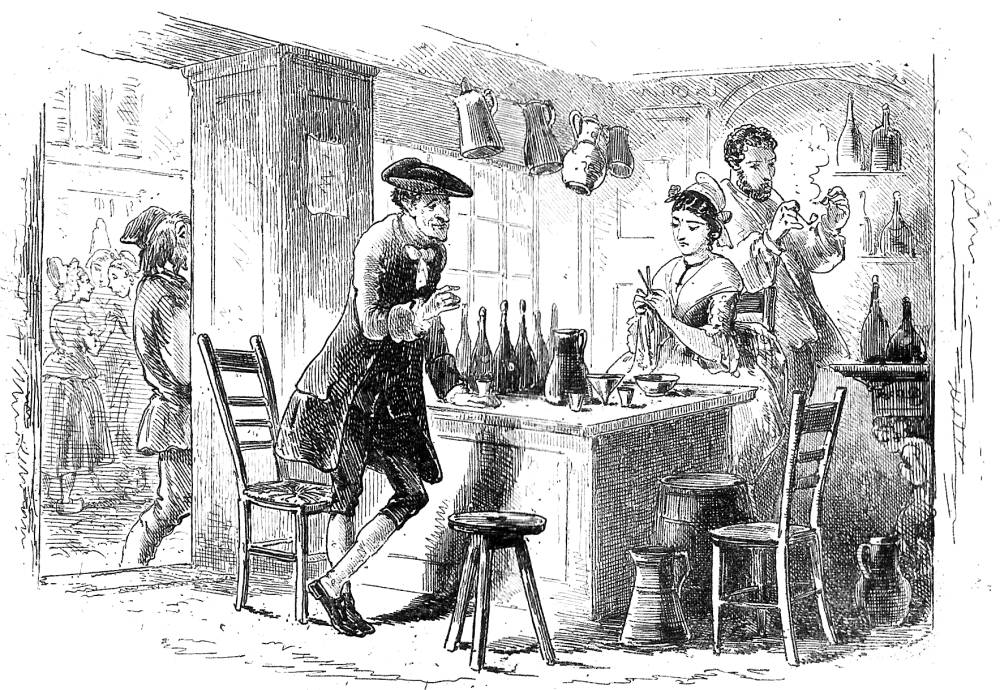

Left: Phiz's September 1859 depiction of the publicans in the social centre of the poverty-stricken suburb, The Wine-Shop. Right: A slightly later British interpretation of the St. Antoine pub, Fred Barnard's dramatic scene of the Jacques at the bar in the Household Edition, The Wine-Shop (Vol. VIII, 1874).
Other Illustrated Editions (1859-1910)
- Hablot K. Brown or 'Phiz' (16 monthly steel-engravings)
- John McLenan (64 wood-engravings, 1859)
- Sol Eytinge, Junior (8 wood-engravings, 1867)
- Fred Barnard (25 wood-engravings, 1874)
- Harry Furniss (32 lithographs, 1910)
Related Material
- A Tale of Two Cities 1859 — the last Dickens's novel "Phiz" Illustrated
- How did Victorian critics define the historical novel?
- A Tale of Two Cities (1859): A Model of the Integration of History and Literature
- Costume Notes on A Tale of Two Cities
- List of Phiz's Plates (21 November 1859) from the first volume edition.
- Compare to the headnote vignette by John McLenan in Harper's Weekly Magazine 13 August 1859
- 25 Illustrations for Dickens's A Tale of Two Cities by Fred Barnard (from the Household Edition, 1874)
- Darnay Arrested by Harry Furniss from Volume 13 in The Charles Dickens Library Edition (1910).
Bibliography
Dickens, Charles. A Tale of Two Cities. Illustrated by Hablot Knight Browne. London: Chapman and Hall, 1859.
Dickens, Charles. A Tale of Two Cities and Great Expectations. Diamond Edition. Illustrated by Sol Eytinge, Junior. Boston: Ticknor and Fields, 1867.
Dickens, Charles. A Tale of Two Cities. Illustrated by Fred Barnard. The Household Edition, 22 vols. London: Chapman and Hall, 1874. Vol. VIII.
Dickens, Charles. A Tale of Two Cities. Illustrated by A. A. Dixon. London: Collins, 1905. (From the personal collection of George Gorniak, Editor of The Dickens Magazine.)
Dickens, Charles. A Tale of Two Cities, American Notes, and Pictures from Italy. Illustrated by Harry Furniss. Charles Dickens Library Edition. 18 vols. London: Educational Book Company, 1910. Vol. XIII.
Created 2 November 2013
Last updated 31 August 2026