

“You are paid,” she said.
Arthur A. Dixon
1906
Lithographic reproduction of a watercolour
12.1 cm high by 8 cm wide (4 ⅞ by 3 ⅛ inches), framed.
Sixth illustration for Little Dorrit, Collins' Pocket Edition (1906), facing p. 534, referencing p. 535.
[Click on the image to enlarge it and mouse over text for links.]
Scanned image and text by Philip V. Allingham.

Passage Illustrated Rigaud has a rendezvous with Miss Wade and Tattycoram:
He stopped at the corner, seeming to look back expectantly up the street as if he had made an appointment with some one to meet him there; but he kept a careful eye on the three. When they came together, the man took off his hat, and made Miss Wade a bow. The girl appeared to say a few words as though she presented him, or accounted for his being late, or early, or what not; and then fell a pace or so behind, by herself. Miss Wade and the man then began to walk up and down; the man having the appearance of being extremely courteous and complimentary in manner; Miss Wade having the appearance of being extremely haughty.
When they came down to the corner and turned, she was saying, ‘If I pinch myself for it, sir, that is my business. Confine yourself to yours, and ask me no question.’
‘By Heaven, ma’am!’ he replied, making her another bow. ‘It was my profound respect for the strength of your character, and my admiration of your beauty.’
‘I want neither the one nor the other from any one,’ said she, ‘and certainly not from you of all creatures. Go on with your report.’
‘Am I pardoned?’ he asked, with an air of half abashed gallantry.
‘You are paid,’ she said, ‘and that is all you want.’ [Book Two, “Riches,” Chapter IX, “Appearance and Disappearance,” p. 535]
Commentary: Dickens's Devilish Frenchman, Rigaud: Gentleman Wife-murderer
Dickens has introduced the devilishly self-confident French criminal, Rigaud (alias, “Blandois”) as it were, by accident. Back in London, Clennam spots Tattycoram on a street with a foreigner of singular appearance, and follows them to a clandestine meeting with Miss Wade.
Although Dickens gives no physical description of Rigaud at this point, fortunately for the Edwardian illustrator he had multiple examples of Rigaud to draw upon in the plates of five earlier editions, in addition to Dickens's own description in the opening chapter, in the "villainous prison" at Marseilles:
The man who lay on the ledge of the grating was even chilled. He jerked his great cloak more heavily upon him by an impatient movement of one shoulder, and growled, ‘To the devil with this Brigand of a Sun that never shines in here!’
He was waiting to be fed, looking sideways through the bars that he might see the further down the stairs, with much of the expression of a wild beast in similar expectation. But his eyes, too close together, were not so nobly set in his head as those of the king of beasts are in his, and they were sharp rather than bright — pointed weapons with little surface to betray them. They had no depth or change; they glittered, and they opened and shut. So far, and waiving their use to himself, a clockmaker could have made a better pair. He had a hook nose, handsome after its kind, but too high between the eyes by probably just as much as his eyes were too near to one another. For the rest, he was large and tall in frame, had thin lips, where his thick moustache showed them at all, and a quantity of dry hair, of no definable colour, in its shaggy state, but shot with red. The hand with which he held the grating (seamed all over the back with ugly scratches newly healed), was unusually small and plump; would have been unusually white but for the prison grime. [Book the First, "Poverty," Chapter I, "Sun and Shadow," 11]
Michael Steig in Dickens and Phiz regards Dickens's dissatisfied financier and Mr. Merdle, his name suggestive of the French merde (excrement), as one of the book's "chief embodiments of evil" (168), the other being the wife-murderer and would-be extortionist Rigaud-Blandois. These figures derive from very different literary traditions: whereas Rigaud is a melodramatic villain, with foreign accent, a nutcracker visage, and predatory intentions expressed in suave but excessive gesticulation, Merdle the English banker of decidedly un-aristocratic origins epitomizes Thomas Carlyle's cash nexus — it is as if he is a mere cipher, nothing in himself, and quite ill-at-ease with himself:
While The Birds in the Cage depends on the emergence of detail from darkness, the scene of John Baptist's flight [a dark plate] (Bk 1, ch. 11), uses an elaborate pattern of dark and light . . . . The figure of John Baptist, who flees from the oppressive association with Rigaud now that they are out of prison, recalls Lady Dedlock in The lonely figure, or the woman on the bridge in The Night. [Steig, p. 164]
The key here is "oppressive association," since even a career criminal such as Cavelletto senses the malevolence of the gentlemanly Frenchman of many names. Dickens employs him to reveal Mrs. Clennam's nefarious activities. His attempts to blackmail her are cut short by Nemesis as he is killed in the sudden collapse of her house. Dickens based the devious, snake-like villain on various theatrical traditions (particularly the melodramatic villain) and on the British public's lingering fears of the violence of the French Revolution, rather than on any single sinister prototype. What Dixon contributes to our appreciation of the villain is his exquisite fashion sense.
Pertinent illustrations in five other editions: 1856-7, 1863, 1867, 1873, and 1910
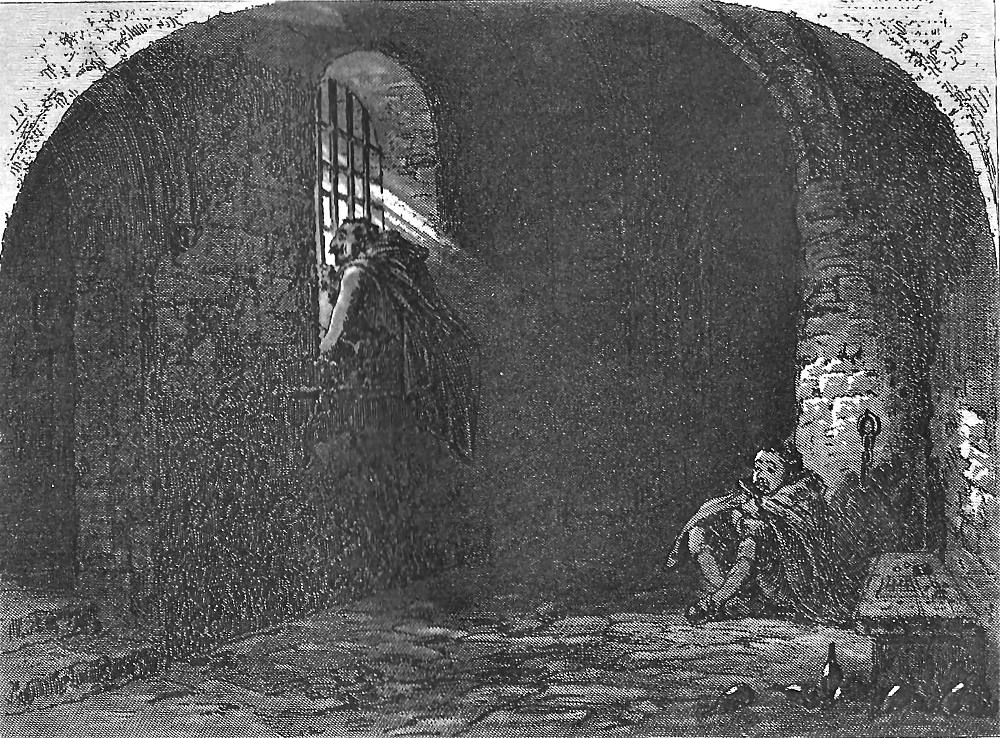

Left: Phiz's setting of the scene in the Marseilles prison cell with Rigaud and Jean Baptist Cavelletto, The Birds in the Cage (December 1855). Right: Phiz's illustration of Rigaud in Part 13 (December 1856), Mr. Flintwinch receives the Embrace of Friendship, for Book II, Chapter 10.
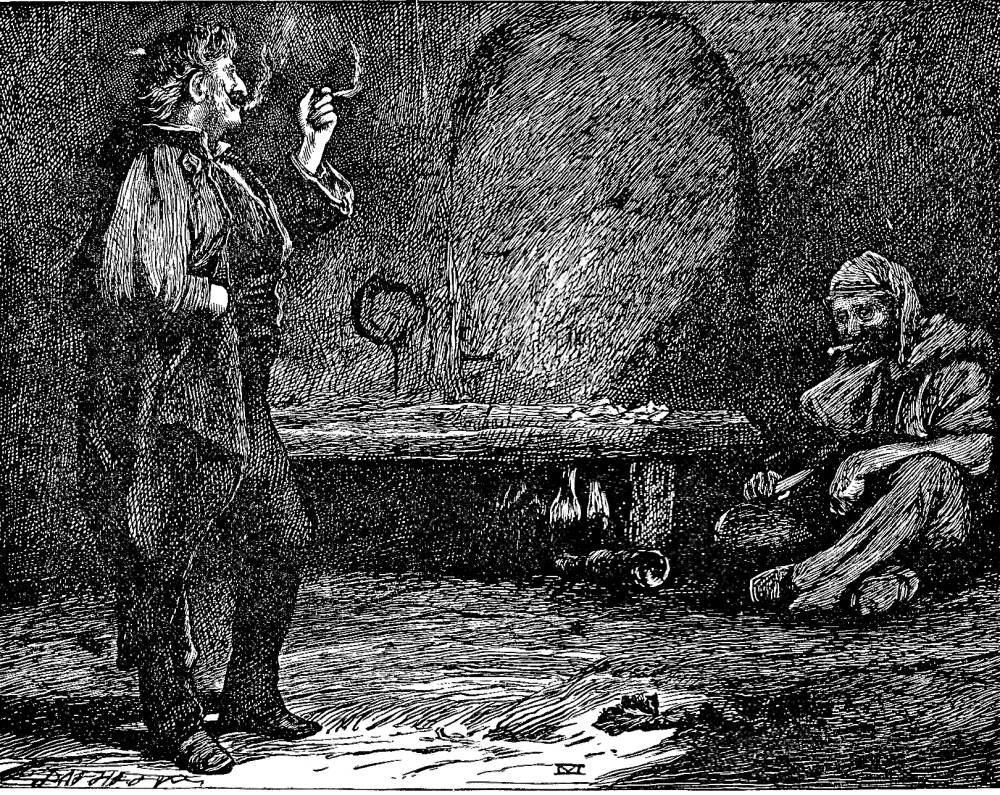

Left: James Mahoney's third Household Edition illustration, again in the Marseilles prison cell with Rigaud and Cavelletto, “I am a citizen of the world.” (1873). Right: Mahoney's illustration of Rigaud's conducting surveillance of Mrs. Gowan and Little Dorrit, in Book Two, Chapter 7, “Good-bye, my love! Good-bye!” he last words were spoken aloud as the vigilant Blandois stopped, turned his head, and looked at them from the bottom of the staircase (p. 257).
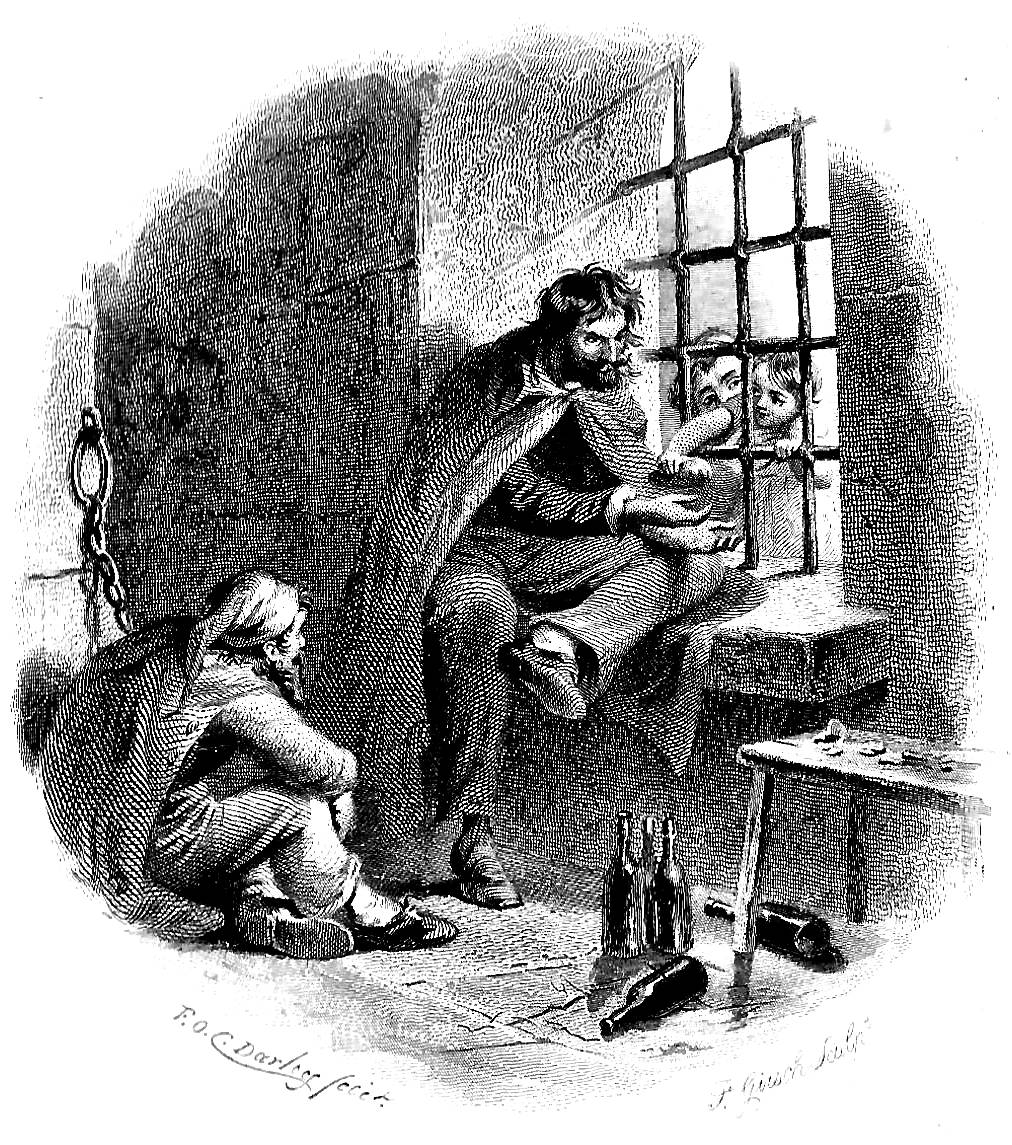


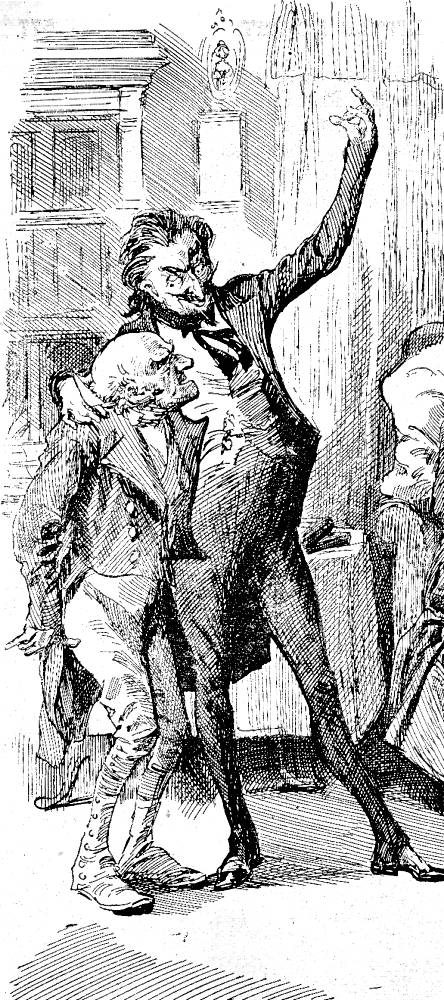
Far left: Felix Darley's photogravure frontispiece for the first volume of the 1863 New York edition, Feeding the Birds for Book I, Chapter 1. Left of centre: Sol Eytinge, Junior's study of the two Marseilles prisoners, Rigaud and Cavelletto (1867), as described in Book I, Chapter 1. Right of centre: An early moment in the narrative that afforded Furniss the opportunity for a dual portrait: of Cavelletto and Rigaud, John Baptist runs away from his Patron (1910). Right: Another Furniss dual portrait, The Plotters for Book II, Chapter 10 (1910) [Click on the images to enlarge them.]
Related Material: The Other Illustrated Editions (1863 — 1910)
- Illustrations by "Phiz" (Hablot Knight Browne) for Little Dorrit (December 1855 — June 1857)
- James Mahoney's 58 illustrations for Dickens's Little Dorrit (1873)
- Harry Furniss's 29 illustrations for Dickens's Little Dorrit (1910)
- Charles Dickens's Little Dorrit (1857): Site Map
- Felix Octavius Carr Darley — three engraved frontispieces, volumes 1, 2, and 4: 1863)
- Illustrations by Sol Eytinge, Jr. — 16 plates from the Ticknor and Fields' Diamond Edition (1867)
Bibliography
Dickens, Charles. Little Dorrit. Illustrated by Hablot Knight Browne ("Phiz"). The Authentic Edition. London: Chapman and Hall, 1901 [rpt. 30 May 1857 volume].
Dickens, Charles. Little Dorrit. Frontispieces by Felix Octavius Carr Darley and Sir John Gilbert. The Household Edition. 55 vols. New York: Sheldon & Co., 1863. 4 vols.
Dickens, Charles. Little Dorrit. Illustrated by Sol Eytinge, Jr. The Diamond Edition. 14 vols. Boston: Ticknor & Fields, 1867.
Dickens, Charles. Little Dorrit. Illustrated by James Mahoney. The Household Edition. 22 vols. London: Chapman and Hall, 1873. Vol. V.
Dickens, Charles. Little Dorrit. Illustrated by A. A. Dixon. With an engraved title by Harry Furniss. London and Glasgow: Collins Clear-Type Press, 1906.
Dickens, Charles. Little Dorrit. Illustrated by Harry Furniss. The Charles Dickens Library Edition. 18 vols. London: Educational Book, 1910. Vol. XII.
Steig, Michael. "Chapter 6: Bleak House and Little Dorrit: Iconography of Darkness." Dickens and Phiz. Bloomington: Indiana University Press, 1978.
Created 10 September 2026