
The Dalziel brothers were the most prominent wood engravers of the Victorian age: not only master-craftsmen, they commissioned many artists and (usually in conjunction with George Routledge) published the outstanding gift-books of the period. Three of the brothers, George, Edward and Thomas (1823–1906), were illustrators, although their achievements as visual artists have been eclipsed by their association with the family company.

Photographic portrait of Thomas Bolton Gilchrist Septimus Dalziel in middle age, circa 1870. Joseph Pennell describes him as ‘a very big man’ (92). © The National Portrait Gallery, London. Reproduced under the terms of the Creative Commons Attribution-NonCommercial-NoDerivs 3.0 Unported CC BY-NC-ND 3.0 Deed.
Thomas was the most productive of the siblings. Only employed by the firm to finish or correct other’s drawings and never to conduct or supervise the engraving work, he was a prolific artist in his own right. He was the sole illustrator of Bunyan’s Pilgrim’s Progress [1865] along with numerous books for children, and is well-represented in the Dalziels’ monumental Bible Gallery (1880–81). Apparently untrained in fine art – having earlier completed an apprenticeship in copper engraving – he was a painter and exhibited work at the Royal Academy, Suffolk Street Galleries, the British Institute, and elsewhere (see Graves 71).
However, his body of work has never been the subject of detailed investigation. His paintings are barely noticed and his wood-engravings, the focus of his output, are usually described in half-hearted terms. For Philip Allingham, Dalziel’s designs ‘are workmanlike rather than inspired’ (Edward and Thomas Dalziel); Percy Muir takes a similar approach, noting that his work in The Arabian Nights(1865) is ‘rather good’ (140) but inconsistent; and for Edward Hodnett he remains a shallowly ‘professional’ illustrator who occasionally showed ‘how good he could be’ (151). Slightly more positive are Forrest Reid and Joseph Pennell. Reid praises the artist’s ‘admirable vignettes’ and landscapes (251–52), while Pennell believes he was capable of ‘remarkable drawings’ (92).
Where, then, to place this highly productive practitioner? Is he just, as Reid puts it, one of the ‘rank and file?’ (247). The sheer volume of Dalziel’s work makes a balanced assessment problematic, but it is also true that critics have underrated his eye for telling figure-groups. He was also a highly expressive designer of landscapes – a quality that Reid identifies as his greatest strength (251). These two elements – figures and landscapes – are worth considering.
Figures
Sixties illustration is largely concerned with the dramatic qualities of human interaction. Facial expressions, underplayed gestures, posture and the dynamics of the gaze are all important features of this type of ‘poetic realism’ as it was developed by Fred Walker, George Du Maurier, Arthur Boyd Houghton and especially J. E. Millais. Dalziel is part of this discourse, offering many designs in which the psychological content of a scene is projected in single figures or in the relationships at work within figure groups.
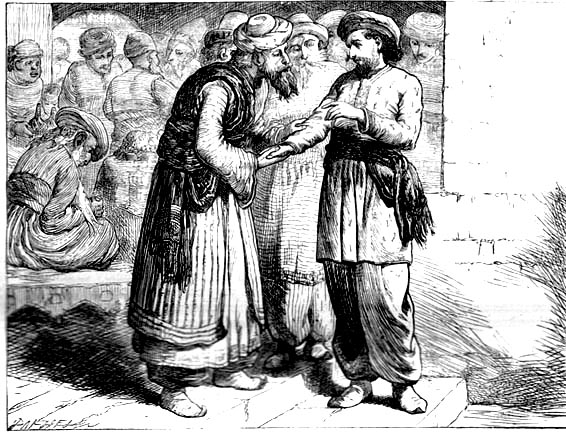
Dalziel’s The Young Man Desiring to Depart.
In building these expressive groups, Dalziel focuses on small but telling gestures, especially those involving the characters’ hands. In his work for The Arabian Nights [1865], for instance, he concentrates on key moments in which the narrative and its psychological implications are economically conveyed in the placing of a finger, a touch on a shoulder, a closed or opened palm or some other, related movement. The Young Man Desiring to Depart typifies this approach: the master of the house sincerely wants the ‘young stranger’ to remain, holds his hand and puts a reassuring hand on his arm, while the visitor raises his hand to stress his view that he cannot stay because he is offended by the barber’s comments (213). It is a complex interaction, but Dalziel epitomizes its dynamic in his arrangement of the gestures.
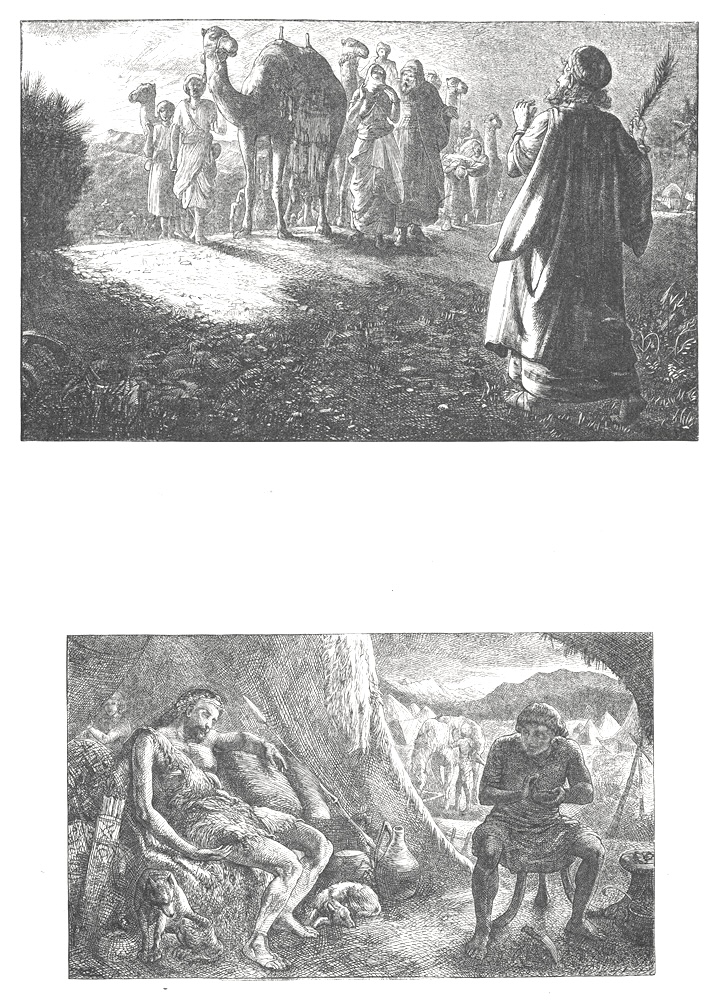
Above:Isaac Meeting Rebecca. Below: Esau Selling his Birthright.
Many other, parallel situations appear throughout the Arabian Nights. In many cases, the hand-gestures convey deep emotion, and the same is true of the artist’s visualization of the drama of the Old Testament in the Dalziels’ Bible Gallery (1880–81). Isaac Meeting Rebecca and Esau Selling his Birthright exemplify the illustrator’s telling deployment of meaningful hands. In the first of these, Isaac’s surprise and delight at seeing his bride for the first time is touchingly illustrated by his upraised arm, his palm half-opened. In the second, by contrast, the emphasis is on negative feeling as Jacob deceives Esau. Esau’s vulnerability is expressed by his open gesture, while Jacob’s deceit is conveyed by the way in which he uses his hand, apparently to shield the soup, but really to suggest his lying as he conceals his thoughts.
Dalziel’s focus, in other words, is on the representation of feeling in what could be described as a universal language of gesture. His approach is interesting because he was also concerned with making his Oriental and biblical figures seem historically exact. In his work for The Arabian Nights he was careful to dress his characters in costumes provided by his collaborator, A.B. Houghton (Dalziel 222), and in the Gallery he presents them in what was believed to be the correct attire. Yet he balances this historical specificity against a more generalized code-system of hand movements – a mode of conveying emotion that was instantly comprehensible to his contemporary Victorian audience.
Figures in a Landscape
Dalziel’s figure compositions are interpretive designs, elucidating their texts in a series of well-conceived designs. But he was most interested in visualizing the relationship between figures, landscapes and seascapes: sometimes he focuses on the harsh physical difficulties posed by a turbulent nature, and sometimes his emphasis is on a pantheistic linkage between nature and human emotion.
The sheer hardness of the material world is exemplified by his illustrations for religious or quasi-religious narratives. Christian’s travails Climbing the Hill of Difficulty for The Pilgrim’s Progress (1863) typifies Dalziel’s capacity to represent brutal nature, showing the voyager’s vertiginous ascent up a rocky, weedy hillside. In his illustration for Robert Buchanan’s ‘Meg Blane’ in North Coast (1867), on the other hand, he strongly evokes the menace of the sea, depicting his fisherman as an heroic figure framed by thrashing, muscular waves; the water rises like mountain tops and the endless movement is amplified by jagged, diagonalized lightning.


Dalziel’s poetic perception of a hostile world. Left: the allegorical landscape that still resonates physically in his visualization of Bunyan’s Hill of Difficulty. Right: The fisherman’s epic struggle with the sea, in an illustration of Buchanan’s ‘Meg Blane.’
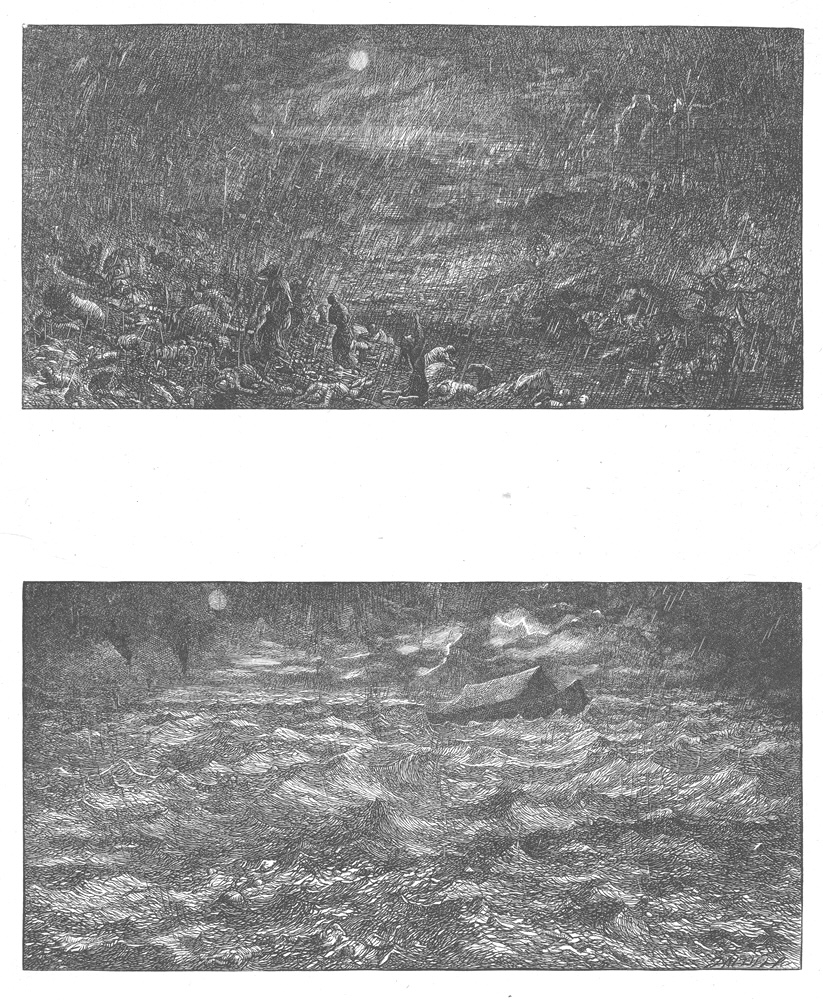
Above:The Deluge. Below: The Ark upon the Water.
Dalziel’s capacity to evoke the colossal power of nature ia further developed in his apocalyptic designs for the Bible Gallery. In The Deluge and The Ark upon the Waters he again evokes the forces of the irresistible: in the first image he collapses the picture-surface into a series of writhing lines, highlighted by chiaroscuro effects and staccato white lines, to represent the rain; and in the second the sea is figured as a convulsive broken plane of tossing pyramidal shapes. God is the motivator of nature in these designs, and Dalziel implies the divinity’s Old Testament authority by showing how nature seems stretched to the point of collapse under His hand and humanity is very much the plaything of omnipotence. Moreover, the same effects are projected in The Destruction of Sodom, with Lot’s family escaping in the foreground and the city, a mass of flame, glowing in the distance as if it had been the subject of a firebombing. In both designs he creates what Reid describes as ‘striking atmospheric effects of light and darkness, cloud, water, and mist’ (252).
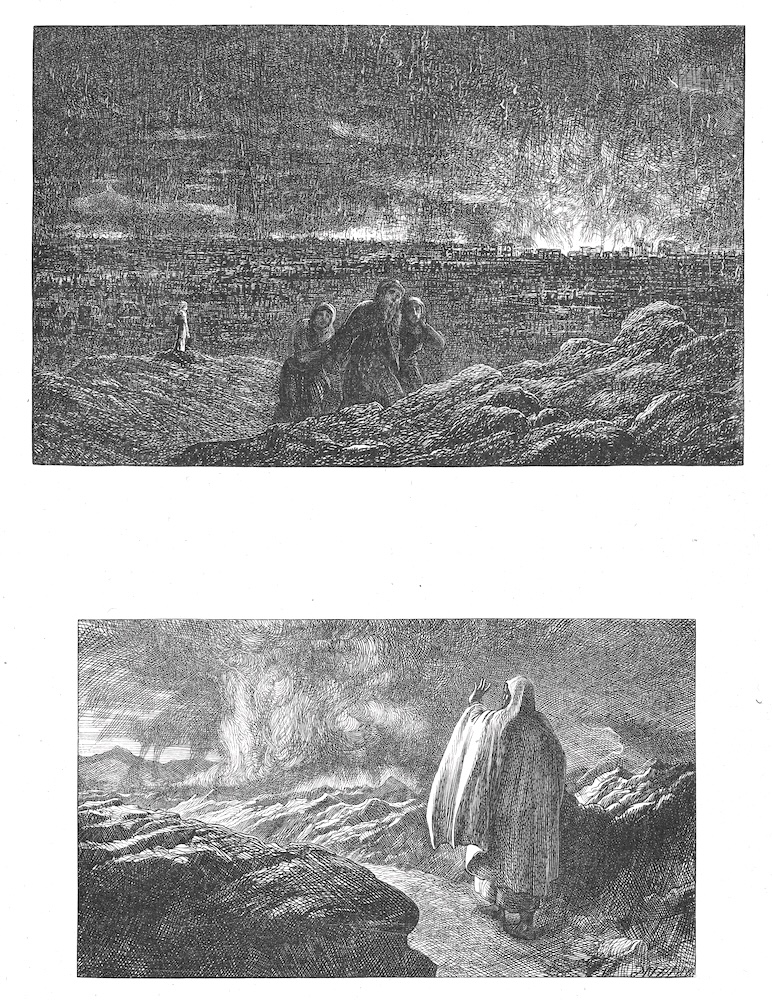
Above:The Destruction of Sodom. Below: Abraham looking towards Sodom. Dalziel’s chiaroscuro effects are brilliantly realized by the engraving and showcase the quality of the company’s work.
Dalziel was equally adept at visualizing nature as a reflection of melancholy or more serene states of mind. His working of the Pathetic Fallacy is displayed to best effect in his illustrations for Jean Ingelow’s Poems (1867). Particularly moving are his visualizations of ‘Divided,’ a typically sentimental lament of the parting of two lifetime lovers, with the woman apparently waiting for his return for overseas – although the implication is that they have really been divided by his death. Dalziel traces the impact of that loss, first of all showing the characters as children in a harmonious nature, but later focusing on psychological division by showing them on either side of a river. In these latter designs he encapsulates grieving in moonlit or twilight scenes, with nature acting as a concomitant or symbol of the woman’s feelings.
Similar in effect is his illustration for ‘Seven Times Seven,’ another lament for a man’s return in which the bereft woman is shown looking out to sea:
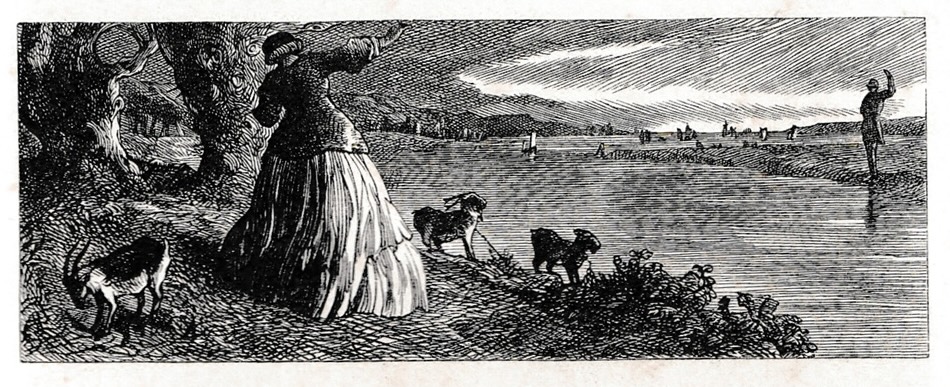

Two scenes from Dalziel’s landscapes in Jean Ingelow’s ‘Divided,’ in her Poems.
The emphasis, again, is on the responsiveness of the land and seascape, with the water and sky projecting a physical void to symbolize the character’s emotional emptiness and grief. The effect is moving: in Reid’s words, it is ‘a beautiful thing, full of atmosphere,’ the epitome of ‘vastness, loneliness, and mystery’ (252).
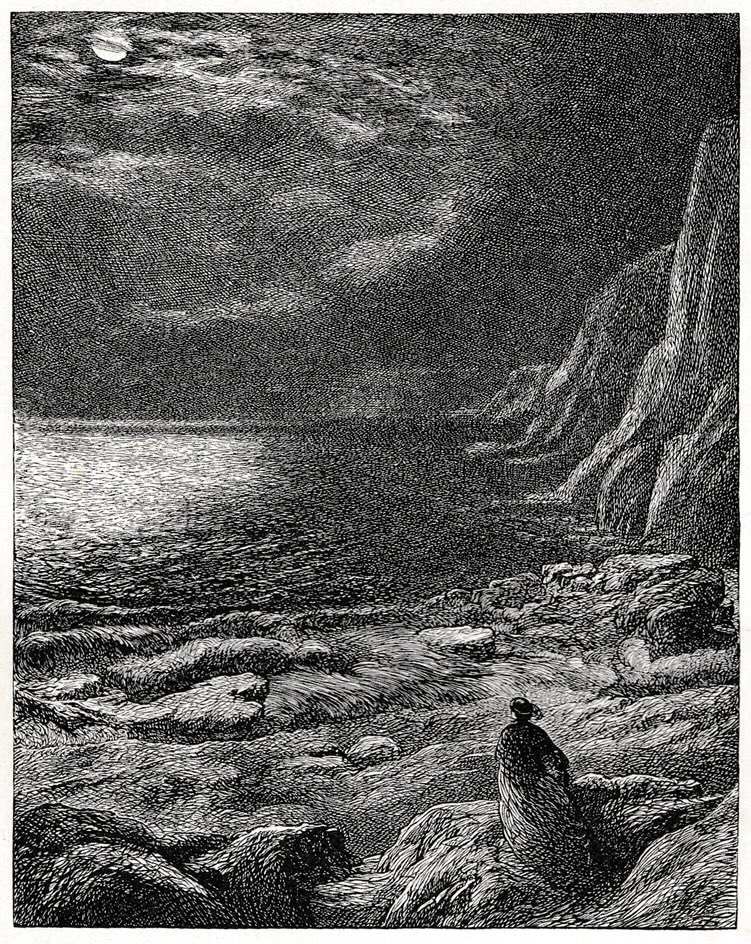
Dalziel’s atmospheric representation of the empty sea in ‘Seven Times Seven’ in Jean Ingelow’s Poems.
We can see, in short, that Dalziel was an accomplished illustrator of figure and landscape, and it is probably fair to say that he was a better designer than he is credited for. Creating illustrations which vary between epic drama and the representation of intimate relationships, he was also sensitive to the intertwining of nature and human nature. Though associated with the Dalziel empire, he stands in his own right as an interesting contributor to the discourse of Sixties illustration.
Bibliography
Primary
Buchanan, Robert.North Coast and Other Poems. London: Routledge, 1868.
Bunyan, John. The Pilgrim’s Progress. London: Ward & Lock [1865].
Dalziels’ Bible Gallery. London: Routledge, 1881 [1880].
Dalziels’ Illustrated Arabian Nights. London: Ward & Lock [1865, 2 vols. rpt. In 1 vol, 1870].
Ingelow, Jean. Poems. London: Longmans, Green, Reader & Dyer, 1867.
Secondary
Allingham, Philip. Edward and Thomas Dalziel. The Victorian Web. https://victorianweb.org/art/illustration/dalziel/pva81.html
The Brothers Dalziel. A Record of Work, 1840–1890. 1901; rpt. with a Foreword by Graham Reynolds. London: Batsford, 1978.
Graves, Algernon. A Dictionary of Artists Who Have Exhibited Works in the Principal London Exhibitions from 1760 to 1893. London: Henry Graves, 1895; Rpt. Bath: Kingsmead, 1970.
Hodnett, Edward. Five Centuries of English Book Illustration. Aldershot: Scolar, 1988.
Muir, Percy. Victorian Illustrated Books. London: Batsford, 1971; rev. ed. 1985.
Pennell, Joseph. Modern Illustration. London: Bell, 1895.
Reid, Forrest. Illustrators of the Eighteen Sixties. 1928; reprint, New York: Dover, 1975.
Created 24 August 2026