
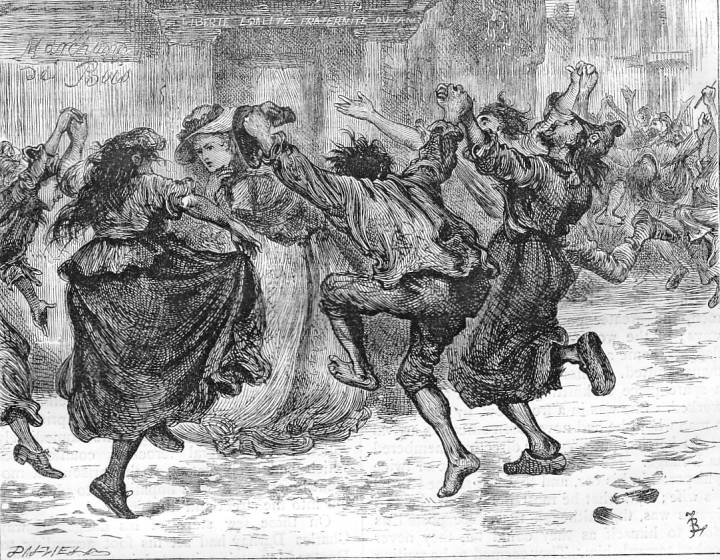
The Carmagnole by Fred Barnard in Volume VIII of the Household Edition (1874), 10.7 cm by 13.8 cm (4 ¼ inches by 5 ½ inches), framed (p. 132). In his second expose of the grim realities behind the slogan "Liberty, Equality, and Fraternity" ("Liberté, Égalité, et Fraternité") Fred Barnard realises the moment at which Lucie Manette finds herself entrapped in a bacchanal near the prison of La Force where she has been visiting her incarcerated husband in "The Wood-Sawyer" in Dickens's A Tale of Two Cities, Book the Third, "The Track of a Storm," Chap. V, originally in the November 1859 monthly number. [Click on the image to enlarge it.]
Passage Illustrated: "Dancing like Five Thousand Demons."
. . . presently she heard a troubled movement and a shouting coming along, which filled her with fear. A moment afterwards, and a throng of people came pouring round the corner by the prison wall, in the midst of whom was the wood-sawyer hand-in-hand with The Vengeance. There could not be fewer than five hundred people, and they were dancing like five thousand demons. There was no other music than their own singing. They danced to the popular Revolution song, keeping a ferocious time that was like a gnashing of teeth in unison. Men and women danced together, women danced together, men danced together, ashazard had brought them together. At first, they were a mere storm of coarse red caps and coarse woollen rags; but, as they filled the place, and stopped to dance about Lucie, some ghastly apparition of a dance-figure gone raving mad arose among them. They advanced, retreated, struck at one another's hands, clutched at one another's heads, spun round alone, caught one another and spun round in pairs, until many of them dropped. While those were down, the rest linked hand-in-hand, and all spun round together: then the ring broke, and in separate rings of two and four they turned and turned until they all stopped at once, began again, struck, clutched, and tore, and then reversed the spin, and all spun round another way. Suddenly they stopped again, paused, struck out the time afresh, formed into lines the width of the public way, and, with their heads low down and their hands high up, swooped screaming off. No fight could have been half so terrible as this dance. It was so emphatically a fallen sport — a something, once innocent, delivered over to all devilry — a healthy pastime changed into a means of angering the blood, bewildering the senses, and steeling the heart. Such grace as was visible in it, made it the uglier, showing how warped and perverted all things good by nature were become. The maidenly bosom bared to this, the pretty almost-child's head thus distracted, the delicate foot mincing in this slough of blood and dirt, were types of the disjointed time.
This was the Carmagnole. [Book the Third, "The Track of a Storm," Chap. V, "The Wood-Sawyer," 129]
Commentary: A Proletarian Bacchanal
Having already encountered the passage realised in The Carmagnole several pages in advance of the actual illustration, the reader is tempted to revert to the passage to see how Barnard has visualised Dickens's riotous street scene which involves the Gothic novelist's suspense-generating device of placing a child or young woman in danger. The place is near Lucie's station outside the walls of La Force, a location that enables her to see the upper window to which her husband can occasionally gain access at mid-afternoon. Often she has little Lucie with her when, lingering up to two hours at a time, she is frequently accosted by the wood-sawyer, who calls his saw his "Little Guillotine" because he fancies that in cutting billets he is chopping off the heads of entire families of aristocrats. And so a year and three months of her husband's imprisonment go by without event — until this winter's day at the little shop of the wood-sawyer.
John McLenan in the Harper's Weekly series had depicted the wood-sawyer as simple worker in "I call myself the Samson of the fire-wood guillotine" (8 October 1859), but Barnard chooses a much more dramatic moment in the same chapter for illustration, showing the wood-sawyer (centre) as an ecstatic celebrant in an orgiastic dance of dozens of Saint Antoine "patriots," including a bearded woman in wooden clogs and Jacobin cap whom we may suppose is Madame Defarge's special friend, The Vengeance. Just left of centre, trapped in the middle of the circle of dancers, is Lucie, in respectable hat and dress, in sharp contrast to the ragged jackets worn by these working-class revolutionaries, the very sort of garb worn by Piedmontese peasants in Carmagnola, Italy.
In the markedly urban background Barnard has identified the wood-sawyer's shop by two signs in French: to the left, "Marchand de Bois," and just above Lucie's head "Liberté, Égalité, Fraternité ou Morte" — the latter being a precise translation of what Dickens terms the "standard inscription" for the houses thereabout, "Death" on the wood-sawyer's sign apparently having been worked with some difficulty.
Other Illustrated Editions (1859-1910)
- Hablot K. Brown or 'Phiz' (16 illustrations, 1859)
- Sol Eytinge, Junior (8 illustrations, 1867)
- John McLenan (63 illustrations, 1859)
- A. A. Dixon (12 illustrations, 1905)
- Harry Furniss (32 illustrations, 1910)
Related Material
- John McLenan's Thirty-One Headnote Vignettes for A Tale of Two Cities in Harper's Weekly (7 May — 3 December 1859)
- McLenan's and Phiz's Illustrations for
A Tale of Two Cities (1859): A Correspondence?
- Images of the French Revolution from Various Editions of A Tale of Two Cities (1859-1910)
- French Revolution
- "A Tale of Two Cities (1859): A Model of the Integration of History and Literature"
Scanned image and text by Philip V. Allingham. [You may use this image without prior permission for any scholarly or educational purpose as long as you (1) credit the person who scanned the image, and (2) link your document to this URL in a web document or cite it in a print one.]
Bibliography
Allingham, Philip V. "Charles Dickens's A Tale of Two Cities (1859) Illustrated: A Critical Reassessment of Hablot Knight Browne's Accompanying Plates." Dickens Studies. 33 (2003): 109-158.

Davis, Paul. Charles Dickens A to Z: The Essential Reference to His Life and Work. New York: Checkmark and Facts On File, 1998.
Dickens, Charles. A Tale of Two Cities. Illustrated by Phiz. London: Chapman & Hall, 1859.
Dickens, Charles. A Tale of Two Cities. Illustrated by Fred Barnard. The Household Edition. London: Chapman & Hall, 1874.
Dickens, Charles. A Tale of Two Cities. Illustrated by John McLenan. Harper's Weekly. (21 May 1859): 325.
Dickens, Charles, and Fred Barnard. The Dickens Souvenir Book. London: Chapman & Hall, 1912.
Created 6 March 2011
Last updated 18 December 2025