
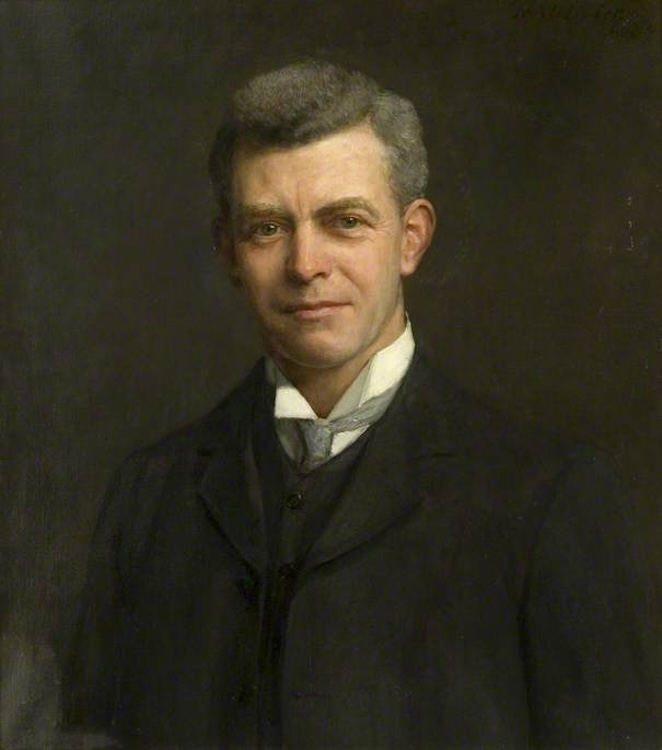
Portrait of Nicholson by Herbert Arnould Olivier.
[Click on the image for more information.]
Charles Archibald Nicholson (1867-1949), who became Sir Charles Nicholson in 1903 after inheriting his father's baronetcy, came from a highly cultured and distinguished family and was an important late nineteenth-century and early twentieth-century architect: "His work was confined mainly to ecclesiastical architecture, and he was known to be a most experienced architect of his generation in the Gothic style" (Obituary, p. 300).
Born in Hadleigh, Essex, Nicholson was the eldest son of Sir Charles Nicholson, who had spent the best part of thirty years in Australia and had been a major public figure there — amongst other roles, he was one of the founders and the first chancellor of Sydney University. His eldest son, the future architect, was born after his return and educated at Rugby and New College, Oxford, both inspiring places for anyone with an eye for architecture. He was then articled to John Dando Sedding, carrying on the practice after Sedding's death with Henry Wilson, who had been Sedding's Chief Assistant. In these early years in the profession, therefore, Nicholson was at the heart of both Gothic Revivalism and the Arts and Crafts Movement ethos. Nicholson had also been, briefly, an assistant to Temple Lushington Moore (1856-1920), a fellow-architect who carried Gothic Revivalism into the Edwardian period and put his own stamp on it.
Nicholson's younger brothers were also high achievers: one was the excellent stained glass artist, A. K. Nicholson, and the other was Sir Sydney Hugo Nicholson, who founded the Royal School of Church Music.
Nicholson more than lived up to family expectations. He set up his own practice in 1893 — in the same year winning RIBA's coveted Tite Prize for Architecture and becoming a Fellow of RIBA. As his practice expanded, he went into partnership with Australian-born Hubert Christian Corlette from 1895, and later with Thomas Johnson Rushton, who had been his chief assistant.
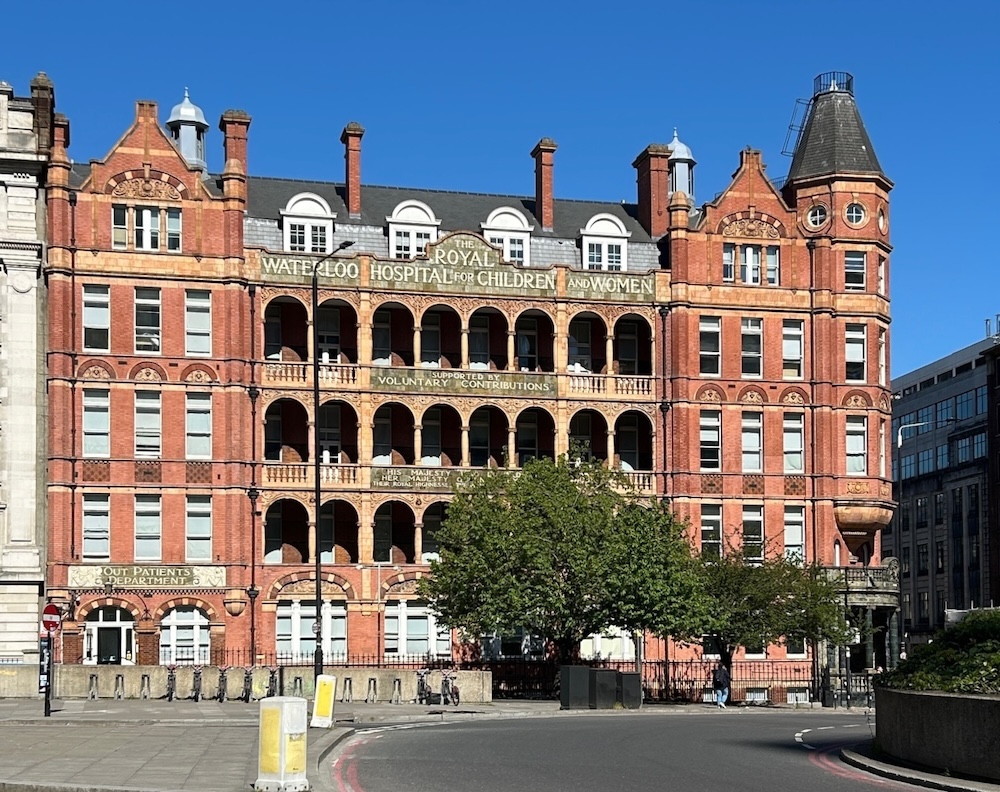
Apart from indivdual works like the Royal Waterloo Hospital, London shown on the left, he was "Consulting Architect to Belfast, Lincoln, Lichfield, Llandaff, Portsmouth, Sheffield and Wells Cathedrals" and "Diocesan Architect for Chelmsford, Portsmouth, Wakefield and Winchester" (Brodie 263). As Michael Yelton says, "Nicholson's practice was enormous" (18).
His obituary in The Builder also notes his involvement with government buildings in Kingston, Jamaica — in fact, this was the complex for the Governor's residence, King's House, which he and Corlette designed to replace a building destroyed by an earthquake in 1907. It was rather revolutionary: "probably the first extensive scheme of reinforced concrete buildings" (Gray 273). Some parts were burnt down in 1908 but they were in turn reconstructed. Mandated by the need for earthquake-proofing, here was an indication of the new age of twentieth-century architecture.
Nicholson's first wife Evelyn died in 1927, and their only son succeeded to the baronetcy, becoming an eminent surgeon (his paternal grandfather had originally been a surgeon). The young Nicholson proved to be a credit to his family in another way, too: he was decorated for his service with the Royal Army Medical Corps in the Second World War. Sir Charles himself remarried a few years after his first wife's death, and died at Headington in Oxfordshire at the age of 81. — Jacqueline Banerjee
Works
- Royal Waterloo Hospital, London
- The reredos and High Altar at Carlisle Cathedral
- King's House, Kingston, Jamaica
Bibliography
Brodie, Antonia. Directory of British Architects 1834-1914. Vol. II (L-Z). London: Continuum / RIBA, 2001. 262-63.
De Lisser, H. G. Twentieth Century Jamaica. Kingston: The Jamaica Times, 1913. Internet Archive, from a copy in Robarts — University of Toronto. Web. 7 May 2026.
Gray, Alexander Stuart. Edwardian Architecture: A Biographical Dictionary. London: Duckworth, 1985.
Obituary. The Builder Vol. 176 (11 March 1949): 300. Internet Archive. Web. 7 May 2026.
Yelton, Michael. Anglican Church Building in London, 1915-1945. Reading: Spire, 2007.
Created 7 May 2026