
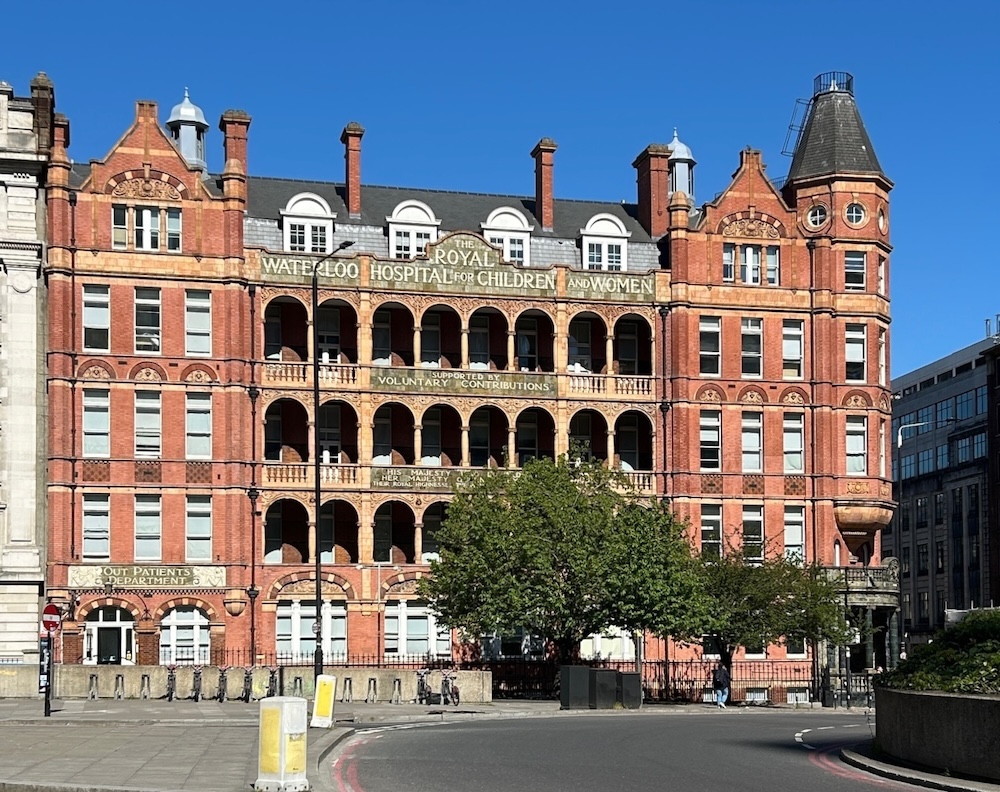
The hospital building today, well maintained and now used for student accommodation for the London branch of the University of Notre Dame, Indiana. Photograph by Tim Willasey-Wilsey. [Click on all the images to enlarge them.]
This impressive Grade II listed building stands prominently on the north-east corner of Waterloo Road and Stamford Street diagonally opposite Waterloo Station (with a roundabout in between) on the run-up to Waterloo Bridge. It was designed by Charles Nicholson (later Sir Charles, 2nd baronet, 1867-1949) and opened in 1905, and has a striking frontage in Lombardic-Renaissance style, with terracotta embellishments, open arcading to the three upper storeys where the wards were, and prominent lettering on the ironwork below each arcade. The inscriptions give the institution's name, identify its original purpose, and proclaim its royal patronage. In descending order, they read: "The Royal Waterloo Hospital for Children and Women," "Supported by Voluntary Donations," and "His Majesty King Edward VI, Her Royal Highness Queen Alexandra, Their Royal Highnesses The Prince & Princess of Wales." Over the ground floor of the last bay towards the bridge, the lettering indicates that this contains the "Out Patients Department."
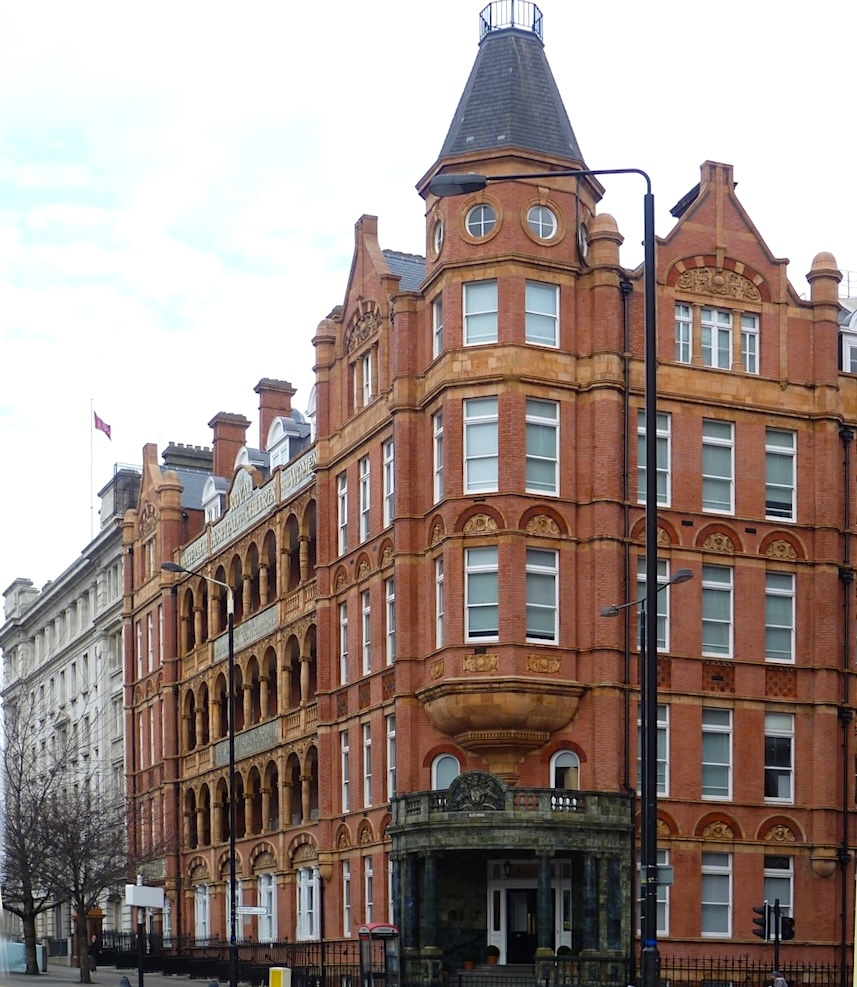
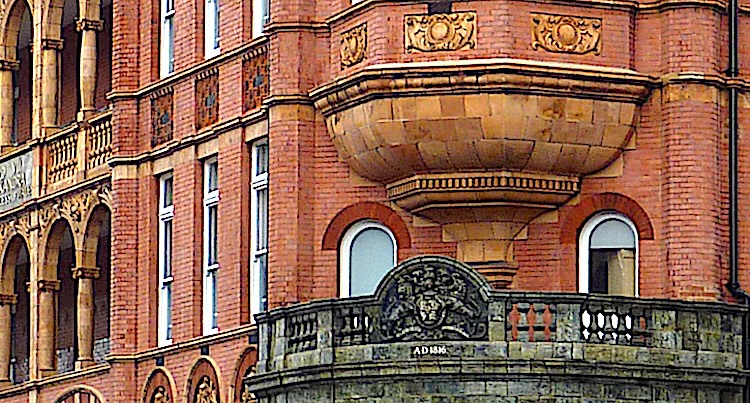
Left: The corner with Stamford Street. Right: Closer view of the decorative work above the entrance porch. Photographs by the author.
At first sight, the date given below the royal arms over the corner entrance, 1816, seems puzzling. But the history of the institution goes back much further than the present building. The initiative came from an eminent physician, Dr. J. Bunnell Davis (1777-1824) with a special mission to provide medical treatment for sick children. The "Universal Dispensary for Sick and Indigent Children" that Dr Davis founded near St Paul's in the city moved to the Waterloo site in the year of his premature death, and here it occupied premises with just two storeys above ground, although it had two below road-level as well.
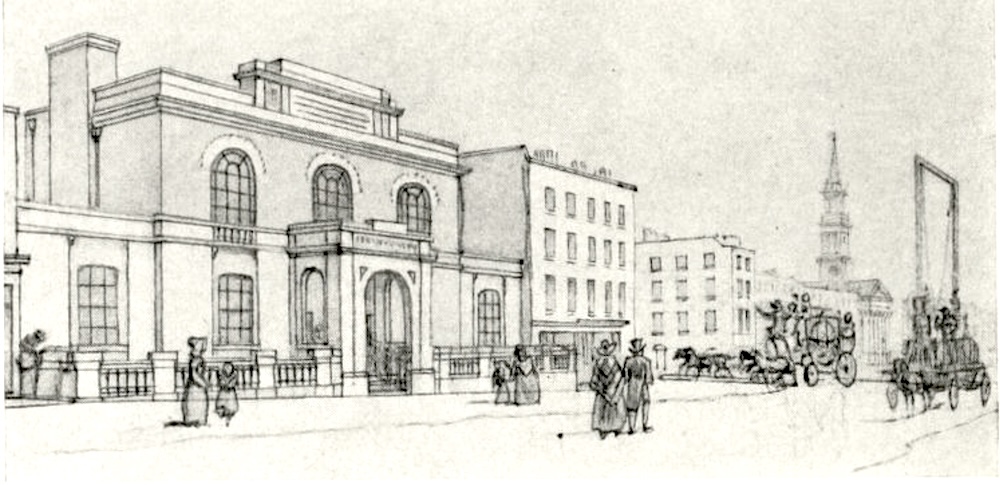
The original stone building on the site, from the Survey of London, Plate 11, facing p. 25.
Because funds were short, part of this pleasant stone building, designed free of charge by the architect David Laing (1774–1856), was originally used as a school. But a surgical ward was opened in 1851, and in the following year the hospital agreed to treat "a certain number of poor women from the parish of Lambeth" ("The Royal Hospital"). So in due course the name was changed from the "Royal Universal Infirmary for Children" to "The Royal Hospital for Women and Children." It had been extended once, but further space was now needed, and Nicholson was commissioned to provide the design for a larger building.
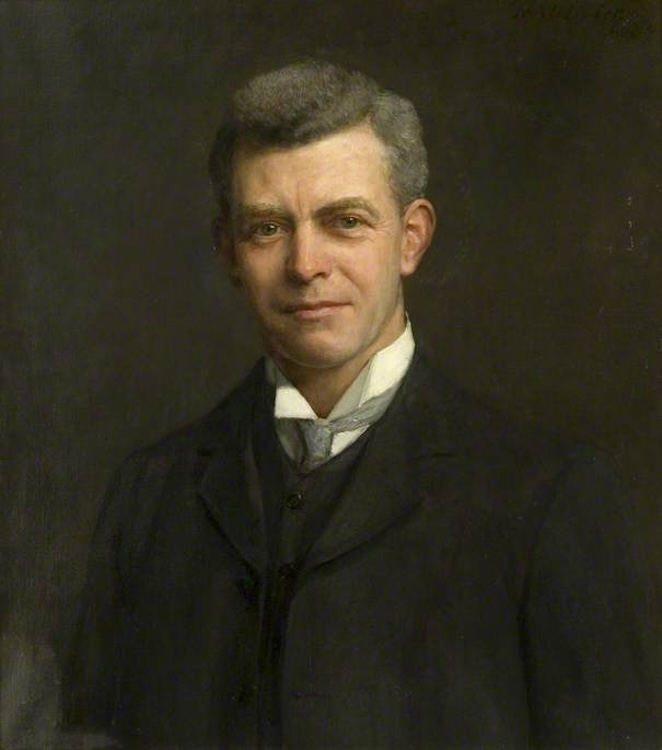
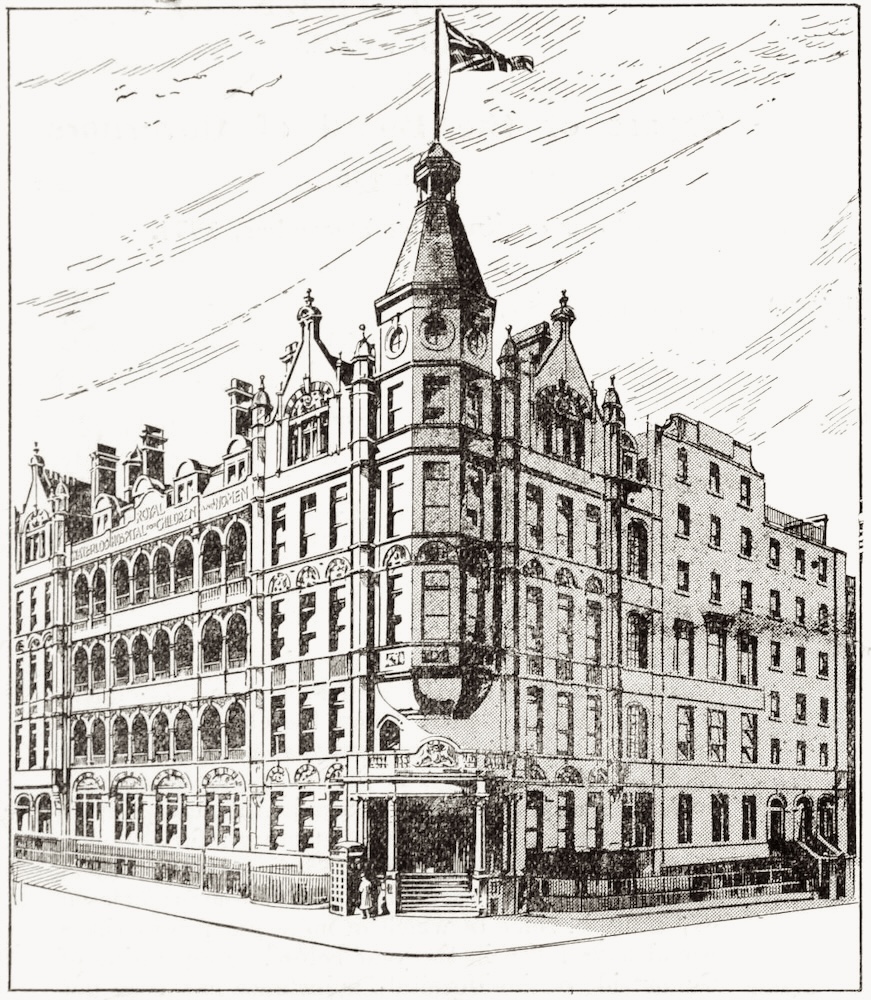
Left: Portrait of Nicholson by Herbert Arnould Olivier. [Click on this for more information.] Right: Royal Waterloo Hospital, London, in outline in 1936, from the hospital's Annual Report for 1934, facing p.14.
Funds were still short, and even as the building was being erected, a piece written by "Mrs T.P. O'Connor" (Elizabeth Paschal O'Connor, an author, playwright and suffragette from Texas) appeared in T.P.'s Weekly, run by her husband, the Irish MP Thomas Power O'Connor, from 1902-1916), asking for contributions. The opening sentences of the piece explained the need:
Please give something to the people of the abyss! For this is literally what they are. Unless you have been in the Waterloo Bridge Road it will not say much to you; but it is in the most wretched and miserable quarter of London, where the hungry, and the sick, and the poverty-stricken live and die. The Royal Waterloo Hospital for the diseases of children and women is right in the middle of the people of the abyss.
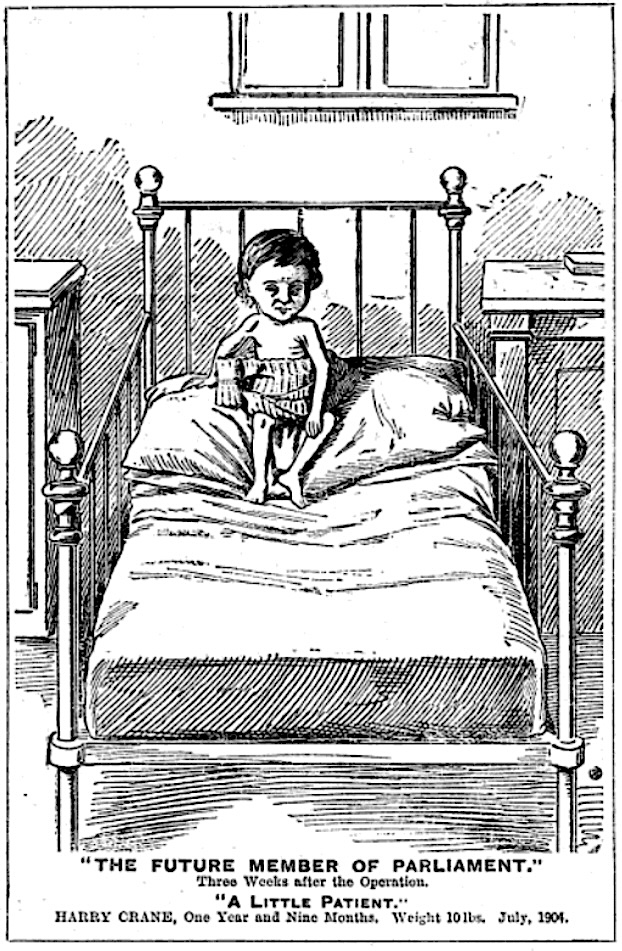
The plea continued by explaining that the hospital has "cured or relieved over 1,000,000 people, chiefly children," drawn from "all religions and all nationalities" — but that while the King had given it the site, only part was currently being rebuilt, because £50,000 more was needed. In particular, the hope was to build an extra wing where a public house still stood. Demolishing it, the writer said, would be a "great blessing for all advocates of temperance" as well as helping "the maimed and unfortunate and diseased of the world — especially as these particular cases are children, and are not responsible for their own illnesses."
Some touching examples follow, of sick children undergoing treatment, including little Harry Crane, who appears in the illustration on the left. Pathetically underweight as he was, the writer was assured on her visit that he was making good progress, and might indeed one day become an MP!
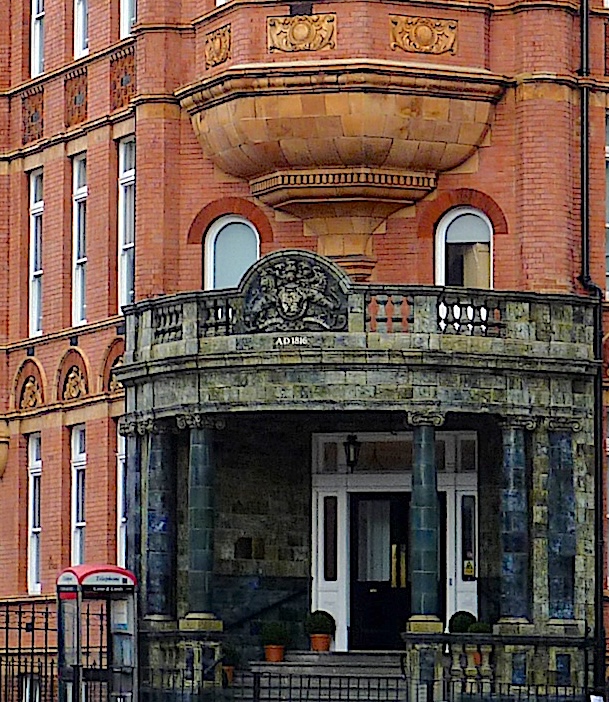
Closer view of the entrance porch. Photograph by the author.
On show at the entrance to the hospital is an example of charitable giving that is still visible today: inscribed in gold lettering on one of the glazed-ware tile panels near the door is the information: "This porch is the gift of H. Lewis Doulton 1905." That also applies to the Doulton tile-panels of nursery tales that were once to be found inside. Southbank House, then the Doulton Art Pottery's headquarters, is nearby on the south bank of the Thames in Lambeth. Still more impressively, according to Elizabeth O'Connor, the doctors serving the hospital at this time gave their services on a voluntary basis.
Despite confining itself strictly to the "deserving" poor, the hospital continued to struggle. The Annual Report for 1834 mentions "collecting boxes outside Hospital" (37) along with a whole list of mostly small individual donations and subscriptions, and cots donated in remembrance. Very much a charitable institution, the hospital nevertheless became a part of the National Health Service in 1948, only to lose out to its long-time rival at Great Ormond Street and close in 1976. The tile panels mentioned above were then transferred to join others in the children's wards at nearby St Thomas's Hospital (Greene 43), with which the Royal Waterloo Hospital had been grouped in 1948; they can still be seen there today.
Bibliography
"Buildings for Women as Patients" (see no. 6) Historic England. Web. 4 May 2026. https://historicengland.org.uk/research/inclusive-heritage/womens-history/women-and-healthcare/women-as-patients/
"Conference Member T.P. O'Connor MP." UK Parliament. Web. 6 May 2026.https://www.parliament.uk/about/living-heritage/transformingsociety/electionsvoting/womenvote/parliamentary-collections/speakers-conference/t-p-oconnor/
Greene, John. Brightening the Long Days: Hospital Tile Pictures. Leeds: Tiles and Architectural Ceramics Society, 1987.
"Mrs T.P. O'Connor." "The Royal Waterloo Hospital for Children and Women." T.P.'s Weekly Vol. 4 (23 September 1904): 406. Google Books. Web. 6 May 2026. Free to read.
"The Royal Hospital for Children and Women." Survey of London: Southbank & Vauxhall. London: London County Council, 1951. Internet Archive, from a copy in Robarts — University of Toronto. Web. 4 May 2026.
The Royal Hospital for Children and Women: Annual Report, 1934. London. Internet Archive, from a copy in the Wellcome Library. Web. 8 May 2026.
Royal Waterloo Hospital, Waterloo Road, SE1. Historic England. Web. 4 May 2026.
Created 9 May 2026