

. F. Hansom came from a family of architects, and has been somewhat overshadowed by his better-known older brother, Joseph Aloysius Hansom. But the younger Hansom was an important and prolific architect in his own right, with as many as sixty or seventy Catholic churches to his name, as well as some that were not Catholic, and various educational establishments. In the same source that reports the large number of his Catholic churches (his obituary in The Builder of 1888), he is described as having shown, early on, "considerable originality in his work," and as having "obtained a great reputation, not only amongst the public, but also amongst his professional brethren" (423).
Born in York in 1817, Hansom trained with his brother Joseph, and went into partnership with him in 1854. He set up an independent practice in 1859, later taking his only son, Edward Joseph Hansom (1842-1900), into partnership until 1871. To the latter period belongs the church which he considered his best: St John the Evangelist in Bath, built 1861-63 for the Benedictine monks, who had a special preference for his work (see Martin 104). After 1870, by which time he was living at Clifton, his ecclesiastical work gave way to secular projects: from then on "he was busier on such non-Catholic work as three public schools (Clifton College, Malvern College, and Kelly College at Tavistock) and on buildings for the Bristol School Board" (Little 138). An interesting exception was his work on the church of St Joseph and St Teresa in Wells, for the Carmelite Convent. Here, despite the church's small size, generous funding nudged him into spreading his wings a little. In 1886, for what were to be the last years of his life, Hansom went into partnership with Frederick Bligh Bond (1861-1945).
In 1841, while still in his early twenties, Hansom had married Elizabeth (neé Muston) from Hinckley in Leicestershire, when he was living and working there with his brother, and they had just the one son, Edward, as mentioned above. Along with Alfred Waterhouse and R.J. Johnson, he successfully proposed Edward for FRIBA in 1881. With his family name thus continuing in the architectural world, Hansom died in Clifton, Bristol and was buried at Perrymead Cemetery in Bath.
Perhaps his reputation has suffered since then precisely because, despite the "originality" that Hansom's Builder obituarist claimed for him, Hansom's churches displayed a "consistent adherence to correct medieval details" (Matthew et al, 89). Remaining a "devoted follower" of A.W.N. Pugin, he would "have nothing to do with the freer, more adventurous interpretations" of the Gothic that became popular later on (Martin 62). — Jacqueline Banerjee
Biographical Material
Works
- The Church of St Thomas and St Edmund, Erdington, Birmingham
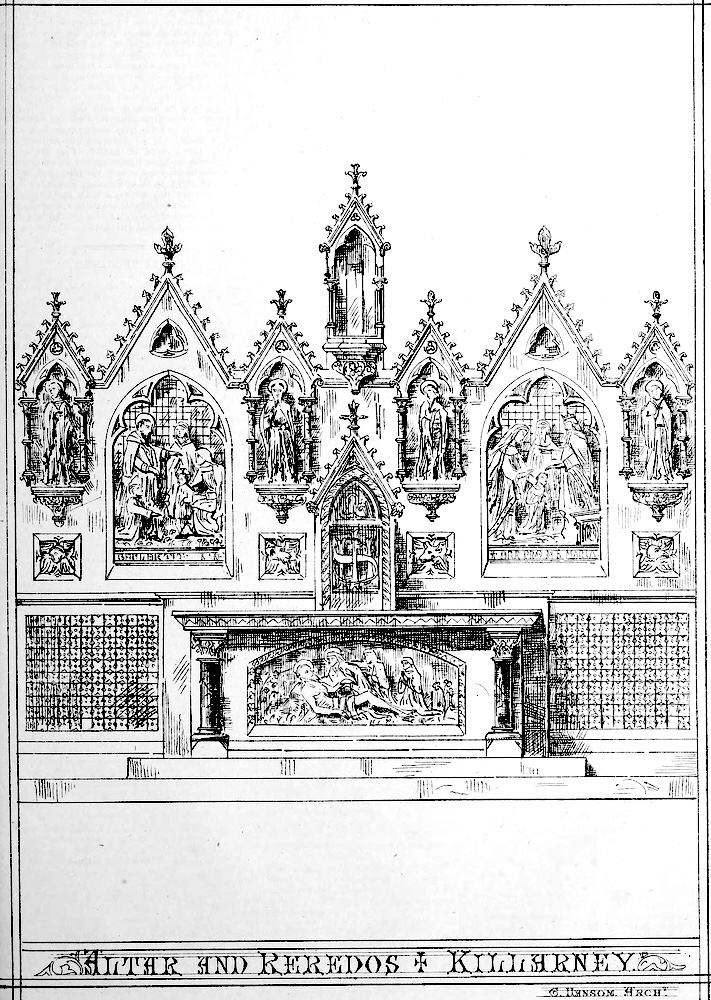
- Altar and Reredos, Kilarney
- The Church of Our Lady and St Alphonsus, Hanley Swan, Worcestershire
Bibliography
"Death of Mr. C.F. Hansom, Architect." The Builder Vol. 55 (8 December 1888): 423. Internet Archive. Web. 29 July 2026.
Directory of British Architects, 1834-1914. Compiled by Alison Felstead, Jonathan Franklin and Leslie Pinfield. London: Mansell, 1993.
Dixon, Roger, and Stefan Muthesius. Victorian Architecture. 2nd ed. London: Thames and Hudson, 1985.
Edward Joseph Hansom. Architects of Greater Manchester, 1800-1940. Web. 29 July 2026.
Harris, Penelope. The Architectural Achievement of Joseph Aloysius Hansom (1803-1882): Designer the Hansom Cab, Birmingham Town Hall, and Churches of the Catholic Revival. Lewiston, N.Y.: Edwin Mellen Press, 2010.
"The Late Mr C.F. Hansom." The Building News and Engineering Journal. Vol. 55 (2, July-December 1888): 763. Internet Archive, from a copy in the University of Illinois Urbana-Champaign. Web. 29 July 2026. [Full text given here.]
Little, Bryan. Catholic Churches since 1623: A study of Roman Catholic churches in England and Wales from penal times to the present decade. London: Hale, 1966.
Martin, Christopher. A Glimpse of Heaven: Catholic Churches of England and Wales. Swindon: English Heritage, 2006.
Matthew, H.C.G., Brian Harrison, and the British Academy. Oxford Dictionary of National Biography: in association with the British Academy : from the earliest times to the year 2000. Oxford and New York: Oxford University Press, 2004.
Created 29 July 2026
Last modified 10 August 2026