
e remember the Victorian age as one of industrialisation, huge population growth, and urbanisation; of key scientific and technological developments; of the struggle for self-improvement (whether for spiritual or material gain) and social reform at home; and of colonial ambitions abroad. What place, if any, did Nature have in this rapidly changing world?
The following brief overview suggests ways of looking at the role of Nature in several different sectors — that is, at the ways in which local authorities, high-minded individuals, and the great creative minds of the age, all tried to ensure that it remained accessible and meaningful to the people. At the same time, advances in scientific understanding encouraged a growing awareness of the impact of human progress on the natural world, and encouraged ecological thinking, even before ecology had developed as a scientific discipline, and long before it had arrived on the political scene.
Bringing the Countryside to the City
Public Parks
The first wave of industrialisation had provoked the Romantic movement; now that the danger of losing touch with the countryside was accelerating, the drive to preserve it even, or especially, in the midst of the metropolis was soon under way. Royal Victoria Park in Bath, the first to bear that name, was opened not by Victoria as queen, but by the young Princess Victoria, in 1830. Bath had long been a fashionable resort, and this was to be an additional amenity. But the real push for public parks came in the industrial towns of the north west: the first town here to provide one for the community was Preston, where the borough council enclosed about a hundred acres of the Town Moor for this purpose in 1833 (see Conway 9, and "Moor Park"). References to the "mid-Victorian" Public Parks Movement are misleading, as other local authorities quickly followed suit. Still quite early in the reign, Victoria Park in East London opened in 1845, and several parks, including Queen's Park, opened in Manchester in the following year. The opening of Birkenhead Park opened in the Wirral, Merseyside, in 1847 was a significant milestone, because it was purpose-built, rather than enclosing land previously used for other purposes.

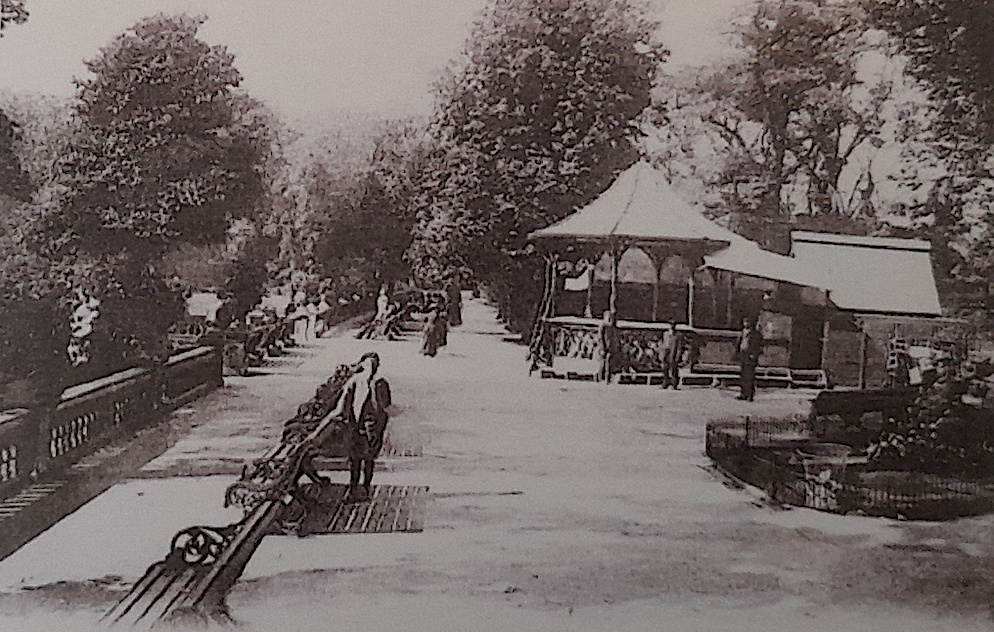
Left: The Queen's visit to Victoria Park in 1873. Right: Ellington Park, with the terrace prior to 1896.
Whatever the background, such spaces were intended to give urban communities the benefits already being commonly ascribed to nature: fresh air and moral uplift. Environmental concerns were growing, with the fear that epidemics were spread by "miasma" or "unclean air"; but the moral benefits were considered equally if not more important: "The moral geography of the public park included in its design lodges, statues, drinking fountains, bandstands and planting. These were intended to ‘improve’ the park users and to encourage local pride and patriotism" (Garden History Society, 12). The movement maintained its momentum, with new initiatives starting in the later period too. On 15 February 1884, for example, questions were raised in Hansard about creating a public park for Paddington and north-west London. A complex matter of leases involving the Ecclesiastical Commissioners (Hansard's Parliament, 1024), this came to nothing. Less complicated and more successful was Ramsgate Corporation's acquisition in 1892 of twelve acres from the estate of Ellington House, "with the intention of creating a park and pleasure grounds for the people of Ramsgate" (Blaker 18). Ellington Park was opened in the following year, complete with wooded vistas, and such typical features as a fountain, and tennis lawns for healthful exercise.
Garden Cemeteries

Highgate Cemetery, 1843.
Whilst hardly pleasure grounds, the new cemeteries being laid out on the outskirts of cities were also landscaped as if they were parks, with pleasant walks and a variety of trees. The visitors who strolled around the plots were often mourners visiting graves, and in need of the consolation of nature. But, like the municipal parks, the cemeteries were expected to promote the moral as well as the physical health of more casual visitors too: "Hard, indeed, must be the heart and degraded the soul of the man who could wander here — here amid so many emblems of the Creator's love, so many touching records of human affection, so many solemn warnings of mortal destiny - and not feel the all-pervading influence - not be moved by the silent eloquence of the scene" (Justyne 8). The verdant vistas of Highgate Cemetery and the other "garden cemeteries" that followed it were also no less useful than parks for providing lungs for the cities, and havens for urban wild life, from birds and foxes to snowdrops and bluebells.
Bringing the Countryside nearer Home
Gardens, houseplants and allotments
The concern for community access to pockets of nature in the urban and burgeoning suburban environment permeated Victorian culture, and took other forms. Much closer to home, what had once been the preserve of country mansions set in grand landscaped grounds, was now miniaturised: nature was brought right to the doors of the smallest terraced house, in the form of front and back gardens with lawns and flower borders. Interest in plants and gardening gathered such pace that historians talk of a horticultural revolution. In George and Weedon Grossmiths' Diary of a Nobody (1892), the Pooters have "a little front garden" and a "nice little back garden which runs down to the railway" (13) and Mr Pooter soon sets to work on the borders:
Spent the whole of the afternoon in the garden, having this morning picked up at a bookstall for fivepence a capital little book, in good condition, on Gardening. I procured and sowed some half-hardy annuals in what I fancy will be a warm, sunny border. I thought of a joke, and called out Carrie. Carrie came out rather testy, I thought. I said: “I have just discovered we have got a lodging-house.” She replied: “How do you mean?” I said: “Look at the boarders.” Carrie said: “Is that all you wanted me for?” I said: “Any other time you would have laughed at my little pleasantry.” Carrie said: “Certainly — at any other time, but not when I am busy in the house.” [28-29]
The novelty of the enterprise is clear, as is the divison of labour — a city clerk gardening in his own little plot, while his wife occupies herself indoors. Encouragement to engage in this new hobby came, if not from the wife, then from books readily available at bookstalls. Ideas about garden design and plant species which would once have influenced the landed gentry now filtered through to the lower orders. It is no coincidence that perhaps the best known of the pundits, Gertrude Jekyll, also wrote about village England, for instance in her book, Old West Surrey, published just after the end of the Victorian age, in 1904.


Left: The Pooters' home, The Laurels, drawn by Weedon Grossmith (Grossmith 14). Right: The Cottage Porch, photographed by Gertrude Jekyll, pre-1904.
In the new flowerbeds, nostalgia for the rural past, and belief in Nature's ability to promote physical, moral and spiritual wellbeing, were joined with evidence of the reach of empire. Those who took their ideas from William Robinson's immensely popular The English Flower Garden, might display cottage-garden favourites against a background of white azaleas from India, at least in the warmer southern counties (125), or plant some of the hardier exotic ferns among the ivy in the carefully planned "wild" parts of their gardens (156-57). Whatever the varied impulses behind this "return to nature," and whatever new ideas the "return" incorporated, it encouraged what now amounted to a national obsession with surrounding the domestic space with the garden beautiful.
It was fashionable, too, to bring Nature through the doors, right into the home — not Nature in the harsh, raw form of cantos LV and LVI of Tennyson's "In Memoriam," or even necessarily in traditional cut-flower arrangements. Nature met artifice more obviously as flowers and fruit were simulated in wax and covered with bell jars, or housed in ornamental window-sill conservatories. Like some sought-after species of garden flowers, much of what was showcased in these ways was not to be found locally in the British countryside: it was often introduced from other countries. Tropical ferns, for instance, had been coming in since at least the previous century, and in fact it was their usual means of transport, "a special glass box called a Wardian case, invented by a British doctor named Nathaniel Ward" (Amberger-Ochsenbauer 6), that inspired such indoor features. Exotic ferns and orchids in particular became so popular that they fuelled crazes.

Ornamental shell-work flower arrangement in a dome.
But not everyone was satisfied with climbing roses by the front door and ornamental exotica in the parlour. Another apparently more authentic way of bringing nature back into everyday life presented itself — "detached gardens" (Way 17) or allotments, small plots of land rented by individuals not for enhancing their surroundings, but for their physical welfare. Here, they could cultivate fresh foods for their own tables. The allotment movement has even deeper roots than the call for public parks, going back to "peasants' revolts and labourers' land movements" (Way 8). However, according to Jeremy Burchardt, allotments "were rare before 1830" (137). Even then they were largely a provision encouraged for the rural poor, to foster the work ethic, and prevent insalubrious habits and social unrest. But missions to promote them in this sector proved successful, there were soon long waiting lists for them — and demand spread. By 1850 there were allotments in some southern as well northern towns. City dwellers' gardens were inadequate for growing much in the way of sustenance: Mr Pooter does try to grow mustard-and-cress and radishes, but they fail to come up. So when municipalities began to offer more sites at reasonable rents, what was once "overwhelmingly a phenomenon of rural life .... in a surprisingly short space of time ... would come to be seen as an archetypal feature of urban life" (Burchardt 230). When an act of 1887 required local authorities to provide allotments when there was a demand for them, urban districts were explicitly included, and by the early twentieth century "the Allotment Movement was very much an urban matter" (Poole 10).
Studying Nature
Natural History as a Hobby
More generally, the Victorians sought to relate to the natural world not just in some small way, by gazing at it or even working on a patch of soil, but by studying it and understanding its workings more deeply. John Ruskin, who had such an influence on the era's culture, especially its arts, exemplifies the evolving attitudes to nature. At first, on his early travels, he was overawed by the grandeur of mountains, and responded enthusiastically to the work of William Wordsworth — poetry that described nature's majesty, and identified with it in heart and soul. Ruskin wholly concurred. He saw himself as having a greater capacity for enjoying landscape than most men: at this stage, when he wrote Part V ("Mountain Beauty") of his highly influential Modern Painters in 1856, he called such enjoyment in Chapter 17, "the ruling passion" of his life (315). But he also took a more scientific interest in nature, one that depended less on wide-eyed looking, than on close observation and minute analysis. Ruskin himself focused on and drew in loving detail such small objects as the feather of a peacock or a spray of fallen oakleaves, and collected specimens of minerals, saying in one of his lectures on art ("Of Leaf Beauty"), also published in Modern Painters: "you cannot so much as once look at the rufflings of the plumes of a pelican or carefully draw the contours of the wing either of a vulture or a common swift, or paint the rose and vermilion on that of a flamingo, without receiving almost a new conception of the meaning of form and colour in creation" (Lecture IV, 73). To Ruskin's mind, not only nature itself, but also the very act of observing it closely, enhanced the senses, developed the mind, and enriched the spirit.
Ruskin's huge influence on the Pre-Raphaelite artists is well-known. He saw detailed observation like this as a vital training of the eye for the further work of the artist's vision. But looking at nature was not simply for artists. Natural history was another pursuit that became something of a craze in the mid-Victorian period. In an era that urged self-improvement for gain, whether material or spiritual, young folk, especially city-dwellers, were exhorted in books and periodicals, by mechanics institutes for local working men, and by societies for amateur enthusiasts, to devote some of their energies to exploring the wonders of the natural world. Kew Gardens in London, with its collections of many different species of plants, was opened to the public for "agreeable recreation and instruction, not for idle sports," as its first director declared, close to the beginning of the reign, in 1840 (Hooker 4). And here is Charles Kingsley, author of the children's classic, The Water Babies, several decades later, encouraging the youth of Chester in his Preface to Town Geology:
Suppose that any one of you, learning a little sound Natural History, should abide here in Britain to your life’s end, and observe nothing but the hedgerow plants: he would find that there is much more to be seen in those mere hedgerow plants than he fancies now. The microscope will reveal to him in the tissues of any wood, of any seed, wonders which will first amuse him, then puzzle him, and at last (I hope) awe him, as he perceives that smallness of size interferes in no way with perfection of development, and that “Nature,” as has been well said, "is greatest in that which is least." And more. Suppose that he went further still. Suppose that he extended his researches somewhat to those minuter vegetable forms, the mosses, fungi, lichens; suppose that he went a little further still, and tried what the microscope would show him in any stagnant pool, whether fresh water or salt.... Suppose he learnt something of this, but nothing of aught else. Would he have gained no solid wisdom? [xxv-xxvii]
These were not just passing thoughts: they were calls to action, and duly acted upon. Kingsley founded the Chester Natural Sciences Society in 1871 and became its first president.
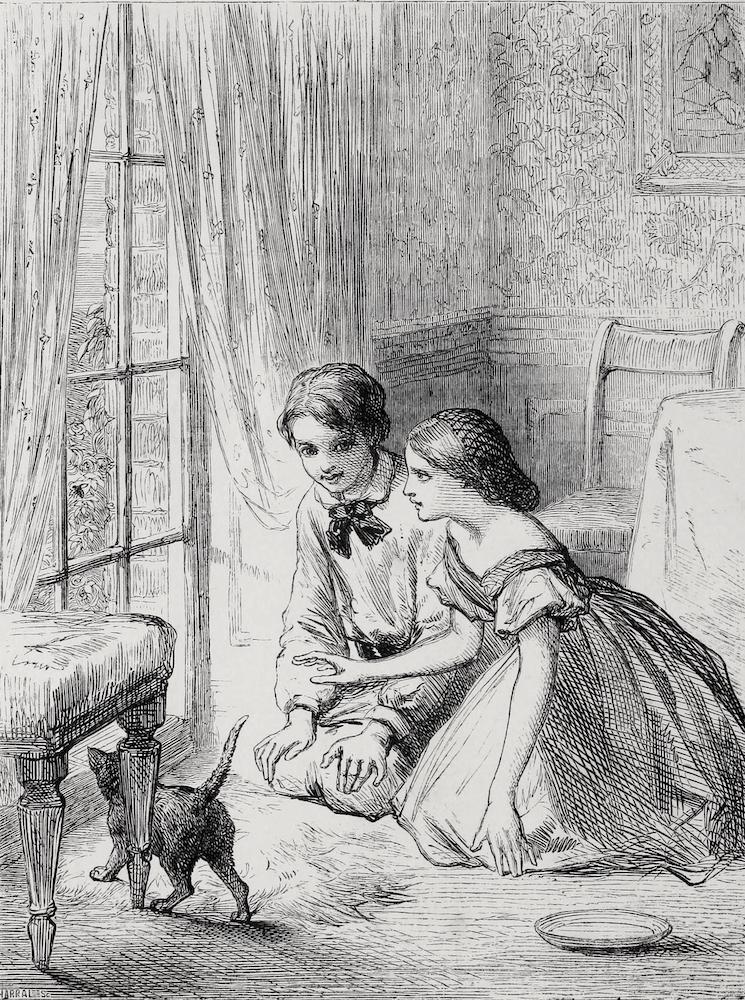
A girl, observing intently the bee on the window-frame, listens to her brother explaining the workings of the beehive. Source: Gatty 6.
Women, for much of the reign effectively barred from most fields of endeavour, also found opportunities here: botany and flower painting, the study of insects and small creatures like snails, and fossil collection, brought the most able of them, like the palaeontologist Mary Anning, into new prominence. We are just beginning to recognise their contributions now. Even the smallest children were encouraged to study and learn from nature: in one of Mrs Gatty's best-selling Parables from Nature, first published in 1858, a young girl observes a bee on the window-pane, as her older brother explains how a hive is organised. The girl, suitably edified, covers the bee carefully "in a soft handkerchief" and releases it into the air (16).
The Victorians' close study of natural specimens and their behaviour would have enormous repercussions. One gentleman naturalist went on a long voyage of discovery to distant lands, and in 1859 his findings led him to publish a theory so convincing that it challenged the very concept of God's creation, and shook the foundations of the Christian faith. This, of course, was Charles Darwin. But while his ideas about evolution made many question the old beliefs, and caused some, like Darwin himself, to become agnostics, the idea of the "survival of the fittest by means of natural selection" did not faze everybody. One churchman, the controversial socialist Revd. Stewart Headlam, said in a sermon of 1879: "It gives us far grander notions of God to think of him making the world by his Spirit through the ages, than to think of him making it in a few days" (qtd. in Vidler 119).

Darwin's Tree: "Thus genera would be formed...."
And while Darwin may have struck a blow against the literal interpretation of the Bible as the "Word of God," he had also boosted the importance of Nature itself: whether or not it was seen as an instrument of the Divine, it was vital in itself, and an ever-evolving source of new life, manifestations of which (including humanity) were now seen to be organically linked in a way that had only been grasped before by the poetic sensibility. As Clara puts it in William Morris's subversively utopian News from Nowhere (1890), it was simply no longer possible to see "everything, except mankind, animate and inanimate — “nature”, as people used to call it — as one thing, and mankind as another" (234).
Collections and Museums
Those wonderful manifestations of the physical world were miraculous in their own right. To make them easier to investigate and appreciate, natural objects were collected and catalogued, and natural science museums set up to display them. Built in 1874, for instance, the Booth Museum in Brighton housed the collection of ornithologist Edward Thomas Booth, and as time went by its curators added butterflies, fossils, minerals and so on to the display cases. In the same seaside town where so many Londoners went on holiday — another manifestation, incidentally, of the impulse to refresh the spirit in natural surroundings — a palatial aquarium opened in that same decade, to show off the wonders of the sea. London's own huge Natural History Museum, with its magnificent central gallery, opened in 1881.


Left: The Booth Museum, Brighton. Right: The Great Hall of the Natural History Museum, London.
Nature in Art and Design
Landscape Painting
As swathes of the country were turned into suburbs, the effort to claim, reclaim or create green spaces took yet another form. Landscape painting, with representations of the countryside and rural life, became increasingly popular. Scenery was no longer simply a background to a portrait, figures or structures, to be taken for granted. Meaningful in itself, it had to be restored to sight and memory, sometimes as the very "paradise lost" of daily existence, but also, and perhaps more tellingly, as a powerful force which influenced that existence. As in its other new contexts, such as the vogue for "wild Nature" which inspired artfully simulated rockeries and water features in people's gardens, it could be disciplined or crafted. Our relationship to it was vital and constantly developing. The Pre-Raphaelite focus on every little detail gave way gradually to art which specifically sought to recreate our complex relationship with nature. "It was no longer sufficient for a painter to provide literal information about the physical world," says one art historian, Christopher Newall; the Idyllic School of painters "sought to convey their emotional response to the landscape, the feelings of sentiment that reveal the painter's involvement with the scenery represented" (54). With this in mind many artists started painting out of doors, en plein air, to give immediacy to their work, and especially to capture the true effect of the light.
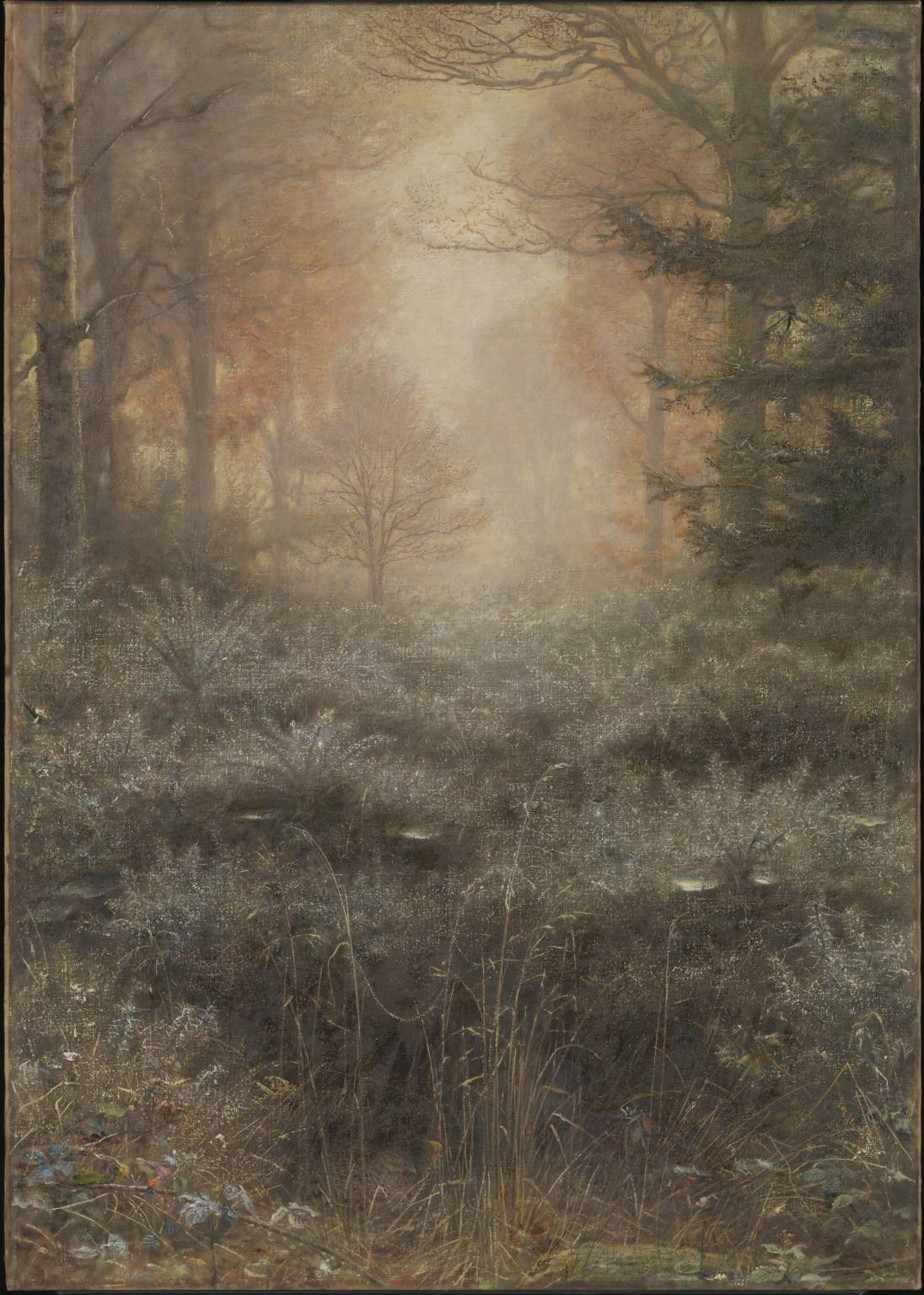
John Everett Millais's Dew-Drenched Furze, of 1888.
Among the best-known of these painters was Sir John Everett Millais, who painted his famous Autumn Leaves, with its melancholic mood, out of doors. Less well-known, but even more experimental, is his Dew-Drenched Furze, another outdoor project, which his son John Guille Millais, described as "a scene such as had probably never been painted before" (213), and has no human figures or conventional focus — just the hazy glow of the early morning sun, seen between an avenue of trees in Scottish woodland. Not beautiful in any conventional sense, the scene poeticises a walk in the early morning woods, with its dim sense of promise.
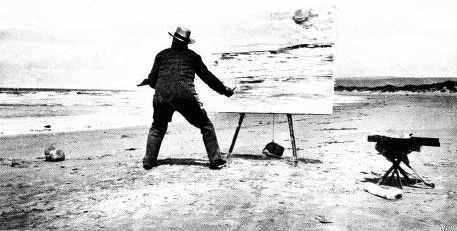
The Scottish artist, William McTaggart, painting on the shore, his easel weighted down to stop it from being blown away.
Marine artists too battled winds and rain at all times of day to depict the sea in its constantly-changing moods, whether at its most serene, its most sparkling, or its most stormy and dramatic. Thanks to technological advances, and the availability of engraved reproductions, such evocative scenes could give nature a permanent presence on the very walls of people's rooms.
Interior Design
Importing flowers, whether arranged in vases, grown in planters or under glass, or simulated in bell-jars, was only the most obvious way of bringing nature indoors. Interior decoration was a fairly recent concept, having been introduced in 1807 by Thomas Hope in his Household Furniture and Interior Decoration, and it relied not just on placing decorative objets d'art on show, but on incorporating patterns and motifs into everything from wall-coverings to soft furnishings and the furniture itself. For most people, the interior of a building would once have been a place of shelter from the elements; in nineteenth-century suburbia, the domestic hearth was still a haven, but now in a moral and spiritual sense. The influence of church furnishings was apparent in all sorts of items, from andirons at the fireside that would not have looked at all out of place on an altar, to domestic stained glass which would have looked equally at home in a church porch. From floor to ceiling, these and other items could be designed to produce a wholesome and uplifting ambience, drawing on what Hope himself had described as "the infinitely more complicated, more significant, and consequently more beautiful forms, borrowed from animated nature" (9; emphasis added).
The very colours were to be derived from nature (although, ironically enough, it was the industrial revolution that enabled their mass production). Jane Panton, for instance, in her book on Suburban Residences, recommended "'hedge sparrow egg blue" (228) and liked "green "Isis" matting and rugs, made from rushes in the higher Thames" (169, "Isis" being the name of the Thames as it runs through Oxford). Foliage and birds abounded as design motifs. This was the age of William Morris wallpaper, with patterns entitled "Wild Tulip," "Blackthorn" and so on. Leaf-patterned William De Morgan tiles in a fireplace surround, as in the Library of Wightwick Manor (below left); tapestry wall-hangings and/or paintings of the countryside (over the same fireplace, George Dunlop's Harvest Moon); curtains, screens, rugs of the kind suggested by Mrs Paton — all these could help to create a wholesome and uplifting natural ambience.
The geometric patterns of the Gothic Revival gradually gave way to more fluid natural forms, created by the artisans of the Arts and Crafts Movement in more artistically individualistic ways. Furniture itself, however functional, featured design elements inspired by nature, whether integral to the form of the piece, or in painted, stencilled or carved embellishments to it.


Left: The fireplace area — the hearth — in the Library at Wightwick Manor, with William De Morgan's tile surround. Right: Sideboard by Philip Speakman Webb.
As with flower domes, this was, of course, nature tamed and adapted: showing the thorns with the roses, so to speak, was considered by some to be in bad taste (see Cohen 21-24). After all, interior design was also felt to be an expression of personality, especially of refinement of taste. The pictorial inset panels of Philip Speakman Webb's sideboard (above right), take imitative or "naturalistic" design as far as such taste allowed. Of embossed and stained leather, the panels vary subtly in detail and colour, just hinting at the process of growth and seasonal change in the organic world beyond.
Nature in Literature
Reading was yet another way to bring nature back into everyday life. Victorian literature is sometimes considered to be "anti-nature" because it moves on from the Romantics' (particularly Wordsworth's) view of it. It can certainly present nature as inimical to human endeavour. There is nothing kindly or elevating about the storm that rages at the beginning of Wuthering Heights, for instance, or the one that robs Steerforth and Ham of their lives in David Copperfield. But it is true to say that the Victorians, Emily Brontë and Dickens included, still experienced the natural world as "a repository of feeling, a sanctuary they were all too eager to retain" (Knoepflmacher and Tennyson 24). As memorable as that first storm in Wuthering Heights, for instance, is Catherine Heathcliff's description of her ideal of "heaven’s happiness" in Chapter 24, in which she imagines herself
rocking in a rustling green tree, with a west wind blowing, and bright white clouds flitting rapidly above; and not only larks, but throstles, and blackbirds, and linnets, and cuckoos pouring out music on every side, and the moors seen at a distance, broken into cool dusky dells; but close by great swells of long grass undulating in waves to the breeze; and woods and sounding water, and the whole world awake and wild with joy. He wanted all to lie in an ecstasy of peace; I wanted all to sparkle and dance in a glorious jubilee. [210]
In novel after novel, the countryside and seaside provide much more than a setting. Elizabeth Gaskell's Ruth, George Eliot's Adam Bede, Thomas Hardy's Tess of the D'urbervilles — these are just a few of the Victorian novels that derive much of their power from the interaction of character with the natural world. Anyone who turns to them for other reasons, looking for the way these authors deal with social problems, for example, may chance with surprise on passages like this one in Chapter 5 of Ruth:
Ruth was up betimes, and out and away, brushing the dew-drops from the short crisp grass; the lark sung high above her head, and she knew not if she moved or stood still, for the grandeur of this beautiful earth absorbed all idea of separate and individual existence. Even rain was a pleasure to her. She sat in the window-seat of their parlour ... she saw the swift-fleeting showers come athwart the sunlight like a rush of silver arrows; she watched the purple darkness on the heathery mountain-side, and then the pale golden gleam which succeeded. There was no change or alteration of nature that had not its own peculiar beauty in the eyes of Ruth. [56]

Poplars on the Thames bank.
Responding to the natural world with this kind of intensity led Gerard Manley Hopkins to give a strong voice to the need to protect what was still left of it. His distress was palpable when he found in 1879 that the poplars by the river Thames at Binsey, a village near Oxford, had been felled:
After-comers cannot guess the beauty been.
Ten or twelve, only ten or twelve
Strokes of havoc unselve
The sweet especial scene,
Rural scene, a rural scene,
Sweet especial rural scene.
Significantly though, this poem is not simply nostalgic, or indeed even preservationist. Close reading of the earlier stanzas shows that Hopkins, writing at a time when ecological thinking was only just becoming recognised as a scientific approach, understood only too well that removing one element from the scene risked playing "havoc" with the whole ecology of the riverside.
Non-fiction nature writing also appeared as a genre now, with some Victorian writers gaining a readership simply by describing their encounters with wild life and the feelings it inspired, and warning about our interference with it. Indeed, as the critic and philosopher Roger Scruton said, “the rural documentary" became the most popular form of non-fiction among the reading public — a position that it has retained to this day” (235). Richard Jefferies, for example, had no time for the "affected assumption of countryness" ("Trees about Town," 29). He tramped miles across whole counties, taking field notes and writing up his findings in columns for magazines like the Pall Mall Gazette, and in books like Wild Life in a Southern County (of 1879), that won him a cult following. "I want to be always in company with these," he wrote, in the seventh chapter of his autobiography, The Story of My Heart: "with earth, and sun, and sea, and stars by night. The pettiness of house-life — chairs and tables — and the pettiness of observances, the petty necessity of useless labour, useless because productive of nothing, chafe me the year through. I want to be always in company with the sun, and sea, and earth. These, and the stars by night, are my natural companions" (116). Every small evidence of nature's bounty moved him profoundly. In one of his last essays, "Hours of Spring," he wrote, in words that might have been uttered by Ruskin himself, “You do not know you may find each day,” he said. “Perhaps you may only pick up a fallen feather, but it is beautiful, every filament. Always beautiful!” (included in Field and Hedgerow, 18).
Combining visionary mysticism with this kind of close attention to the minutiae of the natural world, and expressing profound anxiety in his post-apocalyptic novel, After London, about what might happen if man continued to ride roughshod over it, Jefferies reveals an ecological sensibility that again anticipates, more dramatically than Hopkins's, later concerns with the environment. As Wendy Parker and Peter Adkins have pointed out, the Victorians had become "intuitively cognizant of what was at stake in the emergent ecological picture of the world."
Even a handful of examples, selected from a few different areas, indicates the profound concern with Nature at the heart of the Victorian age. Carried through from the Romantics, and made more pressing by the enormous changes that impinged on it during these years, as well as the advances in scientific knowledge, it was expressed in a variety of ways: in the provision of green spaces of various kinds in cities and housing developments; in the encouragement to study natural history and the establishment of facilities to cater for such studies; and in both the art and literature of the age. Our present anxiety about the environment follows on from that evinced, with mounting alarm, by Hopkins and Jefferies. The question now is whether we still have time to act on it.
Related Material (a selection)
- Romantic Nature
- Nature in Wordsworth and Tennyson
- Nature: The Legacy of Wordsworth (about Arthur Henry Hallam)
- Ruskin and Nature
- Richard Jefferies and other British Nature Writers — Gilbert White, William Cobbett, and W.H. Hudson
- “The heart searches deeper” — Richard Jefferies and John Ruskin confront the beauties of Nature
- Nature as Amenity and Liberal Economics in the Victorian Age
- Connecting The Dots: A Review of John MacNeill Miller's The Ecological Plot: How Stories Gave Rise to a Science (2024)
- "Colonel Sibthorpe's Elms" (a Victorian Web podcast)
Bibliography
Allotments Act 1887. legislation.gov.uk.
Amberger-Ochsenbauer, Susanne. Success with Ferns. London: Meerhurst, 1996.
Brontë, Emily. Wuthering Heights. 1847. London: Penguin Popular Classics, 1994.
Burchardt, Jeremy. The Allotment Movement. Woodbridge, Suffolk: The Boydell Press, 2002.
Cohen, Deborah. Household Gods: The British and Their Possessions. New Haven and London: Yale University Press, 2006 [Review].
Conway, Hazel. Public Parks. Shire Garden History Series. Princes Risborough, Bucks: Shire, 1996.
Ferry, Katherine. The Victorian Home. Botely, Oxford: Shire, 2010 [Review].
The Garden History Society and Landscape Design Trust. The Regeneration of Public Parks. London and New York: E.F. Spon, 2000.
Gaskell, Elizabeth. Ruth. Edited by Nancy Henry. London: Dent, 2001.
Gatty, Margaret. Parables from Nature. London: Bell & Daldy, 1861. Internet Archive, from a copy in Fisher — University of Toronto. Web. 30 June 2026.
Grossmith, George and Weedon. Diary of a Nobody. Bristol: J.W. Arrowsmith / London: Simpkin & Marshall, 1892. Internet Archive, from a copy in the University of N. Carolina. Web. 30 June 2026.
Hooker, W. J. Kew Gardens, or A Popular Guide to the Royal Botanic Gardens of Kew. 13th ed. London: Longmans, 1855. Google Books. Free to read. Web. 30 June 2026.
Hope, Thomas. Household Furniture and Interior Decoration. London: Longman, 1807. Internet Archive, from a copy in the Smithsonian Libraries. Web. 19 July 2026.
Hopkins, Gerard Manley. Poems and Prose, selected and edited by W.H. Gardner. Harmondsworth: Penguin, 1963.
Jefferies, Richard. Field and Hedgerow. London: Longmans, 1889. Internet Archive. Contributed by Harvard University Library. Web. 30 June 2026.
_____. The Story of my Heart: My Autobiography. London: Longmans, 1883. Internet Archive. Contributed by Harvard University Library. Web. 30 June 2026.
Justyne, William. A Guide to Highgate Cemetery. London: (printed by) J. Moore, c.1865. Hathi Trust. Web. 30 June 2026.
Kingsley, Charles. Town Geology. Internet Archive, from a copy in the digitallibraryindia; JaiGyan. Web. 30 June 2026.
Knoepflmacher, U.C., and G.B. Tennyson, eds. Nature and the Victorian Imagination. Berkley and Los Angeles: University of California Press, 1977.
Millais, John Guille. The Life and Letters of John Everett Millais, President of the Royal Academy. 2 vols. Vol. II. New York: Frederick A. Stokes, 1899. Internet Archive, from a copy in the Hrold B. Lee Library in Brigham Young University. Web. 30 June 2026.
"Moor Park" (official list entry). Historic England. Web. 30 June 2026.
Morris, William. News From Nowhere: Or an Epoch of Rest, Being Some Chapters From a Utopian Romance. Author's Edition. Boston: Roberts, 1890. HathiTrust, from a copy in Duke University Library. Web. 30 June 2026.
Newall, Christopher. "Innovation and Conservation in the Later Victorian Period." Chapter 4 in Scott Wilcox and Christopher Newall. Victorian Landscape Watercolours. New York: Hudson Hills Press Inc., 1992. 53-62.
Parkins, Wendy, and Peter Adkins. “Introduction: Victorian Ecology and the Anthropocene.” 19: Interdisciplinary Studies in the Long Nineteenth Century 26 (2018). Web. 30 June 2026. https://19.bbk.ac.uk/article/id/1717/ (doi: https://doi.org/10.16995/ntn.818).
Panton, Mrs J.E. Suburban Residences, and How to Circumvent Them. London: Ward & Downey, 1896. Internet Archive, from a copy in Oxford University Library. Web. 19 July 2026.
Poole, Steve. The Allotment Chronicles: A Social History of Allotment Gardening. Kettering: Silver Link, 2006.
"Public Parks (Metropolis) — Paddington Park." Hansard's Parliamentary Debates. London: HMSO, 1884. Google Books. Free to read. Web. 30 June 2026.
Robinson, William. The English Flower Garden and home grounds.... 9th ed. London: John Murray, 1905. Internet Archive, from the collection of Cornell University Library. Web. 30 June 2026.
Ruskin, John. Lecture IV in Modern Painters, Vol. 5. The Works of John Ruskin. New York: John B. Alden, 1885. Google Books. Free to read.
Ruskin, John. Part V ("Of Mountain Beauty") in Modern Painters, Vol. 3. The Works of John Ruskin. New York: John B. Alden, 1885. Google Books. Free to read.
Scruton, Roger. England: An Elegy. London: Chatto & Windus, 2000.
Vidler, Alec R. The Church in an Age of Revolution: 1789 to the Present Day. Harmondsworth: Penguin, 1961.
Way, Twigs. Allotments. Stroud: Amberley, 2017.
Created 30 June 2026
Last modified 20 July 2026