

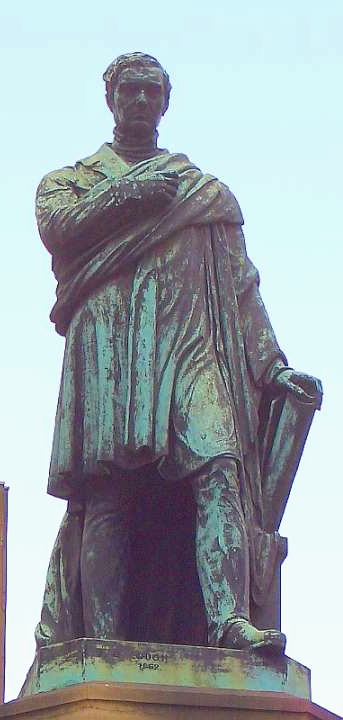
John Graham Lough's 1862 bronze and grit-stone memorial to the great engineer George Stephenson, which stands near Newcastle's Central Station at the Neville Road junction, is one of this sculptor's finest works. [Click on images to enlarge them.]
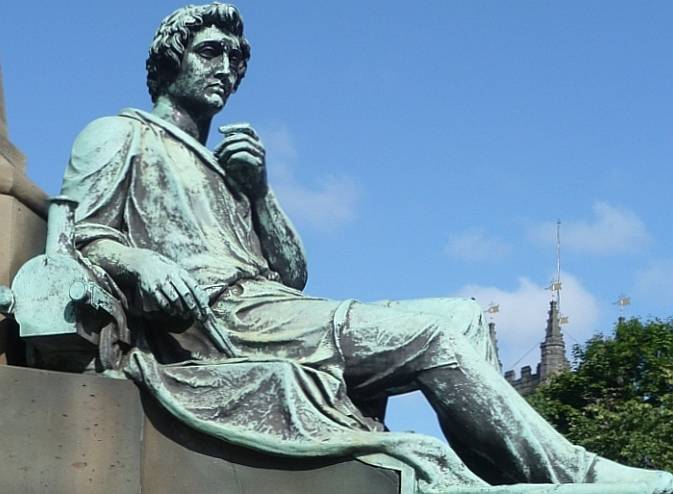
The memorial shows a larger-than-life Stephenson in a thoughtful pose, with a rolled plan in one hand. Four bronze figures are seated at the corners of the base. Of the two shown here, one (on the right) is an engineer resting his arm on a model of a steam engine, while the other, more muscular and classically-robed, is a blacksmith with an anvil. The other two figures, not visible from the front, are of a miner with a safety lamp (invented by Stephenson) and a plate-layer with a type of rail also invented by Stephenson. All the figures, to varying degrees, have a mix of classical and more modern elements — for example, the main figure's "toga-like scarf" has been described as a "Northumberland plaid" ("Monument to George Stephenson").
As this mixture might suggest, Lough can be categorised as a "transitional" sculptor. The term is applied to him by T.S.R. Boase, who believes that "Lough is, in his reactions to stylistic conflicts and in his final capitulation to the Gothic revival, one of the most characteristic figures of the period." Boase continues,
if he failed to produce any masterpieces, he at least made some stir in his own day. Springing from peasant stock, received as an artist into the aristocratic circles of the day, marrying much above his original environment, passionately single-minded and often unreasonably despondent about his own work, he is also a striking instance of the opening to the talents that artistic careers then provided. [277]
Tyneside residents might not be happy with Boase's verdict on the work, though. Lough not only made the headlines in his own time (the Literary Gazette, for example, hailed him in 1827 as an "Extraordinary Genius," qtd. in Cooper 54), but received a good deal of attention more recently, with no less than seven of his works, including a later bronze version of the Milo statue sited at Blagdon Hall, being featured in Benedict Read's widely-acclaimed and authoritative book on Victorian sculpture.

Related Material
- George Stephenson (homepage)
- A Giorgio Stephenson i Ferrovieri d’Italia [To George Stephenson [from] the Railwaymen of Italy]
- The Art and Architecture of Victorian Newcastle
Photographs by the author. [You may use this image without prior permission for any scholarly or educational purpose as long as you (1) credit the photographer and (2) link your document to this URL in a web document or cite the Victorian Web in a print one.]
Bibliography
Boase, T.S.R. "John Graham Lough: A Transitional Sculptor." Journal of the Warburg and Courtauld Institutes Vol. 23, 3/4 (July-December 1960): 277-90.
Cooper, Kay. "Mighty Man of Stone." Tyndale Life (Spring 2008): 52-55.
"Monument to George Stephenson." PMSA (Public Monuments & Sculpture Association). Web. 10 March 2026. https://co-curate.ncl.ac.uk/resources/view/74072/
Read, Benedict. Victorian Sculpture. New Haven and London: Yale University Press, 1982.
Created 25 March 2008
Last modified 10 March 2026