
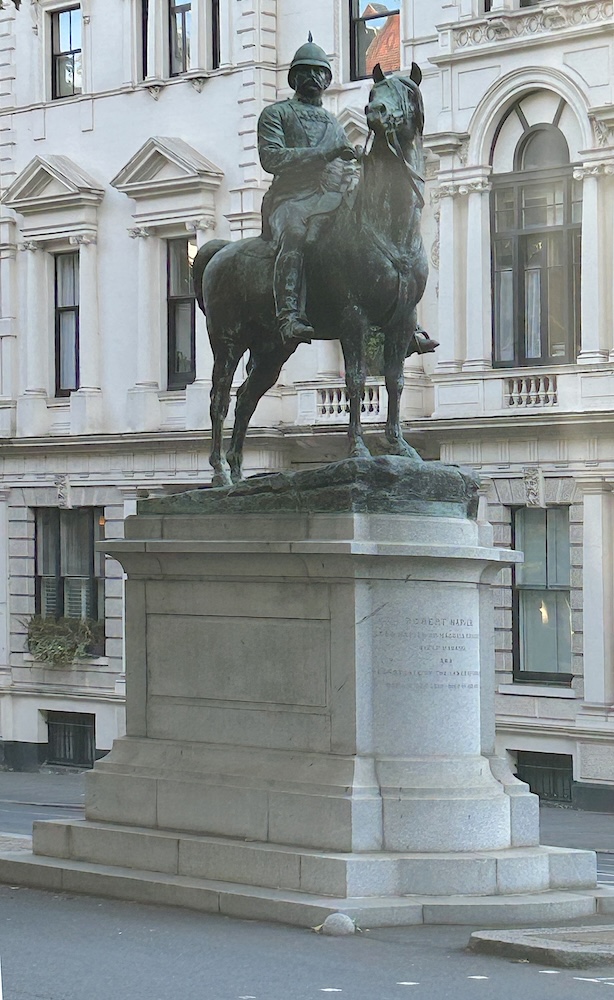
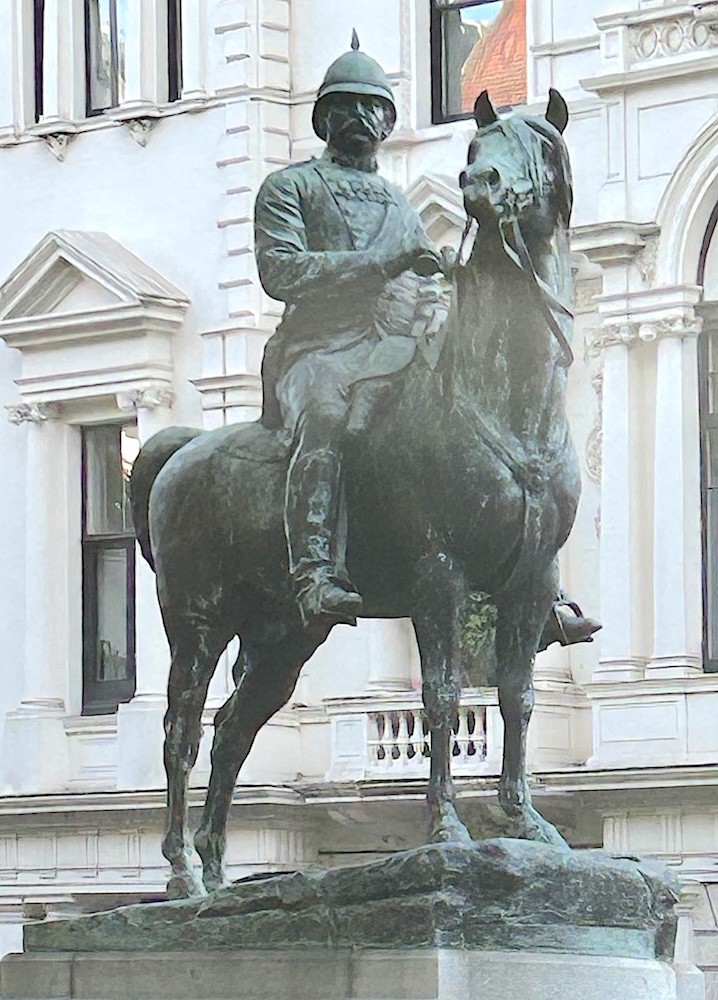
Monument to Robert Napier, 1st Baron Napier of Magdala (1810-1890), designed by Sir Joseph Edgar Boehm, Bart., R.A. (1834-1890), and completed after his death by Alfred Gilbert (but substantially the same as Boehm's earlier statue of Napier for Calcutta). Left: Whole monument. Right: Equestrian statue of Napier. [Click on the images to enlarge them.]
The monument was unveiled in Waterloo Place in 1891. Bronze on a granite plinth, it was later moved to its present location at the top of Queen's Gate, Kensington, just a short walk from the Albert Memorial.
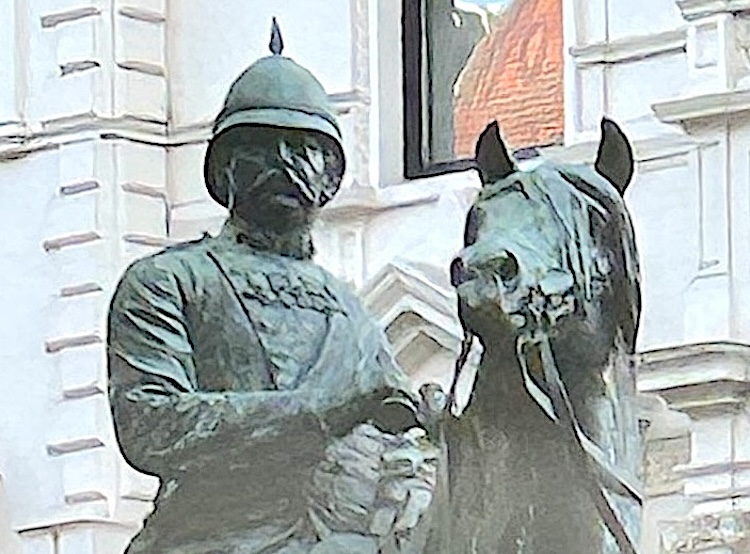
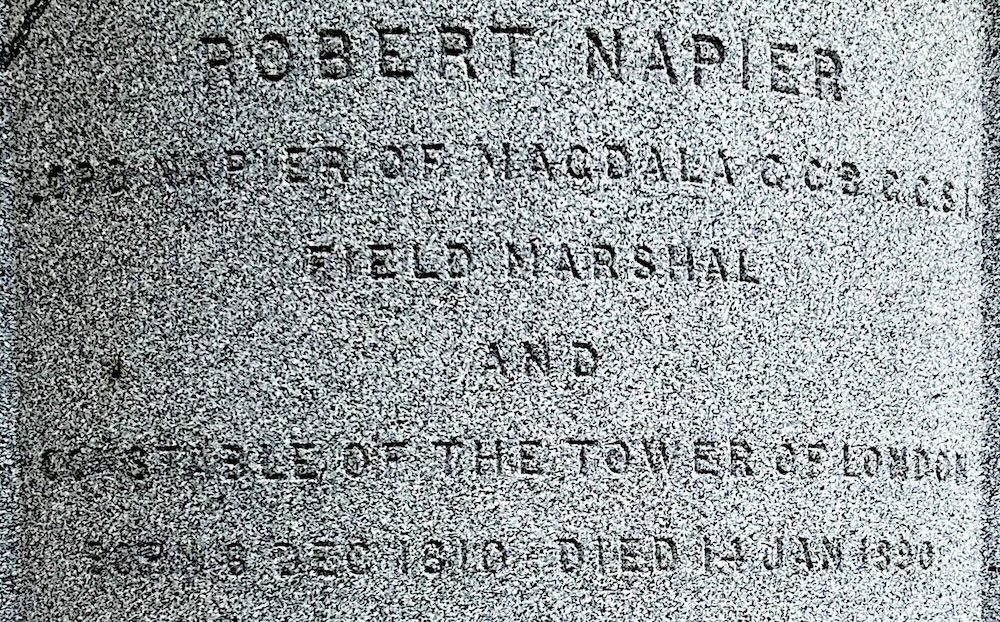
Napier, who was born into a military family in Ceylon (today's Sri Lanka), was a celebrated British field marshal whose engineering and military career with the Bengal Engineers had encompassed key projects like the laying out of Darjeeling, as well as the command of important actions in India, Ethiopia and China. As Margaret Baker says, he is "chiefly remembered for his capture of the fortress of Magdala in Abyssinia after a gruelling 400 mile march which lasted ten weeks" (60) — hence his title. After retiring from active service, he had served as governor of Gibraltar from 1876–82, and in 1887 was appointed constable of the Tower of London. He was buried in the crypt of St Paul's.
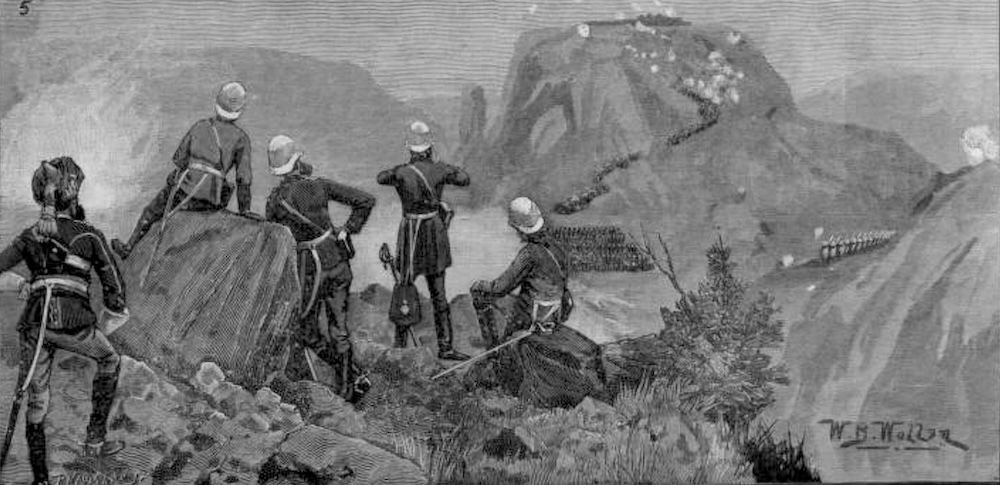
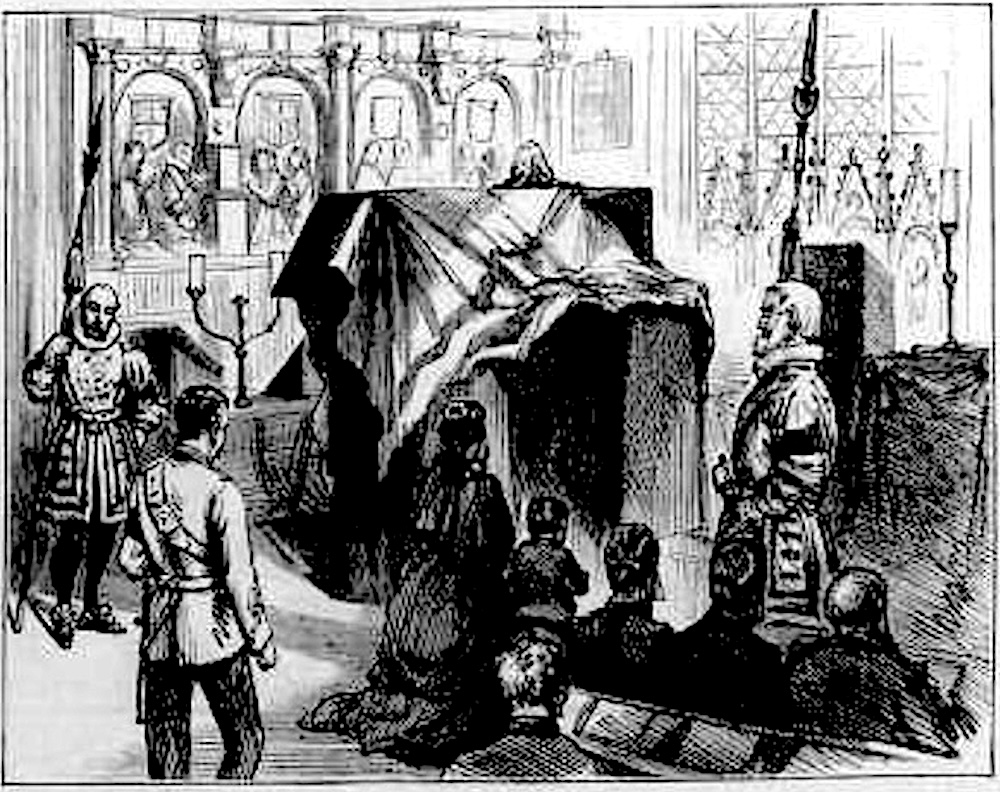
Two illustrations from the Illustrated London News, 1890-1899 of 25 January 1890: Storming of Magdala, Abyssinian Expedition, April 12, 1868 (p. 109). Right: The Coffin in the Chapel at the Tower, p.99.
Napier's passing was extensively covered at the time, and indeed dominated the last issue of the Illustrated London News for January 1890. It may be hard to understand now the full impact of Napier's greatest military feat, but it was truly exceptional. The mission to rescue around sixty British hostages taken by the aggrieved King Theodore (or Theodorus, or Tewodros II), Emperor of Ethiopia, as a result of a failure of diplomacy, at first appeared utterly impossible. But in a powerful demonstration of "bravado and professional competence," Napier rose to the challenge and was able to
transport a full-size field army assembled at a distant port, deliver it over a wide stretch of ocean to land on a hostile coast without suitable anchorages, move that army inland over the harshest of terrains, supply it wholly by a maritime delivery of goods subsequently transported on just-built roads by enormous trains of draft animals, march it nearly 400 miles into the interior of a primitive country to invest a mountain fortress holding three score hostages and effect their release in a period of some 190 days! [Zoll 63]
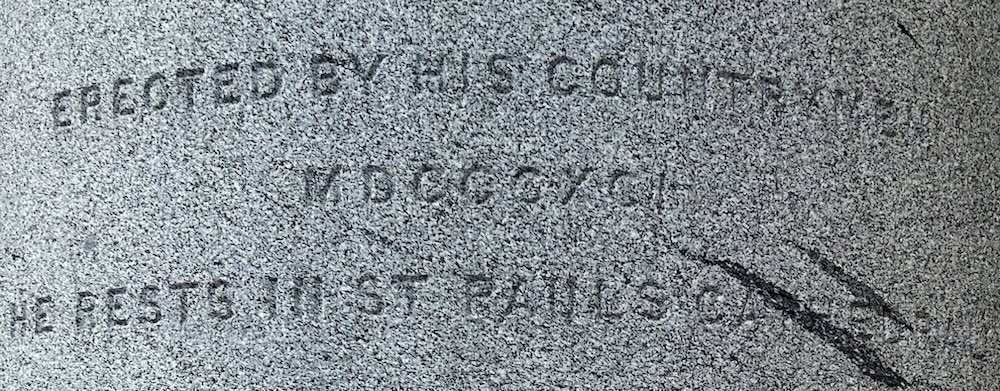
Napier' achievement was remembered for years. After his coffin was taken across to St Paul's, he was given what amounted to a state funeral, with the Prince of Wales and other members of the royal family in attendance. His monument was funded by public subscription. On the back of the plinth is inscribed, "Erected by his countrymen, MDCCCXCI 1891 / He rests in St Paul's Cathedral."
Triumph on one side had its inevitable counterpart in tragedy for the other. As a sad footnote, when the defeated Emperor took his own life, his seven-year-old son was brought to England. His mother died on the way, and the orphaned child became one of Queen Victoria's several protégés. Prince Alemayehu was given a thoroughly English education at Cheltenham College, Rugby and Sandhurst; but he seems, understandably enough, never to have been happy in the English context, and died after an illness at the age of eighteen. At the Queen's own request, he was buried at St George's Chapel, Windsor Castle; but calls for the restitution of his remains, and the return of many items from Magdala at the British Museum, continue.
Related Material
Scanned images, text and formatting by Jacqueline Banerjee. [You may use the images on this page without prior permission for any scholarly or educational purpose as long as you (1) credit the person who photographed or scanned them and (2) link your document to this URL in a web document or cite the Victorian Web in a print one.]

Bibliography
Baker, Margaret. London Statues and Monuments. Princes Risborough, Bucks: Shire, 1995.
Illustrated London News, 1890-1899. See 25 January 1890: "Military Career of Lord Napier of Magdala," p. 98; "Incidents of Lord Napier of Magdala's Military Career"(p.109); "Funeral of Lord Napier of Magdala" (p. 99); Obituary: Lord Napier of Magdala, p. 110. Internet Archive. Web. 1 Octorber 2026.
"Statue of Field Marshal Lord Napier." Historic England. Web. 1 October 2026.
Zoll, Donald Atwell. "The British Hostage Rescue in Ethiopia, 1867-68." Military Review, June 1988: 54-63. Google Books. Web. 1 October 2026. https://www.google.co.uk/books/edition/Military_review/8BmyAAAAIAAJ?hl=en&gbpv=1&dq=Magdala+Expedition&pg=RA5-PA63&printsec=frontcover
Created 1 October 2026