
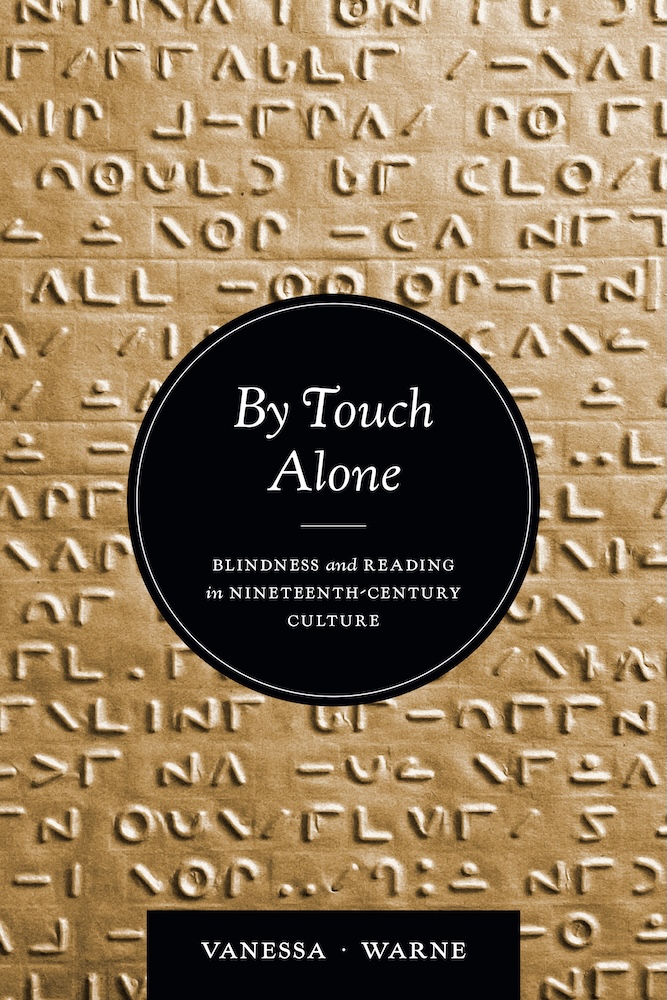
 y Touch Alone: Blindness and Reading in
Nineteenth-Century Culture represents a fascinating convergence
of disability studies, book history, and the history of Anglo-American
blind people's reading practices. Vanessa Warne examines shifting
perceptions of blind people reading by
touch, the development of raised-print scripts and books, blind people's
(in)ability to participate in the economy and broader culture, and the
various ways in which reading by touch had transformative effects on
people's lives in terms of education, religion, social inclusivity, and
access to privacy. Given that the nineteenth century is "the first
century of reading by touch" (179), Warne's work is crucial to the
scholarship of blindness.
In the Introduction, Warne outlines the parameters of her project, mapping some of the major changes that occur throughout the Victorian era in regard to blind people's literacy. For instance, there was the development of various raised-print scripts that led to the eventual adoption of the namesake script of Louis Braille (1809-1852). Being able to read again was pivotal to ideas of rehabilitation: "Commentators frequently highlighted the value of reading as a route to full membership in the human community" (9). Those with disabilities were — and still are — misunderstood as lesser. Their change in ability is often characterized as a lack. As a result, reading by touch allowed members of the blind community to reassert their humanity and to redefine themselves in ways that defied ableist thought and society at large. Of course, reading by touch also inspired innovations and instigated debates about printing techniques, book design, libraries for the blind, and which kinds of books should be published for this community. Warne emphasizes the significance of blind people's reading for sighted people as well: the two groups could connect over literature and in doing so, revise negative stereotypes—of blindness as "a tragic condition" (18)—into more progressive possibilities.
To borrow Warne's turn of phrase, raised print had "a prosthetic quality" that allowed "human bod[ies] to perform an activity" that they otherwise could not (17), and it altered the relationship between books and readers. In fact, reading by touch epitomizes Hannah Thompson's theorization of "‘blindness gain'" more than a century later; instead of viewing blindness as a loss, she suggests that we can choose to see it as a benefit (Warne 20, 70; Thompson). If we think of blindness as a benefit, then we are faced, as Warne discerns, with the fact that blindness's limitations or dependencies are "product[s] of culture, including material culture" (20). Reading by touch, therefore, reminds us of this fact and demonstrates that technological innovations can minimize the effects of vision loss. Throughout her study, Warne goes on to discuss various inventions by the blind and sighted, scrutinizes case studies, and intersperses insightful analyses of the literary record throughout to show the dynamic nature of blind people's lives in the nineteenth century.
Each chapter of By Touch Alone explores a different component of blind culture and considers how identifications of class and gender affected blindness. A merit of Warne's study is that these chapter-by-chapter investigations draw on diverse, understudied sources from both sighted and blind people, including canonical and obscure fiction, poetry, articles, essays, letters, speeches, testimonials, photographs, and paintings. Notably, Warne acknowledges that while the literary record is crowded with the voices of sighted authors and characters (26), one of her goals is to center the perspectives and experiences of blind people. The variety of sources in By Touch Alone indicates the enduring presence of blind people's culture and community. Perhaps most importantly, the various sources challenge an ableist focus on sight as the predominant mode of engaging meaningfully with the world.
In Chapter 1, Warne examines working class and poor blind people reading raised-print texts on bridges and in streets from legal and literary perspectives. She considers how the performative element of this activity publicized blind people's new literacy and the lack of options for improving their poverty. She uses Henry Mayhew's interview with a blind man, the poetry of blind poet Edmund White (b. 1811?), and a short story called "The Poor Blind Woman" (1881) by an anonymous author to point out the mixed reactions this practice provoked, including curiosity, suspicion, and sympathy.
In Chapter 2, the focus shifts to blind people in higher social classes. Warne emphasizes the figure of the blind scholar, "a Victorian-era alternative to earlier blind types such as the blind seer" (32). She draws on the work of blind activist Alfred Hirst to exemplify the idea of "blindness gain." Hirst advanced the argument that blind people were keener readers than sighted people because they reread texts by touch many times, improved their retention, paid attention to details, and found mistakes in the works of sighted authors (64, 67). For Hirst and others, the poet John Milton (1608–74) became an important figure in blind people's reading culture (for his poetry) and in the broader Victorian commentary on visual disability (66–7).
While the first two chapters usefully compare experiences of blindness at different class levels, Chapter 3 turns to the collaborative efforts between the sighted and blind. Specifically, Warne investigates the relationships between blind authors and sighted amanuenses, concentrating on literary depictions of the blind author as an exploited figure who is dependent on an assistant. Class and gender are also crucial to understanding author-amanuensis relationships; working-class authors might have found it difficult to afford to hire assistants and "the pairing of a blind male author with a sighted female assistant" was the historical convention (91). The fictional blind author-amanuensis relationships are contrasted with real blind authors' experiences, such as those of W. W. Fenn (1862–1932), Alice King (1839–94), Frances Browne (1816–79), and Edmund White. Over the course of the chapter, Warne offers readings of Bertrand W. Babcock and Winnifred Eaton's "Eyes that Saw not" (1902) and George du Maurier's The Martian (1897), which transformed the conventional pairing of a blind male author and a sighted female assistant in interesting ways.
In Chapter 4, Warne explores the private correspondence of blind people: letters that could be read by touch (written in braille) and letters that could not be read by touch (those written in ink). Blind people wrote letters with the use of stamps, braille, and writing (i.e., embossing) machines to access privacy, which demonstrates how nineteenth-century inventions helped them to maintain and to reclaim their social networks and self-expression. But, at the same time, Warne argues that for the mainstream sighted community, letter writing functioned "as a normalizing practic[e]" that served "to minimize differences between blind and sighted people" (121). As a result, she suggests that the ways in which blind people wrote letters fluctuated far more than "the materiality of handwritten letters" (121). The accompanying analyses of Wilkie Collins's Poor Miss Finch (1872), and the letter writing of activist and philanthropist Elizabeth Gilbert (1826–85) and political economist Henry Fawcett (1833–84) supplement Warne's discussion.
The final chapter explores blind people's increased access to and experiences with touching non-textual objects in public, ocular-centric spaces such as museums, art galleries, and exhibitions (i.e., the Great Exhibition of 1851 and Chicago's World Fair of 1893). Not only were blind people able to experience museum collections via the haptic sense (in ways that sighted visitors were not allowed [158]), but they also curated these spaces and opportunities. For instance, W. H. Levy (1830–74) created a "touch collection" in a one-room museum; activist Alexander Barnhill opened a small museum for blind visitors in Glasgow; and J. A. Charlton Deas (1874–1951) invited blind children and adults to a prototype of "touch tours" at the Sunderland Museum in England (164–7). Thus, blind people's participation in these public spaces once again challenged beliefs that vision loss necessarily meant a life of social isolation, dependency, and above all, tragedy; instead, Chapter 5 shows that reading by touch shaped blind and sighted people's perceptions of "the power of touch" (154).
Throughout the book, Warne acknowledges that there were "real-world limits to the transformative and equalizing effects of reading by touch" (153) while reminding readers that this practice fundamentally changed people's ideas about blindness. Her study does an excellent job detailing the major inventions and technological developments that influenced blind people's reading practices as well as showing the dynamic quality of blind culture and communities. As a sighted academic, Warne underscores her privilege in being able to work in visually oriented spaces such as archives and libraries, as well as using digitized resources that might be most accessible via sight. She concludes By Touch Alone with a coda in which she articulates the importance of research about blindness in the present moment, when resources have been redirected from publishing braille books to the development of digital technologies (178).
Links to Related Material
- Nineteenth-Century Views of Blindness and Deafness in Jane Eyre
- The Blind Basket-Maker with his First Child (1858) by Michael Frederick Halliday
- The Importance of Being Different by Chris Foss, reviewed by Joti Bilkhu
- Reading Victorian Deafness by Jennifer Esmail, reviewed by Diane Josefowicz
Bibliography
[Book under review] Warne, Vanessa. By Touch Alone: Blindness and Reading in Nineteenth-Century Culture. Ann Arbor: University of Michigan Press, 2025. 218 pp. Paperback. $29.95 ISBN 9780472057511
Thompson, Hannah. "Blindness Gain and the Art of Non-Visual Reading." Lecture delivered at Royal Holloway on 30 October 2018. Blind Spot (5 October 2018). https://hannah-thompson.blogspot.com/2018/10/blindness-gain-and-art-of-non-visual.html
Created 28 October 2026
Last modified 30 October 2026