
nterest in the Islam faith long predates the Victorian period. Even leaving aside forced conversions or conversions for gain during interactions with Muslim countries in earlier periods, some international travellers had been drawn to it, and, indeed, Jamie Gilham argues that "Islam was not an altogether negative phenomenon from the Protestant point of view, and in fact many early modern Britons believed Islam to be less dangerous than Roman Catholicism" (Loyal Enemies, 5). Gilham points in particular to William Dalrymple's White Mughals, Love and Betrayal in Eighteenth-Century India, and the story of the British Resident in Hyderabad, James Achilles Kirkpatrick (1764-1805), who married the beautiful princess, Khair un-Nissa, in 1798, and was by no means alone in his assimilation into Islamic life. But Gilham goes a step further than Dalrymple, contesting his and other historians' view that after this "British conversions to Islam abroad petered out": on the contrary, he writes, "the chain of British conversions and attempts to bridge the cultures of (Western) Christianity and Islam since at least the early modern period in fact continued into and beyond the mid-nineteenth century" (Loyal Enemies, 12).
Someone who formed a link in this chain and was not settled abroad was Henry Stanley (1827-1903, a high-profile English diplomat who travelled to Muslim countries in the nineteenth century, and converted, but then returned home. He became 3rd Baron Stanley of Alderley in 1869 and duly entered the House of Lords as the first Muslim Peer of the Realm. His conversion had caused a stir in his family, and he kept his religious faith out of his public life. But he can hardly be said to have hidden it: he defended Islam in his writings and spoke up for the Ottomans from his new platform, generally siding against colonialist prejudices. In a memorable chapter in his book, The East and the West (1865), a chapter which he makes a point of saying was written as early as 1833, he had already stoutly supported Islam as a political system, concluding that the usual charges against it were ill-founded — and in the process criticising not the fundamentals of the English system, but its "fatal perversion" in his own age, "which, if not rectified before it be too late, must, according to my judgment, end in the extinction of this Empire, after inflicting incalculable woes on the human race" (204).
Stanley's foresight with regard to imperialism may have been unusual, but by the end of the Victorian period, attitudes to the peoples and cultures in Britain's extensive empire were already changing. Symptomatic of this were the run-away success of the Colonial and Indian Exposition of 1886, and Queen Victoria's close personal attachment to her Muslim attendant, Abdul Karim. "At the end of the nineteenth and the beginning of the twentieth century," declares historian Peter Clark, "imperial arrogance was already in decline, and there were people who were considering sympathetically the ideas and beliefs of the subjects of the Empire. A small number embraced Islam" (396).
Part I of this introduction is concerned with the prominent early convert, William Quilliam, and his efforts to promote Islam in Liverpool (where he conducted a memorial service for Stanley at his mosque); Part II starts with the Woking Mosque, from the same period, and looks at the expansion of Islam in the Edwardian period onwards.
I: William (Abdullah) Quilliam and the First British Converts
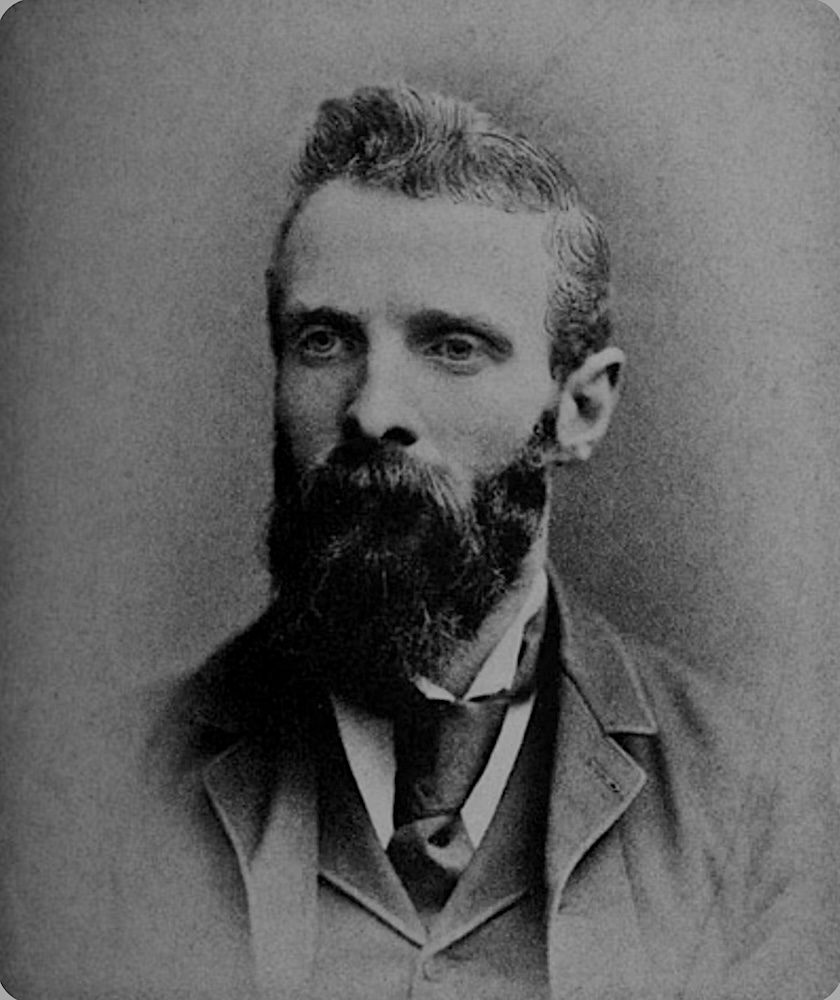
William Quilliam, from Brierley (identified as being in the public domain).
William Quilliam (1856-1932) was one of that "small number" who "embraced Islam" in Victorian times, and the story of British converts to Islam largely centres on his activities. At first, it seems an unlikely story. Quilliam was born in Liverpool into the Wesleyan Methodist family of a watch-maker with a flourishing business. The Quilliams had a strong ancestral background in the Isle of Man, and the boy spent much of his childhood there. After his schooldays at the Liverpool Institute, he attended King William's College on the island. As well as being brought up a Methodist, he was also, from very early on, an active supporter of the Temperance Movement. Evidently a bright young man, he trained and qualified as a solicitor; he was also a man of principle, known to have practiced on behalf of those least able to remunerate him. By conventional English standards, however, his personal life bore less scrutiny: married in 1879, he supported a mistress as well, and had nine children in the two households. After his wife died, he married his mistress, but then again took an additional wife.
Still, these arrangements were not frowned on by Islamic law — and long before the second and third marriages, Quilliam had become a Muslim, taking the name of Abdullah. At some point in the early 1880s, apparently for health reasons, he had visited Morocco, and found himself attracted to the Islamic faith; in 1887 he had finally decided to convert to it. In that same year, Frances Elizabeth Murray (1865-1900), a young woman who had also been involved in the Temperance Movement, was so impressed and influenced by Quilliam's views that she too converted — becoming one of the very first British woman to become a Muslim. As Quilliam engaged in the kind of proselytising that he had practised as an advocate of Temperance, and with the kind of fluency and conviction that he had developed in his professional life, others began to follow suit. With Murray, who married that year and was now known as Fatima Cates, he opened Britain's first mosque in Liverpool in 1889 in an ordinary house, confirmed by Humayam Ansari to have been the "earliest example of institution-building [for Muslims] in the late nineteenth-century" (121); and in 1894 he was honoured with the title of Sheikh-ul-Islam (leader of the Muslims in this country) by the Ottoman Emperor. In time, he was able to open two schools and a orphanage as well (see Geaves 9); under the name of Haroon Mustapha Leon he also published Islamic periodicals, making sure that they were widely distributed.
Quilliam's adoption of the faith, and tireless encouragement to others to follow suit, made him both a well-known and a controversial figure. Although he himself had first encountered Islam whilst in North Africa, his mission attracted considerable interest among the Muslims in India. It was not always favourable. Adaptations to local taste, such as "the singing of hymns, praying in the English language, etc" (Arnold 370), were questioned; yet, at home, the faith that he aimed to introduce to Liverpudlians still seemed too alien to them. John Pool, a contemporary who visited the mosque, was received with every kindness and found much that was familiar in the evening service he attended, including the popular hymn, "Take my life, and let it be /Consecrated Lord to thee" by the Victorian hymnologist, Frances Havergal. Still, for Pool himself, and evidently for many others, this could not be a congenial faith. Noting what he considered to be its misinterpretations of the Bible, Pool criticised, among others, its advocacy of force to convert others, the severity of its punishments, and, "worst" in Pool's eyes, its "laws with regard to marriage and divorce" (17). Thus, while Pool admits that "[t]he Koran is not without its beautiful truths beautifully expressed" (18), he makes it clear from the start of his Studies in Mohammedanism that he hopes his discussion will encourage some of the Liverpool converts to return to "the faith of their fathers" (xv).
In truth, there was a good deal of anti-Muslim feeling in the wider population, and the number of British people converted to Islam at this time was small. Pool, for one, did not expect it to take root here. Sir Thomas Walker Arnold put the total in 1894 at 137. Cates died young at the end of the century, and when Quilliam left Liverpool for Constantinople in 1908, in the wake of a scandal about his handling of a divorce case, the number of Muslims there could still only be put at "about 250-300" (figures from Arnold 370, and Gilham, "Abdullah Quilliam," 109). After he left, impetus was lost, although his eldest son Robert (Ahmed) Quilliam did try to carry on his father's work. It seems that concessions made to familiar devotional practices were, indeed, not enough to convince Liverpudlians that Islam was "an indigenous faith rather than a foreign import" (Geaves 8).
With the restoration of the Ottoman constitution, Quilliam lost his prestigious connection in Turkey, and returned to England in the following year. This was also because his first wife was very ill. On her death, he married his mistress, the mother of his other children, and the couple lived in Nottingham for a while. He seems to have avoided Liverpool and kept a lower profile altogether, still writing and giving talks, but now under the new name of Henri Marcel Léon. Later he gravitated towards London, and spent much of his remaining life on the Isle of Man. He was buried in the Muslim section of Brookwood Cemetery in Woking, not far from the Woking Mosque.
That, however, is hardly the end of the story in which Quilliam had once cut such a dash. Despite the disturbing opposition described by both Pool at the time he visited the Liverpool mosque (street arabs throwing stones, p. 400) and Jamie Gilham later (local people throwing snowballs containing offal and stones, Loyal Enemies, p. 211), the number of Muslims in the country as a whole continued to rise. Gilham writes:
official statistics are unavailable, but one scholar estimated that the number in 1897 was 2,700, compared with 2,600 Muslims in France and 800 in Italy. The Muslim population in Britain swelled at least sixfold (and probably much higher) annually with temporary visitors and occasional settlers comprising seafarers (around 10,000 each year), traders, diplomats, students, intellectuals, professionals such as lawyers, servants and affluent tourists. [Introduction to Islam and Muslims, p. 2]
While most of these late Victorian Muslims, such as the "seafarers," were from abroad, some at least were local converts, and several high-profile British converts of the early twentieth century had grown up if not actually turned to Islam during the Victorian period: notably, Lord Headley (Rowland George Allanson Allanson-Winn, 5th Baron Headley, 1855-1935), who converted to Islam in 1913 and became a prominent spokesperson for it, under the name of Shaikh Rahmatullah al-Farooq (Muhammad); Lady Evelyn (Zainab) Cobbold (1867-1963) who converted to it in 1915, after having long been drawn to it, and became the first British Muslim to make the pilgrimage to Mecca; and Marmaduke Pickthall (1875-1936), the scholar who translated the Koran.

II. The Woking Mosque and the Muslim Diaspora
Although "white British converts ... have a tradition dating back to the late nineteenth-century" (Ansari 14), the vast majority of Muslims were from India, not just lascars from Liverpool and other dockside areas, but students in London, and at the Oriental Institute at Woking. This small town in Surrey, which had largely grown up with the advent of the railway, was where the first purpose-built mosque in Britain had been built in 1889 for those attending the Institute by the enlightened orientalist and educationist, Gottlieb Wilhelm Leitner, with funds provided by the Begum of Bhopal in India. This was the very year in which Quilliam first provided dedicated space in Liverpool for his own converts. At the time when Pool visited the Liverpool mosque he noted its connection to the Institute in Surrey, although he described the Woking establishment as having "only one or two students" (403). But both Institute and mosque expanded, and it was to the Imam in Woking that Quilliam's son Robert Ahmet dutifully appealed for help in the year following his father's death, writing via The Islamic Review to inform him that he was still trying to make converts in Liverpool, and needed "the Muslim Calendar — a guide to Nimaz [ritual prayers] in English" and "any literature on Islam you have to spare" (632).
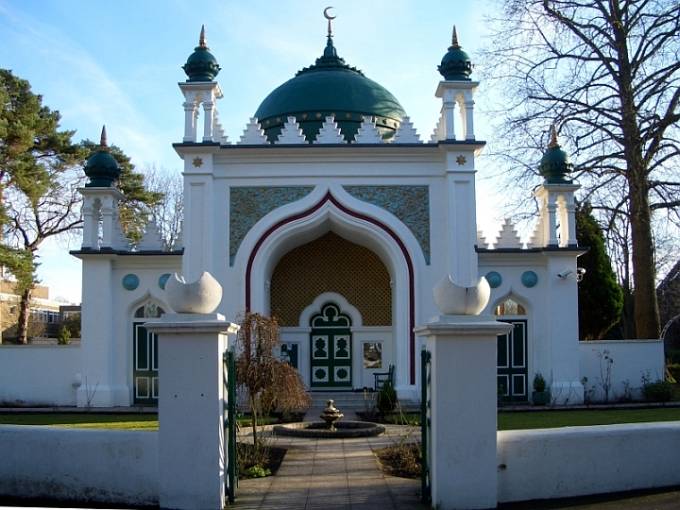
The Woking Mosque. [Click on the image for more information.]
Pool expected attempts to foster the Muslim religion on British soil to drag on for a while, and then "probably die a sudden death" (404); but he could not have been more wrong. For while the conversion of local people was indeed "hard up-hill ... work" (395), and the Liverpool project did gradually peter out after Quilliam left, the influx of immigrants from the Indian subcontinent ensured that Islam would not only be a presence here, but an increasingly significant one. The newcomers would boost numbers well beyond the low thousands into the several millions.
Of particular note was (and is) the reception in Britain of Ahmadiyya Muslims, members of a reformed pacifist sect founded in 1836 but heavily persecuted in Pakistan, whose history here also goes back to the late Victorian period — indeed, on Queen Victoria's Diamond Jubilee in 1897 the "Promised Messiah" of the sect presented Queen Victoria with a book, Tohfa-e-Qaisariyyah [A Gift for the Queen] explaining their beliefs. They started publishing their journal, The Review of Religions, in English in 1905 (Geaves 3), and had established themselves in England, at least in a small way, from "as early as 1912" (Valentine 74). At first, their efforts were focussed on Woking, but in 1926 they opened their own purpose-built mosque, the Fazl (or London) Mosque, in Southfields in south-west London.
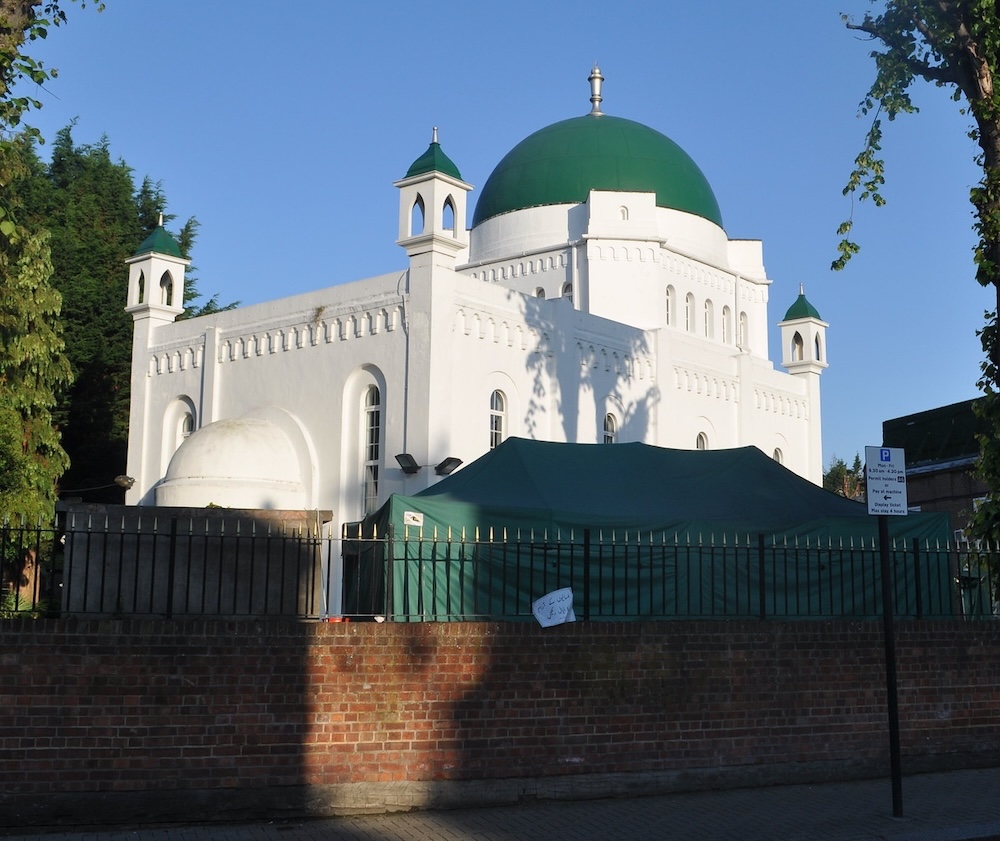
Fazl (or London) Mosque, ©Steve Keiretsu and originally posted on Flickr, reproduced under the terms of the Attribution-NonCommercial 2.0 Generic CC BY-NC 2.0 Deed.
A much larger mosque complex, able to accommodate as many as 13,000 worshippers, has since been built in nearby Morden: the impressive Baitul Futuh Mosque is the Ahmadiyyas' world headquarters. The sect is outside the mainstream. It has not only been decisively rejected by the mainstream in its country of origin, but is regarded as "non-Muslim" elsewhere too because of its "alternative truth claim to that held by the Sunni and Shi'a narratives concerning prophethood" (Geaves 10). Nevertheless, its success here represents a significant rooting of an offshoot of Islam in England.
Quilliam's Victorian converts in Liverpool, the higher class converts early in the following century, and the many immigrant Muslims of more recent years, including the Ahmadiyyas, have all played their part in the story of Islam in Britain. There have been more conversions — and reversions — to the faith in recent years. Reliable figures are hard to gather, but the fact that (for example) the mosque in Cheadle in Greater Manchester offers classes for "Reverts" to Islam speaks for itself. The 2021 census revealed that there were about 4 million British Muslims, amounting to 6% of the total population of 67 million, "more than all the other minority faiths put together" ("British Muslims in Numbers," p.2) at the beginning of the decade. These figures will undoubtedly have risen since then.
Related Material
Bibliography
Ansari, Humayun. Muslims in Britain since 1800. London: Hurst, 2004.
Arnold, Sir Thomas Walker. The Preaching of Islam: A History of the Propagation of the Muslim Faith. Vol. I. London: Constable, 1896. Google Books. Free to read.
Brierley, George. "William Henry Quilliam: The Victorian solicitor who established Britain’s first mosque. British Library. Web. 22 April 2026.
"British Muslims in Numbers." Census Report Summary, March 2025. Web. 22 April 2026. https://mcb.org.uk/wp-content/uploads/2025/03/Census-Report-Summary-2025-.pdf
Cheadle Masjid. "Reverts." Web. 25 Apri 2026. https://cheadlemasjid.org/reverts/
Clark, Peter. Review of Gilham and Geaves. Islam and Christian–Muslim Relations 29(3):396–398. https://doi.org/10.1080/09596410.2018.1447864
Dalrymple, William. White Mughals, Love and Betrayal in Eighteenth-Century India. Pbk ed. London: Flamingo (HarperCollins), 2002.
"Death of Lord Stanley of Alderley, reported in the Review of Religions from Quilliam’s paper." Woking Muslim Mission. Web. 12 July 2026. https://www.wokingmuslim.org/pers/quilliam/rev-rel2.htm
Geaves, Ron. Islam and Britain: Muslim Mission in an Age of Empire. London: Bloomsbury, 2017.
Gilham, Jamie. "Abdullah Quilliam, First and Last 'Sheik-ul-Islam of the British Isles." Victorian Muslim: Abdullah Quilliam and Islam in the West. Edited by Gilham and Ron Geaves. London: Hurst, 2017. 97-112.
Gilham, Jamie. Introduction. Islam and Muslims in Victorian Britain: New Perspectives, edited by Gilham. 1-10. London: Bloomsbury, 2024.
Gilham, Jamie. Loyal Enemies: British Converts to Islam, 1850-1950. London: Hurst, 2014.
Guilford, John. "Quilliam, William Henry [known as Sheikh Abdullah Quilliam; Haroon Mustapha Leon] (1856–1932), lawyer and Muslim leader." Oxford Dictionary of National Biography. Online ed. Web. 22 April 2026.
Pool, John J. Studies in Mohammedanism: historical and doctrinal: with a chapter on Islam in England. London: Constable, 1892. Internet Archive, from a copy in the Salar Jung Museum, Hyderabad. Web. 22 April 2026.
Quilliam, Robert. Letter to the Imam of the Woking Mosque. The Islamic Review (October 1933): 362. Internet Archive, from a copy in the Salar Jung Museum, Hyderabad. Web. 22 April 2026.
Stanley, Henry. The East and the West. London: Hatchard, 1865. Internet Archive, from a copy in digitallibraryindia; JaiGyan. Web. 12 July 2026.
Valentine, Simon Ross. Islam and the Ahmadiyya Jamm'at: History, Belief, Practice. London: Hurst, 2008.
Created 26 April 2026
Last modified 12 July 2026