
![Diana and Endymion [Diana and the Shepherd]](23.jpg)
Diana and Endymion [Diana and the Shepherd] by Walter Crane, RWS (1845-1915). 1883. Watercolour and gouache on paper. 21 ¾ x 30 ¾ inches (55.3 78.1 cm). Image courtesy of Dundee Art Galleries and Museums, reproduced for purposes of non-commercial academic research. [Click on the image to enlarge it.]
Crane exhibited this picture at the Grosvenor Gallery in 1883, no. 75. In the catalogue the title of the painting was listed as Diana and the Shepherd and not Diana and Endymion. It features Diana, the goddess of hunting, clad in a semi-translucent white gown, with a quiver of arrows on her back and a bow in her right hand. The youthful W. Graham Robertson posed for the figure of Diana. She is leading two hounds on a leash in her left hand. The dogs are based on one of the larger of the Crane family's two pets. Diana is staring at the recumbent figure of the shepherd Endymion, who is clad in a blue-purple robe and is naked to the waist. He is lying down asleep in a meadow full of flowers, including harebells, with his shepherd's crook by his side. Clumps of trees can be seen to the left and right and sheep are grazing in the background. The picture was painted at Tunbridge Wells Common after Crane's return from Italy.
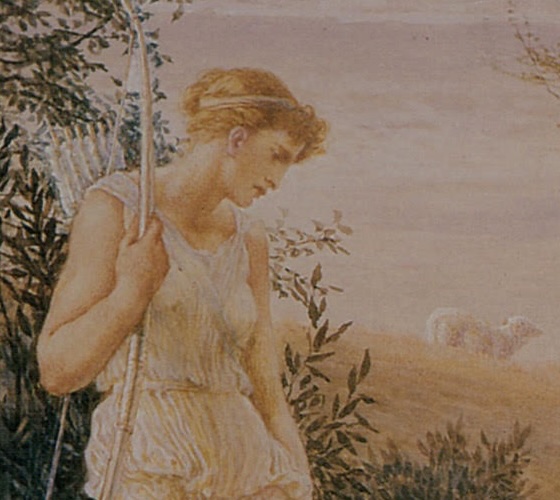
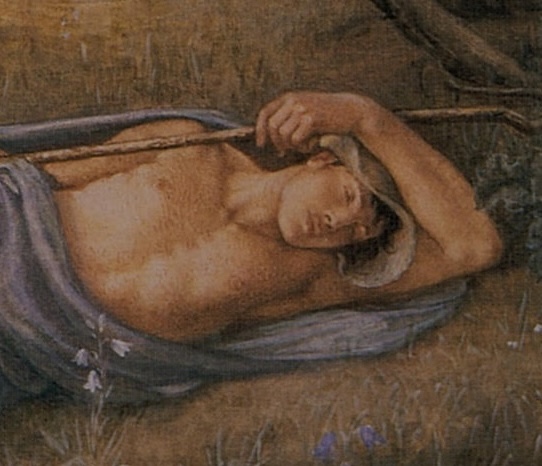
Closer views of the two figures.
In Roman mythology Diana was the goddess of the moon who fell in love with a mortal, the handsome shepherd Endymion. According to the myth Diana used to come each night and kiss Endymion when he was asleep on the top of Mount Latmos. Diana's light touch partly drew Endymion from his slumber and, incredulous at her beauty, he attributed it to a dream. He began to prefer this dreamlike state over his daily routines. Through Diana's love and the power of Jupiter, Endymion was granted eternal youth and timeless beauty in his perpetual state of dreams.
The subject of Diana and Endymion was a favourite with Old Master painters. In the Victorian era the most famous version was by G.F. Watts who exhibited his Diana and Endymion at the Grosvenor Gallery in 1881, no. 56 [see also an etching of it]. This was quite a different composition to Crane's, showing the goddess hovering above the sleeping shepherd. Watts had done an earlier version, c.1869, a different composition again , which was in the Cecil French Bequest to the Fulham Public Libraries, but is now the property of the London Borough of Hammersmith & Fulham. Edward Poynter did a much later version of this subject in 1901-02, now at the Manchester Art Gallery. Poynter's version is based on John Keats's poem "Endymion" and Diana is portrayed nude, except for a large fluttering blue scarf, and she is shown standing above Endymion. The figure of Endymion, however, is remarkably similar to that in Crane's watercolour except that the shepherd is facing in the opposite direction.
Contemporary Reviews of the Painting
This work was not extensively reviewed when it appeared at the Grosvenor Gallery. F.G. Stephens in the Athenaeum gave it a mostly enthusiastic appraisal:
Close to the last-named study is one of the finest works in the gallery, the Diana and the Shepherd (75) of Mr. Walter Crane. The goddess has just issued from a wood where twilight lingers, although the outer world is already arrayed in the soft light of the silvery morning following dawn. She stops in the path which leads across an upland down, and gazes on the shepherd lying fast asleep under the boughs of a tree. Diana is buskined for the chase, she is armed with bow and quiver, and in a leash she holds her dogs, who, with lolling tongues and eager eyes, pull their mistress towards the sleeper, whose "nibbling flocks do stray" along the down, and are seen against the sky, where the still pale light attests how lately Diana left that region. Nothing could be finer than the taste or the poetical motives of this picture's illumination, scheme of colouring, and magical harmony of tone. The figure of Diana was designed in the true spirit of the Renaissance. It is a pity that her face is ugly and her legs are ill drawn. [608]
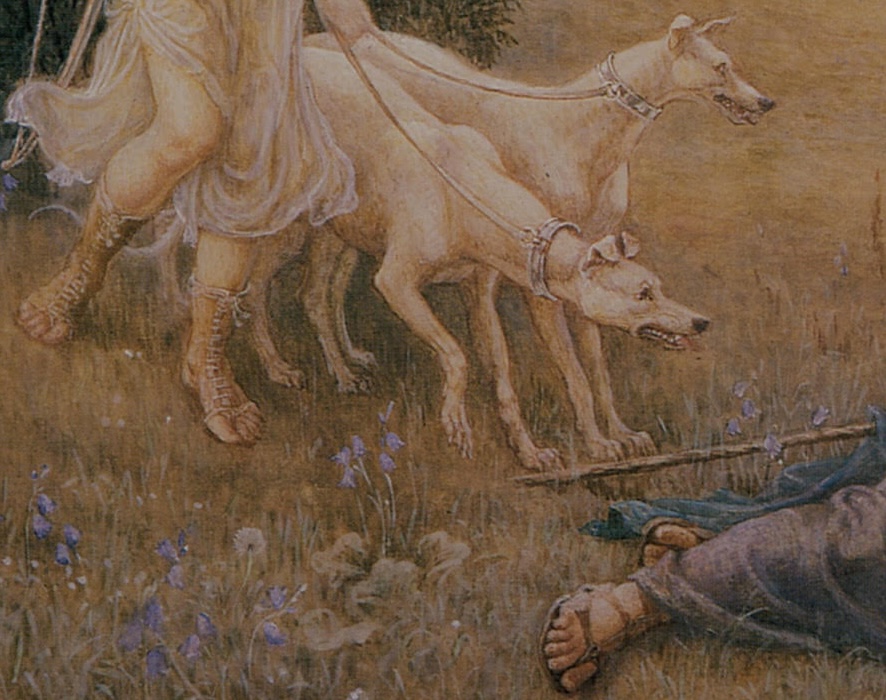
Closer view of the dogs.
Harry Quilter in The Spectator, however, criticized Crane for not being able to paint an olive tree correctly, believing this picture had been painted in Italy and not England: "Mr. Walter Crane's Diana and the Shepherd, only demands notice here as another example of how futile it is for an artist to rely upon his imagination, beyond a certain point. Mr. Crane has been a resident in Italy now for some months, yet we doubt if any artist who had ever seen an olive-tree, could have painted with less fidelity to nature than Mr. Crane has displayed here, in the grey foliage and silver stems. Still more notable is the absence of accurate knowledge in the drawing of the figures in this composition" (738).
Related Material
- Arthur Wardle's drawing, Moon Kissed — Endymion
- Edward Poynter's Study for "The Vision of Endymion"
- Henry Holiday's Diana, Queen and Goddess, Chaste and Fair
Bibliography
Blackburn, Henry. Grosvenor Notes. London: Chatto and Windus (May 1883): no. 75, 22.
Christian, John. Burne-Jones and his Followers. Tokyo: The Tokyo Shimbun, cat. 39, 104.
Christian, John. The Last Romantics. The Romantic Tradition in British Art. London: Lund Humphries Publishers Ltd., 1989, cat. 36, 89-90.
Crane, Walter. An Artist's Reminiscences. London: Methuen, 1907. 243.
Quilter, Harry. "Art. The Grosvenor Gallery." The Spectator LVI (9 June 1883): 737-39.
Spencer, Isobel. Walter Crane. New York: Macmillan Publishing Co. Inc., 1975. 127.
Stephens, Frederic George. "Fine Arts. The Grosvenor Gallery Exhibition." The Athenaeum No. 2898 (12 May 1883): 608-10.
"The Grosvenor Gallery." The Art Journal XLV (1883): 204.
Created 24 November 2025