
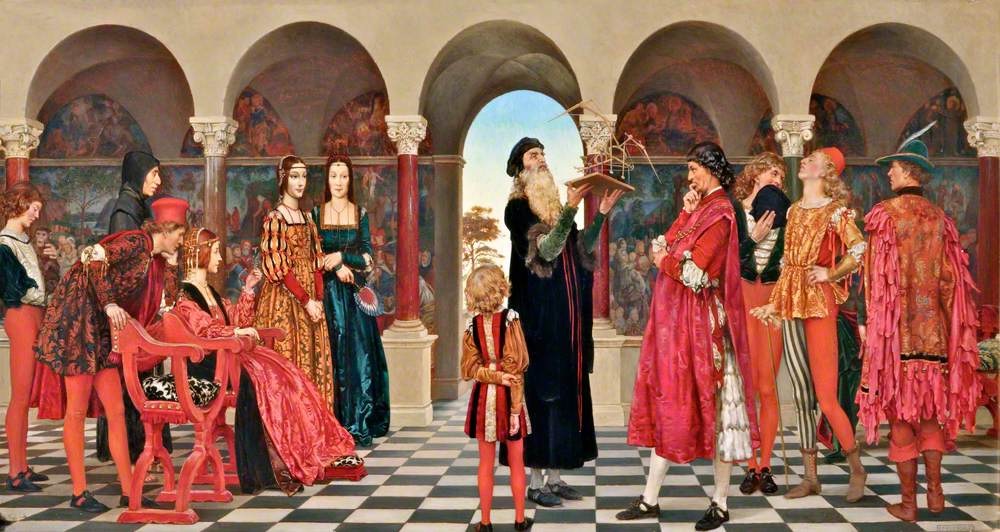
The Forerunner by Eleanor Fortescue Brickdale, ROI, RWS (1872-1945). Oil on mahogany panel, signed E. F-BRICKDALE on the lower right. Exhibited 1920. Panel/support: 59.5 x 122 x 2 cm; Frame: 88 cm x 151 cm. Collection: Lady Lever Art Gallery, accession no. LL3652. Purchased for the gallery the year it was exhibited (perhaps bought from the exhibition) by William Hesketh Lever himself. [Click on the image to enlarge it.]
In this expansive, well-peopled and colourful scene of the Italian Renaissance, Leonardo Da Vinci shows off his model flying machine to his patrons, the Duke and Duchess of Milan. The seated noblewoman is the Duchess, the powerful and queenly Beatrice d'Este, whose husband, Ludovico Sforza, stands close to da Vinci and looks thoughtfully at the model — perhaps wondering whether a project involving such a fantastical object is worth supporting.
There is another kind of tension in the painting too. It has attracted attention because it includes the figure of Girolamo Savonarola, the black-hooded figure standing in the group on the left: da Vinci is known to have been a homosexual, while Savonarola was the priest who tried to reform Florence and ban homosexuality. So these two men were radically opposed to each other. This gives the work a certain piquancy, at least for those with some knowledge of Florence's important historical figures.
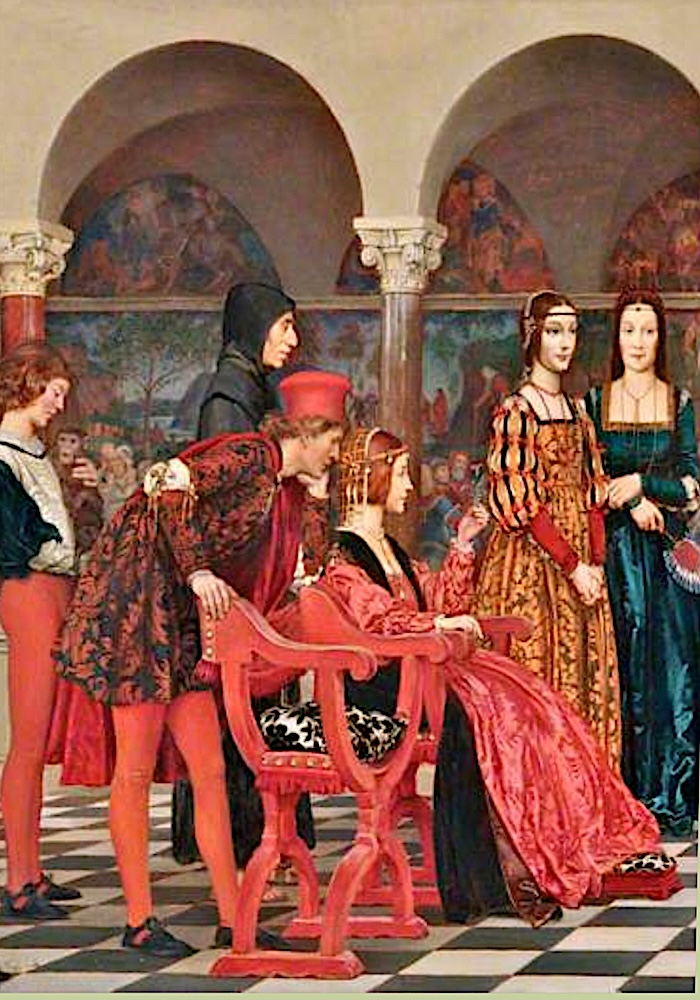
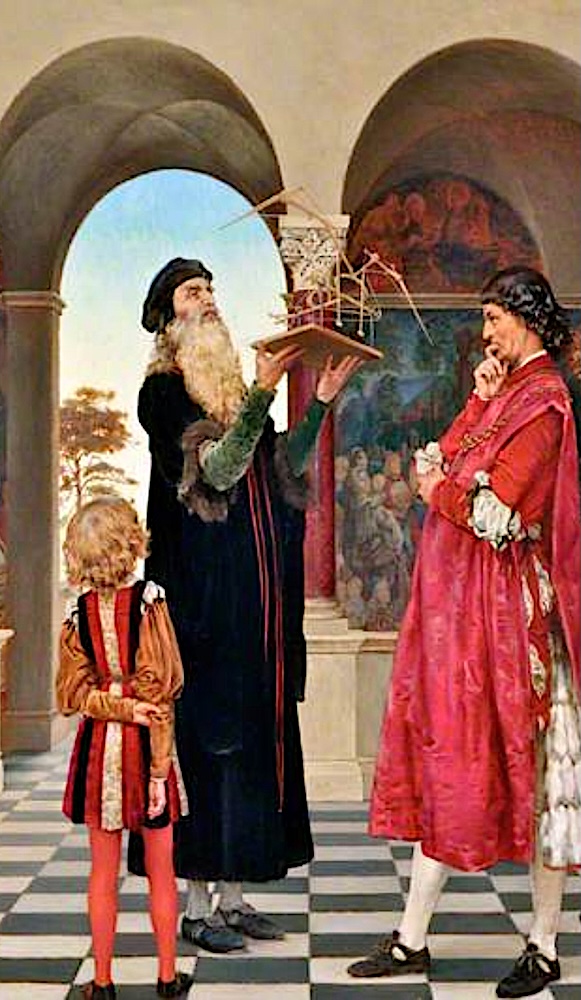
Two groups of figures from the painting. Left: Beatrice d'Este, with a courtier leaning on the back of her red chair, perhaps in murmured conversation. Right: Da Vinci holds his contraption while the Duke ponders.
.The museum essay on the painting also notes the artist's particular interest in aviation. This was nothing recent for Brickdale — witness her watercolour of 1910, Guardian Angel, in which an early aeroplane flies under the aegis of a hovering angel, as swallows are drawn into the updraught: "Brickdale is remarkable as the first and only artist to bring together the imagination of Pre-Raphaelitism with the modern technology of the twentieth century in the field of aviation," write Jan Marsh and Pamela Gerrish Nunn (147). In fact, as these two art historians explain, this earlier work had a predella presenting scenes from aviation history, one of which shows the same incident as the later oil-painting: da Vinci with his model flying machine (the other two being Daedalus fitting Icarus with wings, and a portrait of the aviator Charles Rolls, who died in 1910 when his biplane crashed in Britain's first flying show in Bournemouth).
Yet another point of interest in the 1920 oil-painting is the artist's choice of medium for this later version of the scene in Florence. Women had not been encouraged to paint in oil (see Marsh and Nunn 26), but Brickdale had shown oil paintings at the Royal Academy in 1899, 1900 and 1901, and continued to do so even when her career as an illustrator became important and time-consuming (see Marsh and Nunn 147). It could be said, however, that the focus on illustrating had given a new feel to this work, as well as to her painting more generally. For example, the little pageboy in the centre foreground makes a quaint audience for the scene: dressed in red, black and gold (even his cropped curly hair is gold), he encapsulates the colour scheme of the painting as a whole, adding to its decorative (Renaissance), even frieze-like effect.
Gerrish Nunn has pointed out that this work was followed by a sequel, Botticelli's Studio (1922), which is on long loan to the Delaware Art Museum in America.
Related Material

Image downloaded, text and formatting by Jacqueline Banerjee. Click on the images to enlarge them.]
Bibliography
Fortescue-Brickdale, Eleanor. The Forerunner. Art UK. Web. 10 June 2026.
The Forerunner: Information. National Museums Liverpool. Web. 10 June 2026.
Marsh, Jan, and Pamela Gerrish Nunn. Women Artists and the Pre-Raphaelite Movement. London: Virago, 1989.
Nunn, Pamela Gerrish. A Pre-Raphaelite Journey: Eleanor Fortescue-Brickdale. Liverpool: Liverpool University Press, 2012.
Created 10 June 2026