
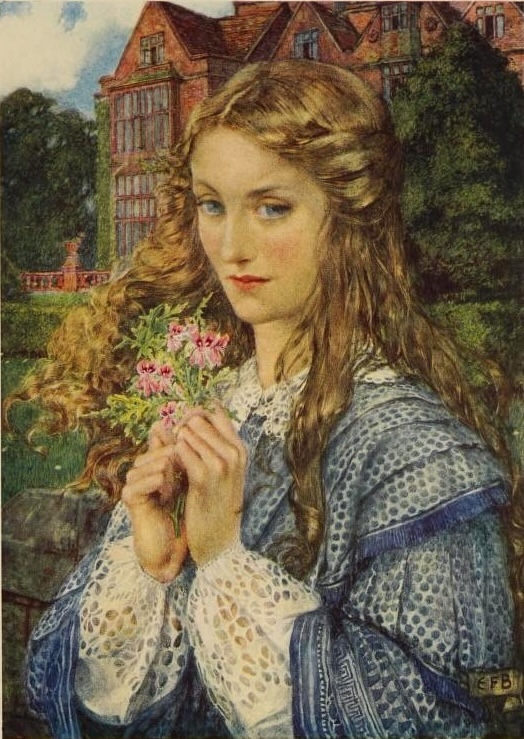
Evelyn Hope
Eleanor Fortescue Brickdale, ROI, RWS (1872-1945)
Illustration
1908
Signed EFB
Source: Browning, facing p. 64.
See below for commentary. [Click on the image to enlarge it, and mouse over the text for links.]
Image scan and text by Jacqueline Banerjee.
[You may use this image without prior permission for any scholarly or educational purpose as long as you (1) credit the Internet Archive and (2) link your document to this URL in a web document or cite the Victorian Web in a print one.]

Browning's poem, "Evelyn Hope," is, at first sight, a sentimental poem: sitting by the body of a sixteen-year-old who has passed away on the very threshold of womanhood, the sitter makes a pledge of continuing love. It starts:
Beautiful Evelyn Hope is dead!
Sit and watch by her side an hour.
That is her book-shelf, this her bed;
She plucked that piece of geranium-flower,
Beginning to die too, in the glass.
Little has yet been changed, I think —
The shutters are shut, no light may pass
Save two long rays thro’ the hinge’s chink...
In the last of the seven stanzas, the speaker, having recalled his life's experiences, confesses,
I loved you, Evelyn, all the while;
My heart seemed full as it could hold —
There was place and to spare for the frank young
smile
And the red young mouth and the hair’s young
old.
So, hush, — I will give you this leaf to keep —
See, I shut it inside the sweet cold hand.
There, that is our secret! go to sleep;
You will wake, and remember, and understand.
A secret disclosed then, and a promise made. Yet the speaker has also confessed, in stanza three, that he is "thrice as old" as Evelyn Hope was, and there is something rather unwholesome about his fixation on such a young person who may, he suggests in the second stanza, have "scarcely heard my name." The closing of her cold hand around the leaf, and the prospect of her "waking" to his love is, in fact, rather creepy.
As might be expected, the artist has shown the living girl rather than the corpse, her lips matching the pink of the geranium petals when both she and the flower were blooming. Her hair's luxurious curls and waves, the delicate cutwork of her white sleeves and the blue/grey robe matching the sleeves in their pattern and her eyes in their colour, all create a vision of loveliness. But she looks a little sideways, with a somewhat melancholic, knowing expression, almost as if she foresees her doom. Brickdale gives no hint of the unexpected visitor to Evelyn Hope's deathbed, with his (surely warped) fantasy of an eventual "understanding" between them. Still, there is something in this portrait that may suggest the complexity of the situation. However attracted he was to her, how likely is it that the young woman would have welcomed the advances of a man so much older than herself, with his life already behind him? He is, in a way, taking advantage of her death to lay claim to her. Poor Evelyn Hope!
Bibliography
Browning, Robert. "Pippa Passes" & Men and Women. 1908. Philadelphia, PA: Lippincott/London: Chatto and Windus, 1909. Internet Archive, from a copy in the library of the University of St Francis University. Web. 9 June 2026.
Victorian
Web
Artists
Eleanor F.
Brickdale
Drawings
Next
Created 9 June 2026