
The following account has been extended and edited with the author's approval for inclusion in this website. — JB.
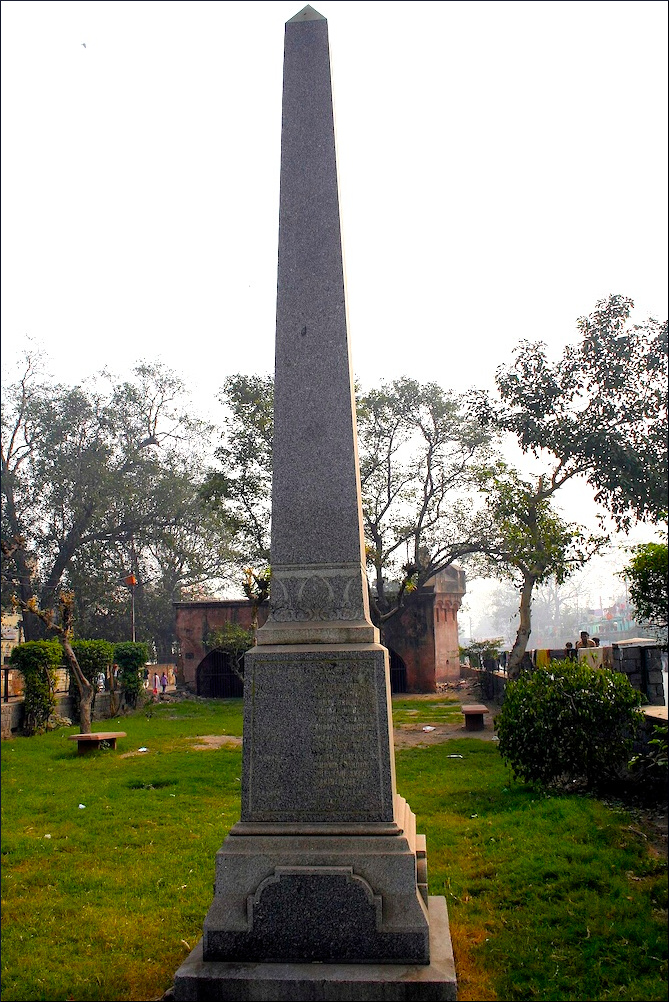
The Telegraph Memorial at Magazine Gateway. opposite Kashmiri Gate Post office in Old Delhi, photographed by Ramesh Lalwani and originally posted on Wikimedia Commons. This granite commemorative column is 5 metres high and dates from 1902.
The older generation of Indians still has fond memories of the telegram service operated by the Indian Postal and Telegraph Department. Until a few years ago, the most accessible way to send a message was to visit a telegraph office and send a telegram. However, with the advent of STD phone service, followed by the Internet, and finally mobile services, telegrams have become a thing of the past.
According to Harold D. Wallace, Jr., when Samuel Finley Breese Morse — widely acclaimed as the inventor of the telegraph — sent the first telegram on May 24, 1844, from Washington, D.C., to his associate Alfred Vail in Baltimore, Maryland, about 44 miles away, the message, “'What Hath God Wrought' [Numbers 23:23] was not the first telegraph message ever sent nor was this the first working telegraph," yet it captured the public imagination and created a worldwide sensation.
Morse's predecessor has been largely forgotten, partly perhaps because of his location. Soham Chandra reports that this earlier inventor, working quite independently, was William Brooke O'Shaughnessy, and his discovery was made in Calcutta (now Kolkata) in 1839:
O'Shaughnessy, an Irish physician, came to Calcutta in 1833 as an Assistant Surgeon of the East India Company and joined Calcutta Medical College as the Professor of Chemistry apart from being the Joint-Secretary to the Asiatic Society of Bengal. Though medical science still remembers him for his path-breaking research on Intravenous therapy and medical properties of Cannabis, O'Shaughnessy also experimented on use of electro-chemical conductivity for communication.
The first proposal to build a telegraph network was presented by one Adolphe Bazin in the meeting of the Asiatic Society of Bengal in June, 1839 but was rejected by a subcommittee as "impracticable," arguing for a simpler system. O'Shaughnessy was a member of the very same subcommittee. Within 3 months, he came up with his primary experiments and published a paper in the Asiatic Society Journal of Sept. 1839 issue - "Memorandum Relative to Experiments on the Communications of Telegraphic Signals by induced Electricity." Here, apart from digging up the details of earlier trials in this field, he explained in brief his experiments so far.
However, it was not until the arrival and backing of Lord Dalhousie (Governor-General from 1848-56), that this attempt to speed up communications finally began to be implemented. No doubt the change of heart had much to do with the acclaim won by Morse. Closely involved in the process on the subcontinent was a subordinate of O'Shaughnessy's at the Calcutta Mint, Shiv Chandra Nandy. In fact, says Chandra, it was Nandy who "sent the first signal from the Diamond Harbour end which was received by O'Shaughnessy at the Calcutta Station in the presence of Lord Dalhousie himself." Nandy's name is till remembered in one of the road names in Calcutta.
In its early days, telegrams in India were used to transmit messages between the East India Company's offices, the Company's army, the Imperial Police, or the Intelligence Department to various parts of the country. By the year of the Mutiny, the Imperial Telegraph Department was already in charge of 4,555 miles of telegraph wire (see Rathva). According to Kevin Standage, this was one of the key factors that contributed to the British success in suppressing the nationwide revolution of 1857. Had the Indian revolutionaries recognized its strategic importance earlier and completely destroyed its operations, British rule in India would quite probably have ended ninety years before 1947.
Accounts of what happened in the Telegraph Office at the outbreak of hostilities are not always reliable, as H. C. Fanshawe discovered when he came to write his history of Delhi (see p. 108), but these were the main events in that episode: on 10 May 1857, when the said revolution began in Meerut, 40 miles (64 km) northeast of Delhi, Charles Todd, the manager of the Delhi Telegraph Office, was manning the office with his two fellow signallers, William Brandish and John Pilkington. Since it was a Sunday, the office was open only from dawn to 9 a.m., opening again at 4 p.m. when the day was cooler. Brandish and Pilkington received no further word from Meerut, so Todd sent them out to examine the telegraph line, which appeared to work only to the river Jumna. He recalled them as darkness fell. Then at midnight (and here Kevin Standage takes up the story in more detail), "the postmaster in Meerut managed to send a private telegram to his aunt in Agra, warning her of the uprising." The telegram read:
Cavalry have risen setting fire to houses having killed or wounded all Europeans they could find. If aunt intends starting tomorrow please detain her.
This message was duly shown to Sir John Colvin, the Lieutenant-Governor of Agra, who realised how serious the situation was and at once informed Lord Canning, the Governor-General in Calcutta (now Kolkata).
Back in Delhi, on the following day (11 May), realising that the telegraph line with Meerut must have been cut, Todd started off early in the morning to see what could be done about it, and was set upon by mutineers and murdered. With no reinforcements yet to forestall their attack, revolutionaries from Meerut crossed the Yamuna River into Delhi, burned European settlements, and killed countless British. Brandish sent word to the Ambala cantonment, writing in a telegram, "We must leave office. All the bungalows are on fire, burned down by the sepoys of Meerut. They came in this morning. We are off. Mr. Todd is dead, I think. He went out this morning and has not returned yet. We heard that nine Europeans were killed” (qtd. in Standage). Of course, they were right about Todd. This information was subsequently relayed to all cantonments in Punjab. Since, as Standage explains, the telegraph line had not yet reached Simla (now Shimla), where the Commander-in-Chief of India, General Sir George Anson, was recuperating from illness, Major-General Sir Henry Bernard, commander of the Sirhind Division, sent his son, Captain Bernard, "on horseback to Simla with a copy of the telegram." Still very unwell, "Anson immediately left for Ambala to prepare a relief force" (the effort must have cost him dear, for he died later that month). It was late, but not as late as it could have been without the benefit of telegraphy. Indeed, after the suppression of the revolution, which the British labeled a rebellion, the Chief Commissioner of Awadh, Sir Robert Montgomery, said (in words recorded on the Mutiny Telegraph Memorial itself) "The electric telegraph has saved India."
The wording of the inscription on the Telegraph Memorial reads:—
Erected on the 19th April 1902, by Members of the Telegraph Department, to commemorate the loyal and devoted services of the Delhi Telegraph Office Staff, on the eventful 11th May 1857. On that day two young Signallers,
remained on duty till ordered to leave, and by telegraphing to Ambala information of what was happening at Delhi, rendered invaluable service to the Punjab Government.
In the words of Sir Robert Montgomery —
The Delhi Telegraph Office Staff on the 11th May 1857 consisted of the following:—
CHARLES TODD, Assistant-in-Charge, killed near Cable House, on left bank river Jumna, on the morning of the above date, while endeavouring to restore telegraphic communication with Meerut.
W. BRENDISH, Signaller, retired ist September 1896.
J. W. PILKiNGTON, Signaller, voluntarily returned to Telegraph Office from Flag Staff Tower, and signalled despatch to Commander-in-Chief, containing full report of Mutiny. Taken prisoner after doing so, but escaped. Died, Roorkee, 24th March 1867.
Perhaps the full importance of the telegraph network already established in India can only be appreciated when we realise that an urgent telegram originally dispatched to London only got as far as the coast — at that point it needed to be taken to England by ship, on the long sea voyage. "The failure of the first cable was a significant blow," writes Rathva Prabhat, noting that it was not until 1859 that "the authorities endorsed plans to link the subcontinent with London."
Related Material
Bibliography
Chandra, Soham. "Shiv Nandy — William Shaughnessy ... The Bengali-Irish pair behind the First Electric Telegraph Line." Wanderlust. Web. 6 July 2026. https://sohamchandra.blogspot.com/2019/04/shiv-nandy-william-shaughnessy-bengali.html
Fanshawe, H.C. Delhi Past and Present. London: John Murray, 1902. Internet Archive, from a copy in Cornell University Library. Web. 6 July 2026.
Rathva, Prabhat. "Strategic Implementation of the Telegraph in India." Porthcurno (Museum of Global Communications). Web. 6 July 2026. https://pkporthcurno.com/pk150/strategic-implementation-of-the-telegraph-in-india/
Standage, Kevin. "Telegraph Memorial — Delhi." Indian Travel Photogprahy. https://kevinstandagephotography.wordpress.com/2025/02/18/telegraph-memorial-delhi/
Wallace, Harold D., Jr. "Samuel Finley Breese Morse: Artist and Inventor." National Museum of American History. Web. 6 July 2026. https://americanhistory.si.edu/blog/2012/05/samuel-finley-breese-morse-artist-and-inventor.html
Created 6 July 2026